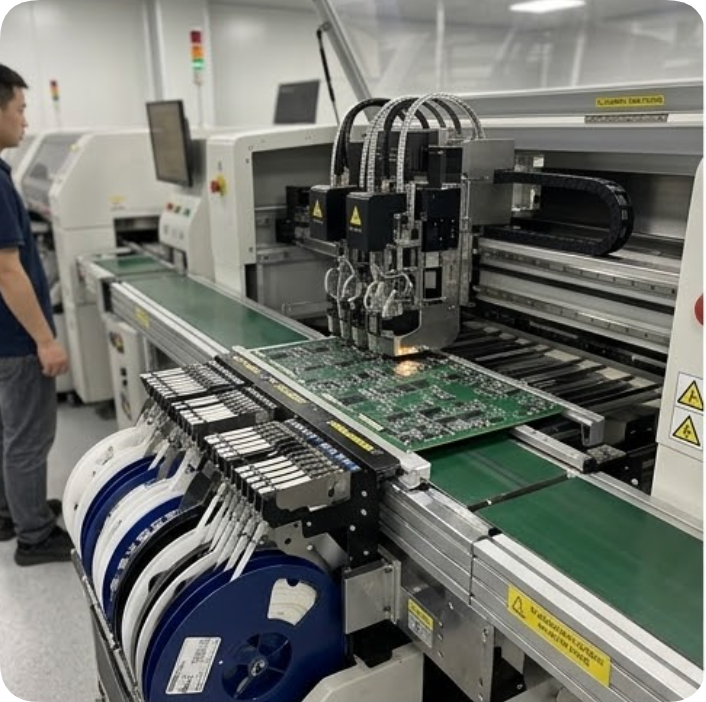

SMT and DIP Assembly Under IPC Standards: What Compliant Electronics Manufacturing Really Demands
My take after more than a decade on the factory floor is simple: most "quality problems" in PCB assembly are decided long before the first component is placed. They are decided in the stencil design, in the solder profile, and in the daily discipline of following IPC standards on every shift, not in the audit week. Buyers chase the lowest unit price and then wonder why field returns climb after the warranty clock starts. If you build for industrial control, automotive, or medical use, compliance is not paperwork sitting in a binder. It is the product. At NEWEI we treat IPC-A-610 and J-STD-001 as the floor we stand on every day, not the target we reach once a year.
Solder Paste Printing and SPI Inspection as the First Gate
Surface-mount quality is won or lost at the stencil. A 0.1 mm deviation in aperture design, a worn squeegee blade, or a pasty that has sat too long at the line edge quietly pushes an entire batch toward tombstoning, insufficient fillets, and solder balls that only show up under magnification. That is why our dedicated SMT assembly line runs 100 percent solder-paste inspection (SPI) before a single placement. SPI catches volume, area, and height issues at the source, so a bad print never reaches the high-speed placement machine. For 0201 passives and 0.4 mm-pitch BGAs this gate is the difference between a 99.9 percent first-pass yield and a rework backlog that eats the schedule.
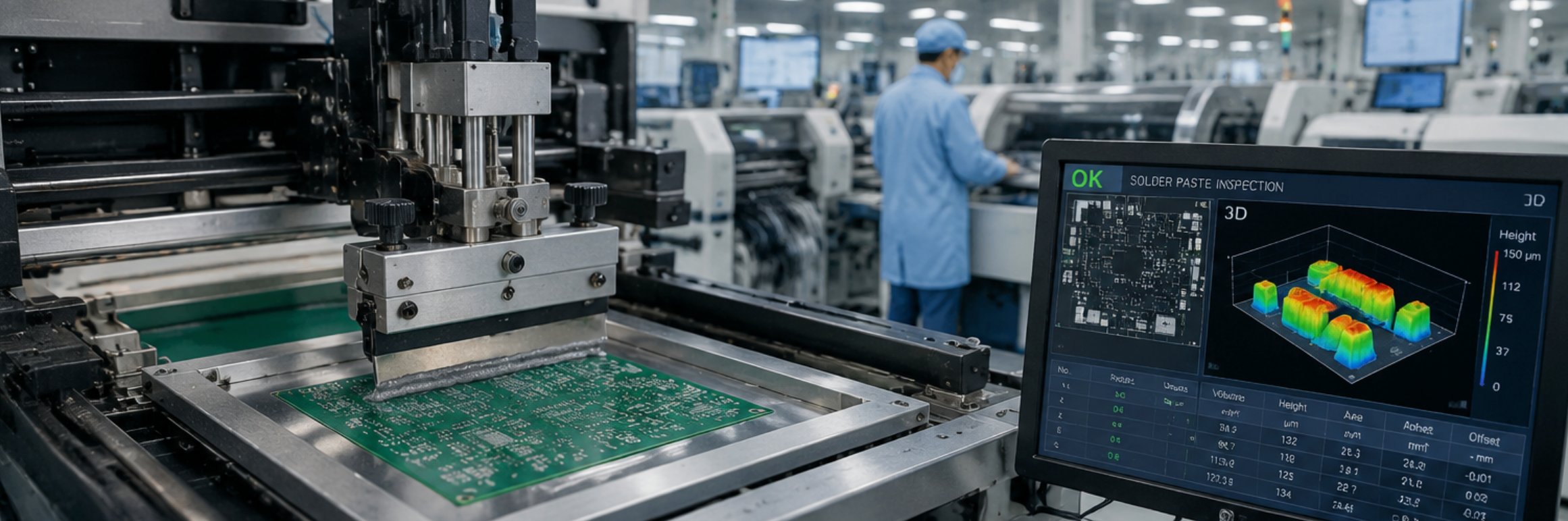
We tune print pressure, separation speed, and stencil thickness per board family instead of forcing one global profile across every job. A power-electronics board with heavy copper and large thermal pads needs a very different approach than a dense IoT module where the smallest aperture is thinner than a human hair. The printer and the SPI sit side by side so the operator closes the loop in seconds, long before a downstream defect would ever be found at functional test.
The paste itself is a controlled material, not a commodity. We track lot numbers, shelf life, and exposure time, and we log the refrigeration chain from receiving to the line. A paste that drifted out of its window is scrapped, not "used up to save cost," because the cost of a field failure is always larger than the cost of a tub of paste.
Through-Hole Reliability Beyond Surface Mount
Not everything belongs in a reflow oven. Connectors, transformers, large electrolytic capacitors, and high-current terminals still go through DIP assembly and selective wave soldering. The failure mode here is different from SMD work: thermal shock to adjacent components, fillet voids hidden under the lead, and bridging on fine-pitch pins that look fine until they short under load. We use selective wave rather than full-wave to protect the surrounding surface-mount parts, and we pre-heat the panel to control the temperature gradient across every joint.
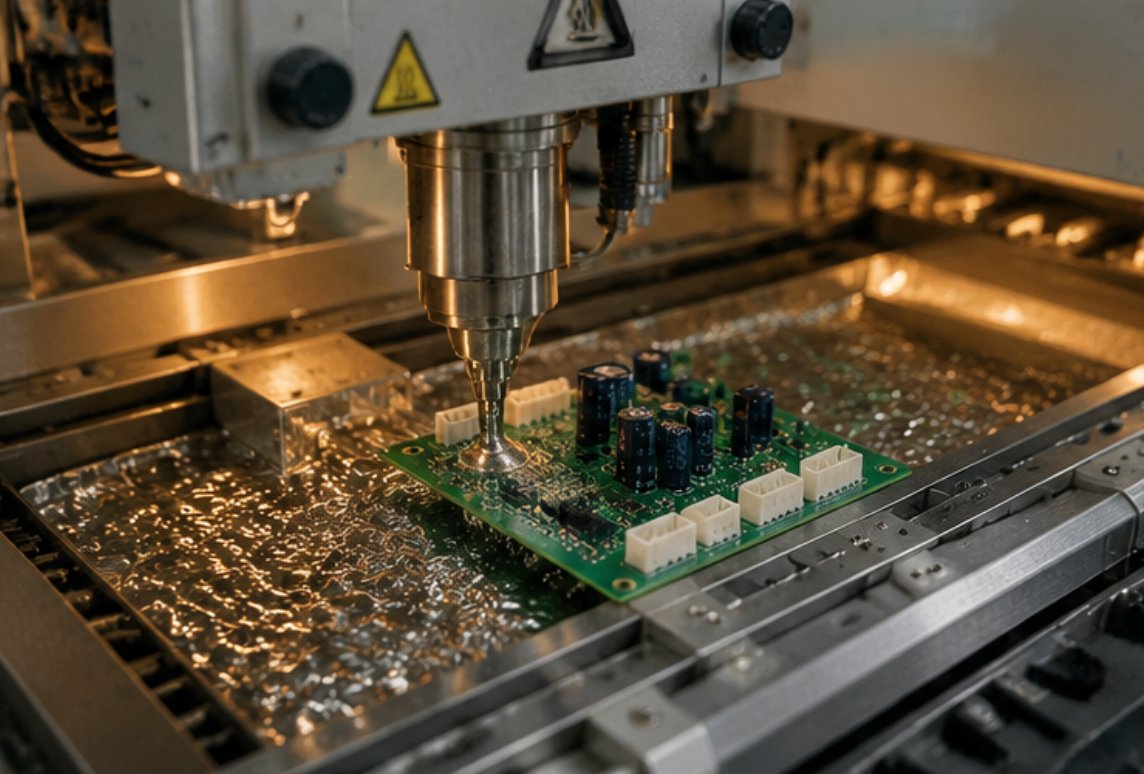
Through-hole joints are judged by cross-section, never by appearance. A shiny fillet can still hide a cold joint or a dewet line that fails after a few hundred thermal cycles. That is why we pull periodic cross-sections and measure wetting angle against IPC-A-610 Class 3, the same bar we hold for aerospace and medical programs. The cross-section photo goes into the job record, so a board shipped today can be compared against a board shipped six months from now.
Why One Facility Outperforms Three Vendors
The real maturity shows when surface-mount and through-hole live inside one continuous flow. Our EMS electronic manufacturing service stitches SMT placement, DIP insertion, and final product assembly into a single traceable process with one bill of materials, one travel card, and one quality record per unit. A customer shipping an industrial controller receives the SMT board, the hand-inserted power section, the housing, and the functional test under one roof, with no blind hand-offs between vendors where the standard silently drifts. The compliance story is stronger precisely because the accountability never changes hands. When an issue appears, there is one system to query and one owner to answer, not three suppliers each pointing at the next.
From Prototype to Volume: A Closed-Loop Quality System
A prototype that passes is the easy part. A volume run that holds the same bar for 50,000 units is where most lines break. We lock the process with first-article inspection, statistical process control on the placement machines, and AOI plus X-ray on every critical lot. Material compliance rides alongside the process: every incoming reel is checked against RoHS and REACH declarations, and conflict-mineral and automotive-grade documentation is filed before the part touches the line. The table below shows how IPC acceptance classes map to the work we actually ship:
| IPC Class | Typical Use | What We Enforce |
|---|---|---|
| Class 1 | Consumer, disposable | Basic workmanship, functional only |
| Class 2 | Industrial, general | Extended reliability, full AOI coverage |
| Class 3 | Automotive, medical, aerospace | Cross-section proof, X-ray, lot traceability |
For Class 3 we add in-circuit test and functional coverage that simulates the field environment, not just an open-short check. The same closed loop applies whether the order is 100 boards or 100,000, because the standard does not get cheaper as the quantity rises. We would rather tell a customer their design needs a fix at prototype than ship a comfortable volume of a board that fails in the field.
Where Automotive and Medical Grades Set the Bar
When the application is a brake controller or an infusion pump, "good enough" is not a category that exists. Requirements like IATF 16949 and ISO 13485 push documentation, lot traceability, and change control to a level most shops never touch. Our automotive electronics PCBA line keeps component-level traceability from incoming inspection to the sealed carton, so a single suspect reel can be isolated in minutes instead of triggering a mass recall. The same discipline serves medical and industrial programs where a silent failure is not an inconvenience but a liability.
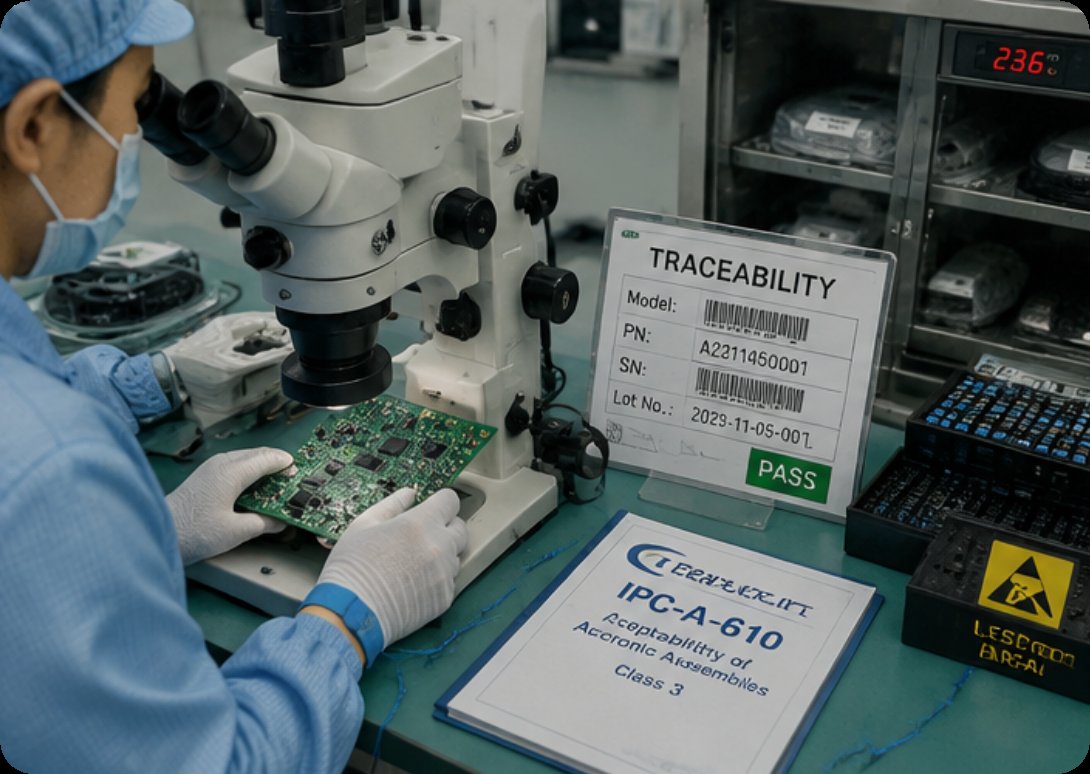
Medical and automotive programs also demand controlled storage for moisture-sensitive devices and strict ESD handling on every bench. We run a monitored warehouse with humidity logging and grounding checks, because a popped BGA hiding under a conformal coat only fails after it is already inside a customer's product on the other side of the world. Catching it at our dock is cheaper than catching it in a recall.
Choosing a Manufacturing Partner That Speaks the Same Standard
The cheapest quote and the compliant quote are rarely the same building, and the gap usually shows up after delivery. Before you commit, ask for the certificates, the cross-section reports, and a sample of the traceability record, not just a price per placement point. If you want to see how a partner handles the full chain from bare board to boxed unit, our PCB manufacturing capabilities page walks through the steps we control in-house. A supplier who owns SMT, DIP, and EMS under one quality system is far easier to audit than three vendors each pointing at the next one.
Compliance is not a certificate on the wall. It is the stencil, the profile, the cross-section, and the travel card attached to every single unit. Build with that discipline and the field returns take care of themselves, while the price you paid for the discipline quietly pays back in retained customers.
Tags: SMT assembly / EMS / DIP assembly / IPC-A-610 / PCBA compliance /
Prev: How Incoming Quality Control Protects Your PCB Fabrication
Next: Closing the Quality Loop: ROI of Integrated PCB Assembly and In-House Testing