
Electronic Component Procurement, PCBA Three-Proofing Paint and PCB Assembly: The Half of a Certification the Factory Cannot Sign
A smart home program usually starts with a product idea and ends, months later, with a certificate. Somewhere between those two points a manufacturing partner is asked to prove things that were settled long before the first purchase order was raised. The difficulty is rarely technical. It is a question of which half of the evidence a factory can honestly sign for.
That half is narrower than most teams assume. A regulatory mark is granted to a finished product that carries a brand owner's name. What leaves a production floor is a set of records instead: where the parts came from, how the copper was formed, and what was sprayed over it. Those records support a certification. They do not stand in for one.
The Mark Goes on a Finished Product
Look at any consumer device and the marks sit on the housing. Nothing on that label points back to a board shop. The unit tested for emissions and electrical safety was a complete product with its enclosure, its wiring and its radio fitted, which is why a file assembled from supplier paperwork alone rarely satisfies the laboratory that runs the test.
| What the approval asks for | Who normally holds it | What a manufacturing partner can hand over |
|---|---|---|
| The mark on the product and the technical file | The brand owner placing it on the market | A build record describing how the unit was produced |
| Emission and immunity results for the assembled unit | A test laboratory working on the finished article | Consistency between the sample tested and the run shipped |
| Spacing and insulation inside the enclosure | The customer's mechanical and layout design | Copper geometry built to the drawing that was issued |
| Material content of every part and coating | Each supplier in the chain, one layer up | Declarations gathered from the parts that were sourced |
Read across those rows and a shape appears. Everything on the left is granted at product level. Everything in the centre is controlled upstream of the factory. The right column is where an electronics partner actually acts, and it is entirely a matter of records rather than approvals.
A smart home unit is judged as it will be installed: fed from a wall outlet, standing in a room, running for weeks without anyone watching it. That framing decides what the supporting documents must describe. It also explains why a partner who can describe a build precisely is more useful than one who promises a result it cannot issue.
A Genuine Channel Is a Compliance Decision
Every part on a board has a history, and the only moment when that history can still be captured is the moment it is bought. Once a reel has been consumed, its origin cannot be reconstructed from the finished assembly. Procurement is therefore not a purchasing chore that runs behind engineering. It is the first compliance step, taken before a single component is placed.

A genuine channel is not a slogan, it is a paper trail. Authorised distribution returns a certificate of conformance, and the reel carries a date code matched against the order. Those two documents let a brand owner answer a traceability question years later, and they make a refusal possible when a cheaper alternative arrives without them, as our component sourcing services are set up to do.
Long-lived consumer products expose this more sharply than industrial ones. A device that sits in a home for a decade will see its bill of materials rewritten several times, usually under cost pressure and usually without anyone asking the compliance question. Capturing the original source at the first build is what keeps later substitutions honest.
Supply Continuity Decides Whether It Still Holds Later
The awkward part of a ten-year product life is that the original part number will not last that long. Manufacturers discontinue lines, allocation tightens, and a second source has to be qualified. This is a supply problem on the surface and a compliance problem underneath, because a substituted component is a change to the product that was certified.
What matters is whether the substitution can be verified before it reaches the customer. A drop-in replacement with a different internal construction may pass a functional check and still alter behaviour under temperature or over time. A test route that can be re-run on a candidate part, such as our aging test services, turns a supply decision into a measurable one.
The Numbers an Inspector Reads Off the Copper
An auditor does not read marketing copy. It reads dimensions: how many layers were used, how thin the dielectric became, how close two conductors were allowed to sit, how much copper carries the current. Those numbers are set by the layout, and they are realised by the board shop. Where the two disagree, the physical board is what an inspector will eventually measure.

| Parameter | Published capability |
|---|---|
| Layer count | 1 to 36 layers, including HDI and blind or buried vias |
| Board thickness | 0.4 mm to 8.0 mm |
| Minimum four-layer thickness | 0.33 mm |
| Minimum line width and spacing | 0.065 mm |
| Maximum copper thickness | 10 oz |
| Minimum mechanical hole and pad | 0.15 mm and 0.35 mm |
| Plated through-hole tolerance | plus or minus 0.03 mm |
| Surface finish | ENIG, OSP, HASL, immersion silver, immersion tin and carbon ink |
Those figures matter because of how the pieces divide. A fine pitch keeps the product compact, but the spacing that satisfies an insulation requirement is a design decision made elsewhere. The shop's job is to hold the tolerance, which is what makes the published limits worth reading before a layout is frozen rather than after, as our PCB fabrication services describe in more detail.
There is a practical reason to check this early. A stack-up that cannot be built at the requested thickness forces either a new layout or a deviation, and a deviation is the one thing a technical file cannot absorb quietly. Sampling the bare board first, in the shortest possible cycle, is the cheapest way to find out which route is real.
A Radio Module Arrives With Its Own Approval
Almost every smart home product carries a radio, and the fastest path through approval is to use a module that has already been tested as a module. Buying a pre-certified part moves a large block of work off the schedule, because the designer inherits test results instead of commissioning them. The catch is that the inherited result describes the module, not the board it is soldered to.
Three things can quietly invalidate that inheritance: the antenna, the ground it sees, and anything placed in its immediate surroundings. A module mounted flush against a metal enclosure, or fed by an antenna routed somewhere the original report never covered, is no longer the device that was tested. None of this is a defect. It is a boundary that has to be recognised before the layout is released.
Where the Customer's Drawing Has to Be Right
A board shop builds what it is given. The keep-out area around an antenna, the creepage distance beside a switching supply, the height limit under a lid: these arrive in the customer's drawing, and the factory reproduces them faithfully. That faithfulness is exactly why an error in the drawing survives all the way into a production run without anyone noticing.
The same logic governs coating. Which connectors, antennas, radio modules and heat sinks are left unsprayed is not a house preference; it is a list drawn from the customer's own configuration, and a coated antenna is a performance change rather than a cosmetic one. A partner who asks for that list before spraying is protecting the customer's approval, not adding a step.
A Material Declaration Has to Name Everything
Market access is conditional on substance declarations now, and those declarations travel with the product rather than with the factory. Each part brings its own statement, and so does the coating. A conformal film that carries the wrong chemistry can put a finished unit outside a restricted-substances limit even when every component on the board is clean.
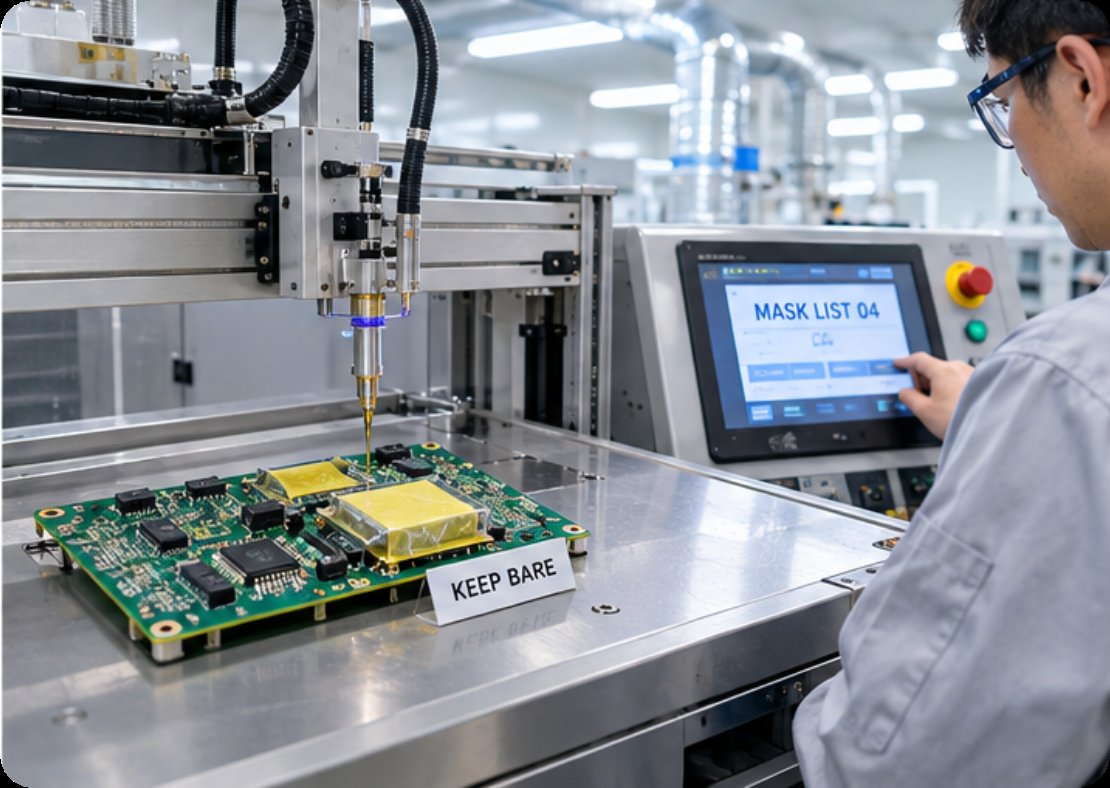
Process detail starts to look like compliance work here. A coating run has to cover dense, fine-pitch assemblies evenly and avoid the parts that must stay bare, which is why a selective spray exists rather than a blanket one. As our conformal coating services put it, the mask list and the material certificate are read together, because either one alone leaves a gap.
Before the First Order Goes Out
None of this requires a new department, only three questions answered before a build starts. Which parts are single-sourced, and what happens if they vanish? Which dimensions in the drawing are load-bearing for an approval? Which surfaces must stay uncovered, and who decides? A partner handling sourcing, fabrication and coating can answer all three from one set of records, which is how our smart home PCBA services work.
What a factory cannot do is sign the certificate. What it can do is leave a trail honest enough that the brand owner can. For a product expected to run unattended in somebody's home for a decade, that trail is the part of compliance that outlives the launch, and it is easier to build deliberately than to reconstruct, as our electronics manufacturing services are intended to make it.
Tags:
Next: No more...