

Wearable PCBA, SMT Assembly and Shell Mold: Three Calendars That Only Run One After Another
A wearable product is quoted by three suppliers who never share a diary. The board designer counts from the day the schematic is stable. The assembler counts from the day the bill of materials and Gerber files arrive. The case supplier counts from the day a drawing is released. Each start is reasonable alone and invisible to the others. The result looks optimistic in every quotation and impossible once combined.
The mismatch rarely appears as a line item. It appears as a launch date that moves twice, a customer asking why the sample arrived after the event it was promised for, and rush fees appearing only after somebody realises the sequence was never written down. This is where the money goes on a turnkey wearable build, and it has little to do with component pricing. Begin by treating SMT assembly services as a scheduled activity rather than as a quotation.
Every Supplier Starts Its Own Clock on the Same Project
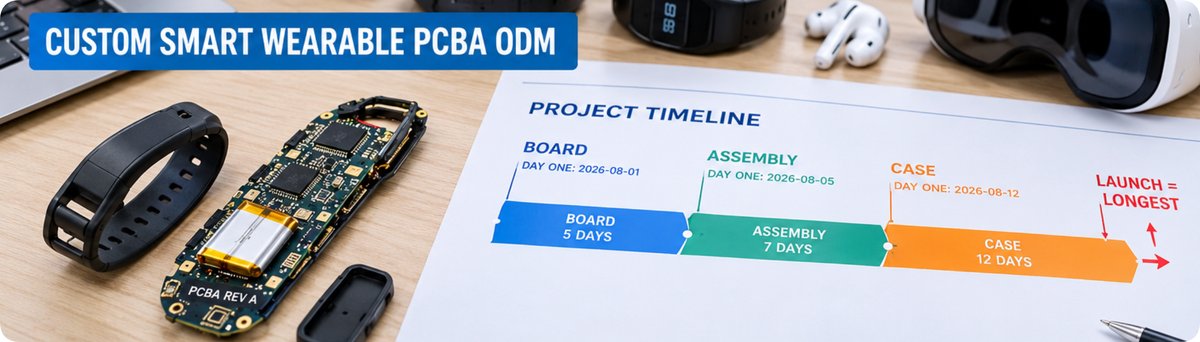
Three parties, three definitions of day one. The assembler counts from receipt of the release package. The case supplier counts from tool approval, and the tool is the long pole. The owner counts from the day the customer announced the product. Each duration is defensible alone; together they give a number no single party would have offered.
The assumption hiding here is that the others will absorb the gap. The case supplier assumes the board will be ready and will not move twice. The assembler assumes the enclosure will not change after the first article. The owner assumes both, because both quotes said yes. Together they produce a schedule nobody wrote down.
Why the Longest Calendar Decides the Launch Date
A programme does not run at the speed of its fastest supplier. It runs at the speed of the slowest, because everything after it is a queue. If case production takes six weeks and assembly takes ten days, the assembly days are not saved; they are spent waiting. This is why a quoted delivery looks generous on paper and disappointing in practice.
The only number worth tracking is therefore the longest single segment, not the sum. A buyer comparing quotations by total cost, or by line duration, compares figures that exclude the waiting. Once it is included, two equivalent-looking quotes can differ by weeks, and the cheaper one is often the slower.
The wearable PCBA services offered by our electronics manufacturing services cover four families that expose this differently: VR glasses, massage belts, smart bracelets and Bluetooth headsets. A wrist board carries a battery envelope and an antenna keep-out a headset does not, so the same operation holds different slack per family.
The Two Jobs That Cannot Start Until the Case Exists
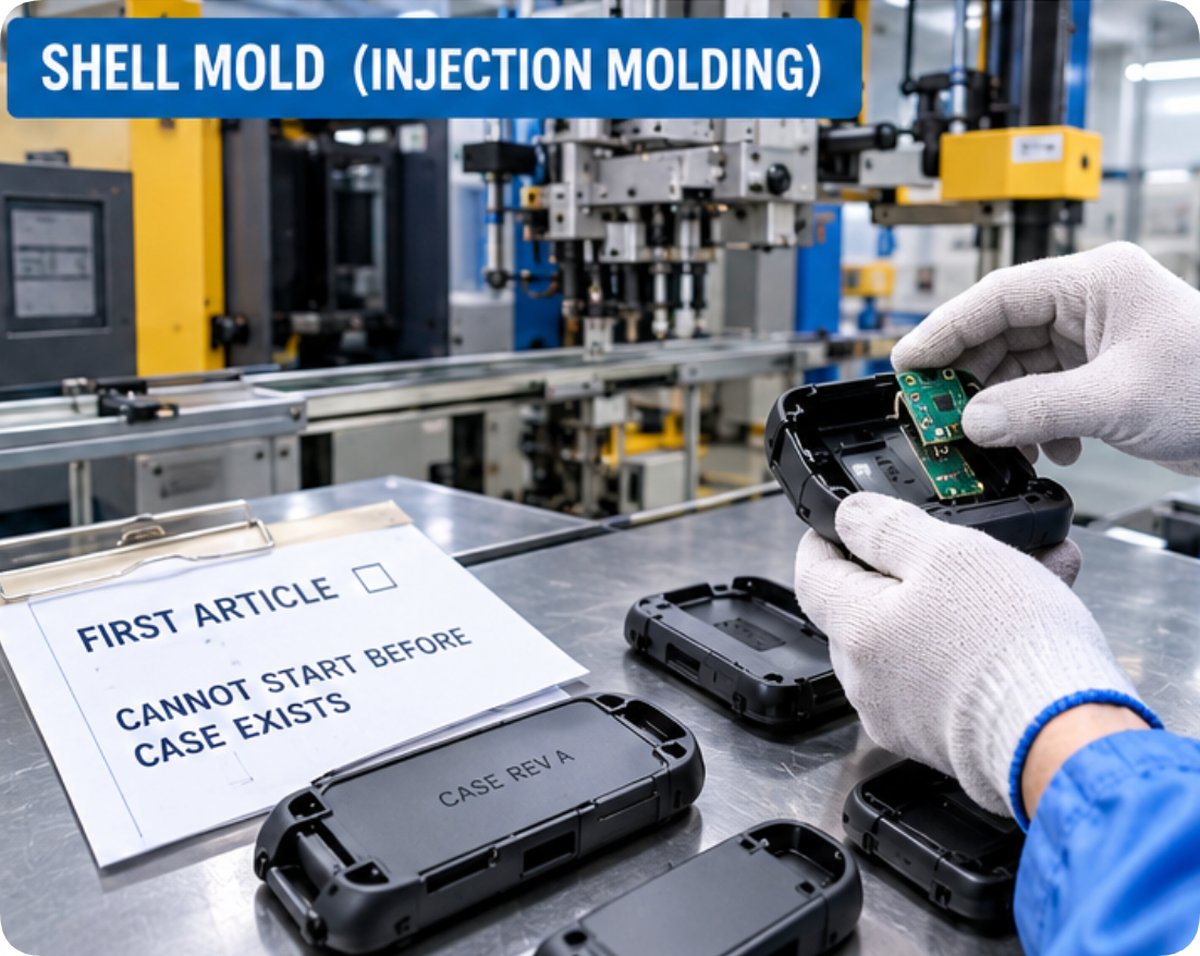
Some steps are strictly sequential in a way that surprises anyone who has dealt only with bare boards. A first article that must sit inside its enclosure cannot be assessed until the enclosure exists. A drop test on a finished wearable cannot run until there is one. Anything depending on the physical relationship between board and case sits downstream of the tool.
This is where our shell mold services stop being a mechanical detail and become the constraint on the electronics programme. The page describes three processes: plastic injection molding, reaction injection molding with a thermosetting resin whose lower viscosity suits larger parts, and metal injection molding using fine powder with a binder. Whichever is chosen, material and geometry decide what the enclosure can accommodate.
Because our product assembly services sit at the far end of that chain, they inherit every delay built into it. A build supposed to reach an assembly bench after ten working days can arrive after forty, while the assembly work itself takes as long as planned. The delay is nowhere visible.
The Quoted Span That Covers Just a Single Stage
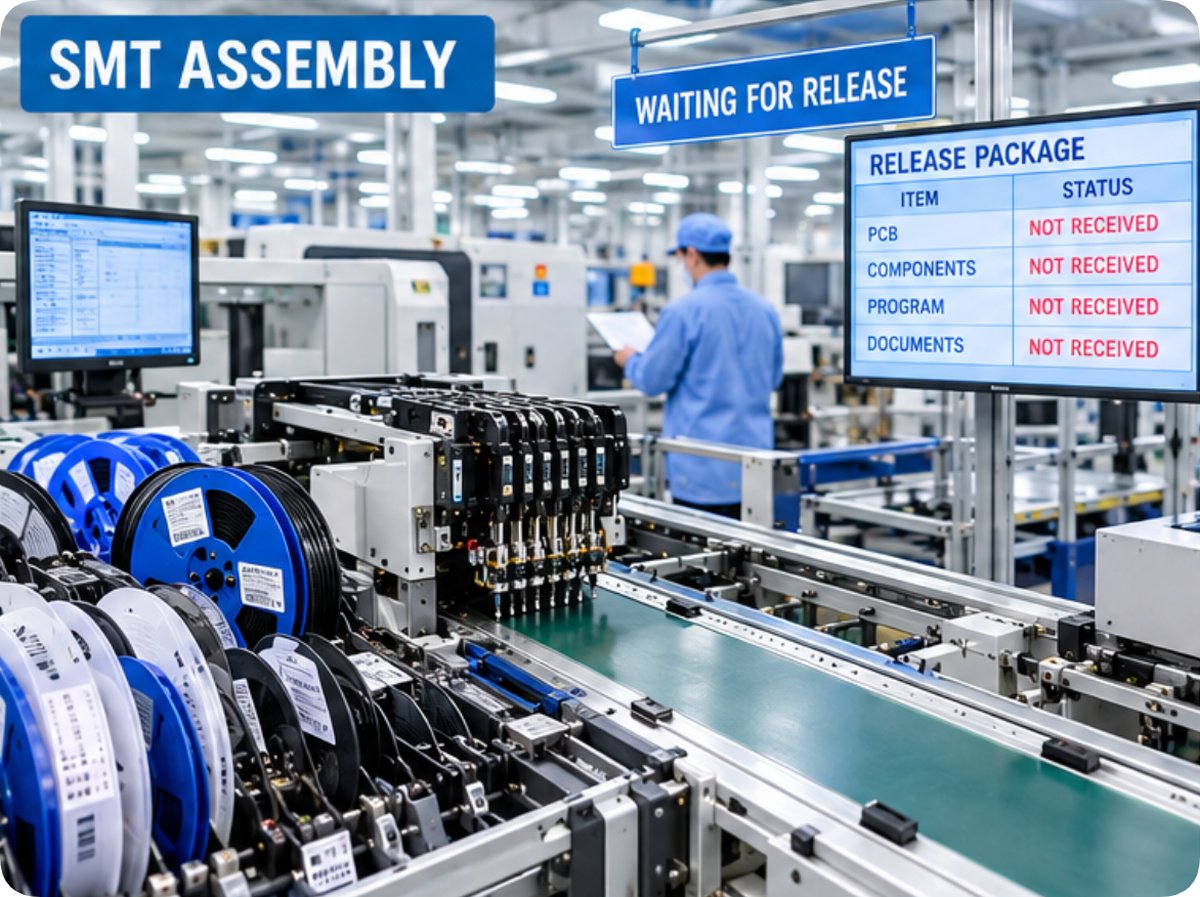
A published lead time is easy to misread. The three to five working days quoted for surface mount processing cover one segment under normal material conditions and exclude public holidays. They start when the release package is verified, not when the project begins. If the bill of materials is missing a line, they do not start at all.
The same applies to every quoted duration. One beginning at an event nobody has scheduled is not a delivery promise; it is an assumption. This is why quotations are issued against a customer's bill of materials and Gerber documents for approval, and why manual soldering or a one-time wave soldering fixture is priced separately.
Treating each duration as conditional on a named trigger turns three calendars into one usable plan. The trigger list is short and verifiable: release package complete, drawing approved, first article accepted, case samples in hand. None requires negotiation, and all four are checkable in an afternoon.
Where a Quiet Week Becomes a Missed Window
Weekly and monthly targets concentrate risk into a few moments. A programme comfortable for six weeks can lose the quarter in the week after one unreviewed drawing, because everything downstream is committed against it. The quiet week is not when risk is visible; it is when nobody checks.
What distinguishes a build that lands on time is rarely supplier quality. It is whether anyone held a single sequence in which all three segments appear in the order they happen. Without it, each supplier optimises its own segment and the schedule holds only if every assumption does.
A programme with the sequence written down behaves differently under stress. When a case sample slips, the response is not a negotiation about dates but a known question about which downstream steps can run alongside the wait. That turns a slip into an adjustment, and costs nothing to have in place beforehand.
Drawing One Sequence Instead of Three Separate Ones
The fix is unglamorous. Take the three durations, put them in one line in dependency order, and mark the four trigger events on it. What emerges is rarely a shorter schedule. It is one that can be defended, and the difference shows the first time something moves.
It also changes what gets asked of each supplier. Instead of requesting a date, the owner asks what it depends on and what would move it. The answers are specific: an unconfirmed footprint, an unapproved resin, a missing signature, a waiting queue. Once on the page they become problems to manage.
| Segment | When the clock starts | What it cannot start without |
|---|---|---|
| Wearables electronics | Release package complete | Confirmed bill of materials and panel data |
| Surface mount processing | Files approved for a specific build | Verified boards and materials on hand |
| Injection or reaction molding | Tool approved | A released drawing and a chosen process |
| Product assembly | Boards and cases both present | Finished cases and an accepted first article |
The table describes a dependency structure rather than a set of dates, which is why it stays useful after the project ships. No row contains a duration, because a duration is the output of a negotiation. The rows carry the condition under which a negotiation can start, and that condition is the same on every project.
Agreeing the Sequence While the Drawings Are Still Open
The best time to write the sequence down is while changes are still cheap. Once the case tool is cut, an enclosure revision is not a drawing update; it is a new tool and a new calendar. Agreeing the order of operations while nothing is irreversible costs one meeting, and is the only point all three suppliers can still influence.
That conversation also settles what happens when priorities conflict. If a mechanical change is more urgent than a firmware one, someone should say so in advance rather than discovering it by asking which supplier can start tomorrow. Programs answering early tend to ship in one sequence rather than three.
For anyone comparing quotations, learn more about our manufacturing capabilities and how the segments are normally scoped. The question at quotation is not only what each segment costs, but what each one waits for, and whether anyone has put the three waiting periods into one line.
The One Number Worth Carrying Into the Meeting
Three numbers matter more than the rest, and none is a price. The first is the longest single segment, because it sets the floor for the programme. The second is the number of triggers not yet met, each a day the supplier cannot start. The third is the number of parties holding a different sequence, usually higher than anyone realises.
None of these requires a supplier relationship to measure, and all three are cheap to establish at quotation. Programmes carrying them into the first production meeting decide in hours rather than weeks. Programmes that do not learn the lesson twice pay at a cost set by whoever holds the enclosure.
Tags:
Prev: PCB Assembly, EMS Manufacturing and Product Assembly: Faults Stop at Three Checkpoints
Next: No more...