
PCB Assembly, EMS Manufacturing and Product Assembly: Faults Stop at Three Checkpoints
Every electronics program eventually meets the same uncomfortable arithmetic: the later a fault is found, the more it costs to fix. A footprint error caught during a Gerber review costs an email. The same error caught after final assembly costs a recall conversation. The factories that keep those costs down are not the ones with the fewest defects — they are the ones that decide, in advance, exactly where each class of fault will be stopped, and what evidence each checkpoint will leave behind.
Three electronics manufacturing services anchor that plan on our floor: our PCB assembly services upstream, the EMS line in the middle, and our product assembly services at the end. The sections below walk through what each checkpoint stops, the numbers behind it, and what happens when something gets past.
The First Stop Happens Before Copper
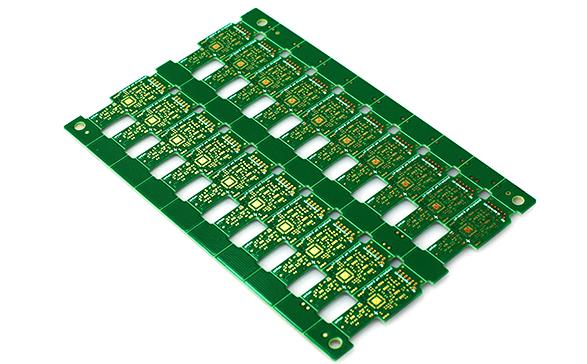
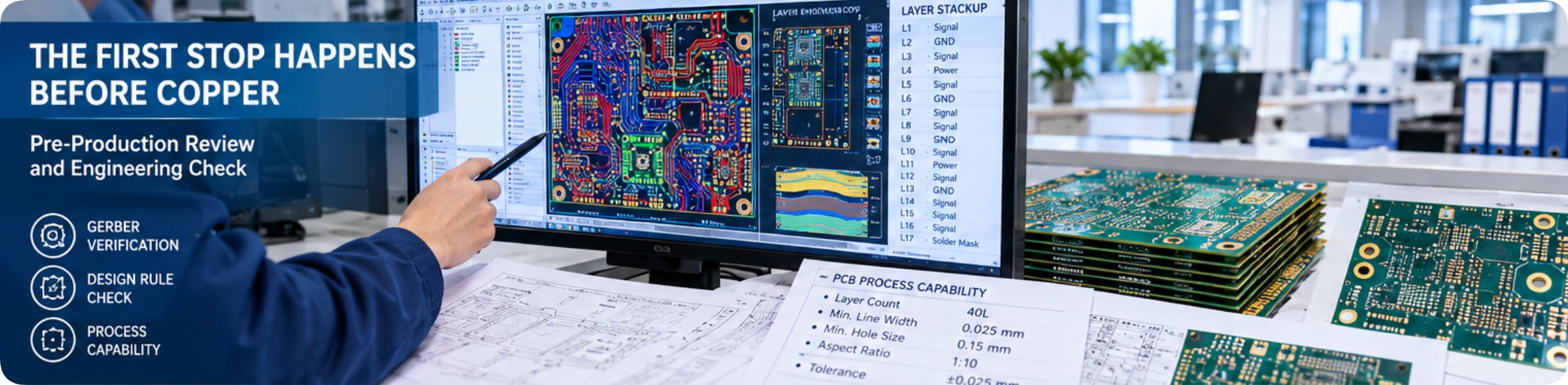
The cheapest fault to fix is the one that never reaches a panel. That is why the PCB assembly checkpoint begins with the documents, not the machines. A Gerber package that asks for a 0.1mm trace on a board with a 14:1 aspect ratio is not a manufacturing challenge; it is a disagreement that has to be settled while it is still a file. The process capability behind that conversation is published and specific: up to 40 layers, plate thickness from 0.4mm to 8.0mm, a maximum working panel of 2000×610mm, drilling accuracy of ±0.025mm, PTH aperture tolerance of ±0.03mm, and minimum line width and spacing of 0.065/0.065mm.
Those numbers are not marketing. They are the boundary conditions a reviewer uses to say "this will build, this will not, and here is the drawing change that makes it build." HDI stacks, blind and buried vias, and FPC flexible boards all pass through the same review. A design-rule escape that survives this checkpoint has beaten the only stage where the fix costs nothing but a revision letter.
The In-Line Nets and the Numbers They Keep
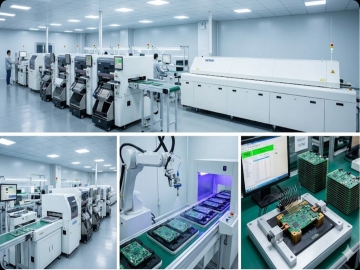
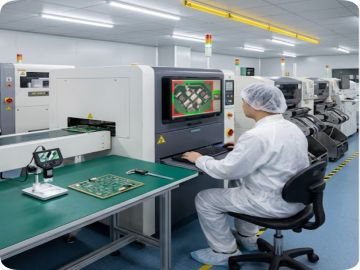
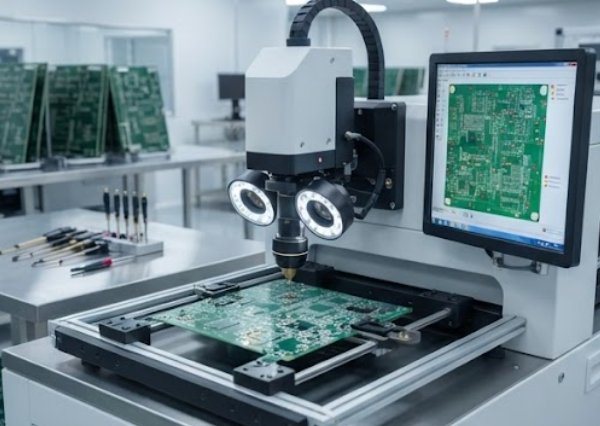
Once copper exists, the strategy changes: faults are no longer prevented, they are intercepted while they are still cheap. The EMS line runs complete AOI, ICT and FCT testing process groups alongside its high-speed SMT and DIP lines, with monthly capacity around 50,000 square meters under TS16949, UL, CE, RoHS and ISO9001 certification. Each instrument watches a different class of escape. AOI watches what the eye would catch if the eye never tired — offset components, tombstones, solder bridges. ICT probes the electrical truth underneath the solder mask: a wrong resistor value hides from a camera and cannot hide from a bed of nails.
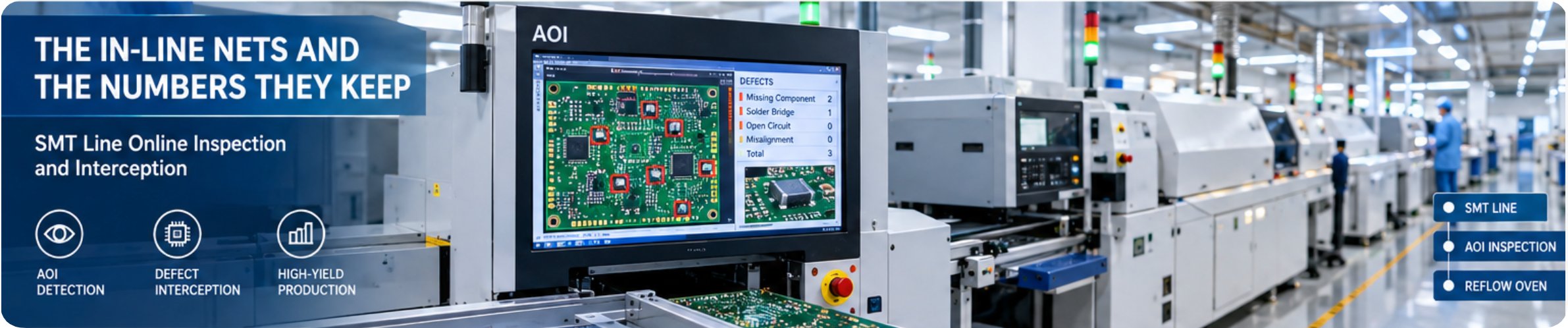
The division of labor matters more than the instrument count. A line that relies on AOI alone will pass a perfectly photographed board with a swapped IC marking; a line that relies on ICT alone will pass cosmetic faults that later become corrosion sites. Running the groups together means each instrument only has to be excellent at what the others cannot see, and the test definitions live in the line's program files rather than in anyone's memory, so a second shift runs the same nets the first shift did.
Flying Needle Test and the Time It Buys
Bed-of-nails fixtures earn their cost on high-volume boards, but a prototype run cannot amortize one. Standard flying needle testing covers that gap: the same netlist coverage as an ICT fixture, moved from a fixed bed to two or four programmable probes. For a customer validating a new revision, flying needle is the checkpoint that answers "is this net even connected" before the fixture money is spent. It is slower per board and faster per program change, which is exactly the trade a mid-volume EMS program wants. When the volume curve justifies a fixture, the transition is a planning decision rather than a coverage gap, because the netlist and the expected values carry over unchanged. Programs that skip this stage usually discover its value later, when a fixture is already committed and the revision it was built for is already obsolete.
The Last Stop: Final Assembly, Firmware and Burn-In
A board can pass every electrical test and still fail as a product, because the last class of faults only exists once hardware meets firmware and an enclosure. Final assembly is where a flexed cable, a poorly seated connector, or a firmware image built for a different board revision shows up — none of which any in-line net can see. Our product assembly services hold ISO9001:2015 and ISO13485 quality management certification, and the discipline those systems require is the point: assembly procedures are documented, revisions are matched, and torque or seating steps are not left to folklore.
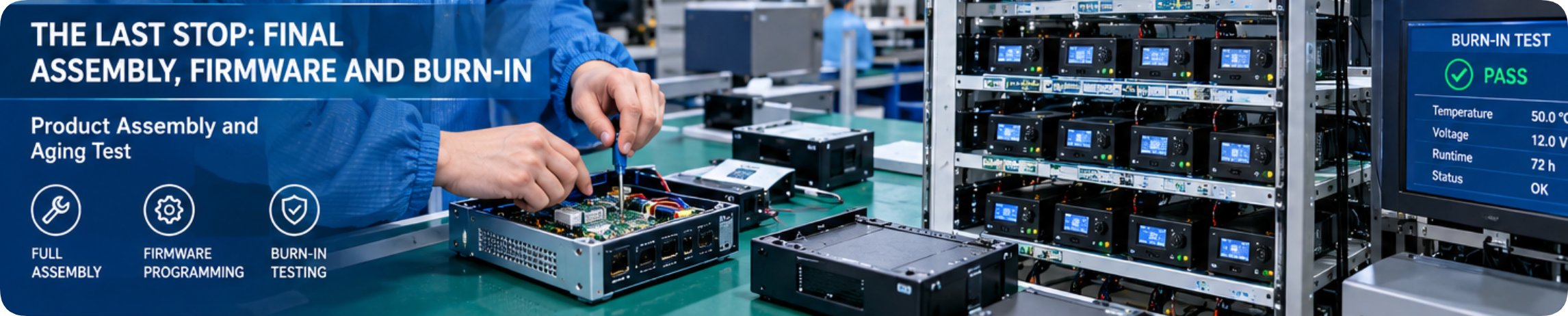
Where the product calls for it, protection steps such as our conformal coating services are verified at this stop as well, since a coating defect behaves like a slow fault: invisible at test, active in the field. Burn-in and aging then close the checkpoint: a finished unit running under power for a defined period flushes out infant mortality before it flushes out a customer relationship. The faults caught here are the ones that would otherwise become day-one returns, and day-one returns are the most expensive fault class in the entire chain.
One Row per Checkpoint
Condensed to one row per checkpoint, the division of labor reads as follows — each row names the fault class it exists to stop, the service that owns the stop, and the published evidence behind it:
| Checkpoint | Class of fault stopped | Service that owns it | Published evidence |
|---|---|---|---|
| Before copper | Unbuildable geometry, DFM disputes | PCB assembly | 40L ceiling; ±0.025mm drilling; 0.065/0.065mm traces |
| In-line | Placement, solder, parametric errors | EMS line | AOI + ICT + FCT groups; flying needle standard |
| Final build | Firmware mismatch, assembly damage, infant mortality | Product assembly | ISO9001:2015 / ISO13485; burn-in under power |
When a Fault Slips Past Two Stops
No net is perfect, and an honest plan plans for escapes. The rule on our floor is simple: a fault found at checkpoint three triggers a walk back through checkpoint two, and if the evidence supports it, checkpoint one. A solder bridge that AOI should have flagged becomes an AOI program review. A parametric error that ICT should have caught becomes a fixture coverage audit. A geometry that made the fault possible in the first place goes back to the Gerber conversation. Escapes are treated as data about the net, not as personal failings about the line, which is why the same escape rarely happens twice. The walk-back also protects the customer's engineering team: the feedback they receive is a specific, traced defect class with a proposed drawing or program change, not a vague report that quality is being improved.
The Paper Trail Each Checkpoint Leaves
A stopped fault is only valuable if it is documented, because the documentation is what turns one fix into a pattern. The first checkpoint leaves revision-controlled drawing feedback. The second leaves inspection records tied to panel serials. The third leaves functional test logs and burn-in charts that follow the unit out the door. When a field failure does occur, those three trails reconstruct the unit's biography in hours instead of weeks — and the difference between those two timescales is usually the difference between a corrective action and a customer departure. Records are kept in the same revision system that controls the drawings, so the trail a customer receives matches the trail the floor works from.
Setting the Stops Before the First Panel
The plan works only if it exists before production does. When we scope a program, the three checkpoints are assigned during quotation: which drawing issues the fabrication review will adjudicate, which instruments the EMS line will run against which netlist classes, and what the final assembly and burn-in procedure will verify. Customers who already know their risk profile — a medical build leans harder on ISO13485 documentation, an automotive build on TS16949 process discipline — can weight each checkpoint accordingly. To see where your program's faults would be caught first, learn more about our SMT assembly capabilities, and for reliability runs after final build, explore our electronics manufacturing services for burn-in planning.
Tags: product assembly / AOI inspection /
Prev: Custom Smart Home Products PCB and PCB Fabrication: The Wearable Wave Pushes Three Floor Decisions
Next: No more...