
PCB Fabrication, PCB Assembly (PCBA) and SMT Assembly Quality Inspection: A Compliance and Standards Guide
PCB Fabrication, PCB Assembly (PCBA) and SMT Assembly Quality Inspection: A Compliance and Standards Guide
Quality inspection is the gate that separates a reliable electronic product from a costly field failure. In modern electronics manufacturing, every board must pass through disciplined checkpoints before it ships. A board that looks fine on the surface can still harbor hidden plating voids, marginal solder joints, or process drift that only surfaces months later in the customer's application. This guide explains how PCB Fabrication, PCB Assembly (PCBA) and SMT Assembly are verified against internationally recognized compliance standards, and how a structured inspection workflow keeps defect rates low, schedules on track, and customers confident in every delivery. For teams planning a professional Quality Inspection strategy, understanding the standards behind each process is the essential first step.
🔌 Meeting IPC-A-600 Acceptance Criteria on Bare Boards
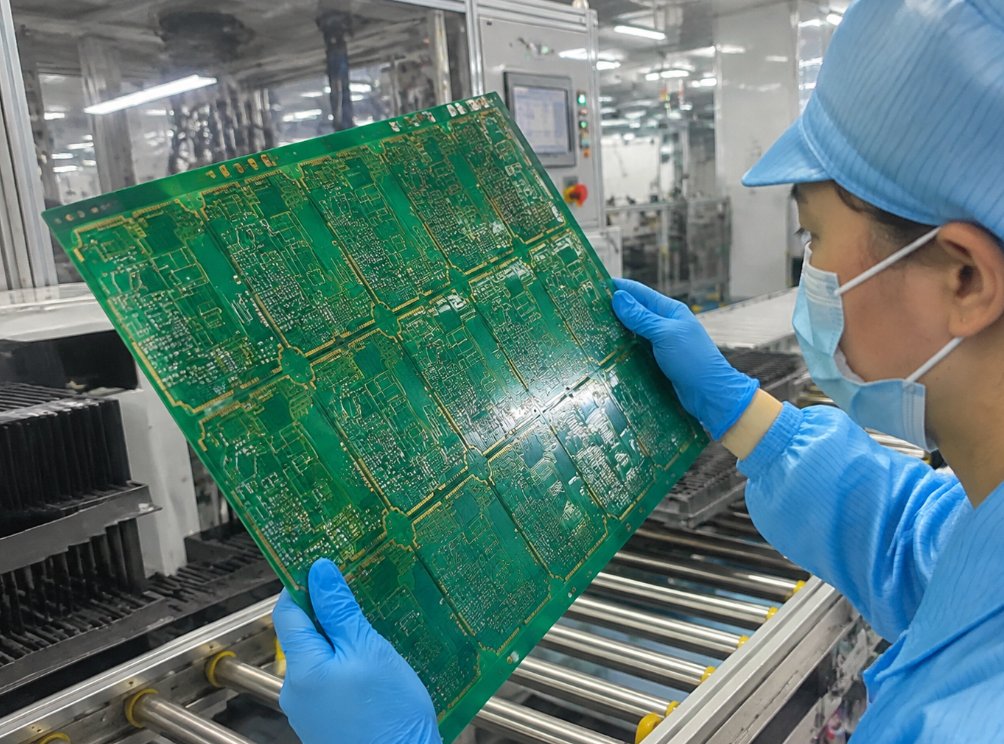
The first line of defense begins in the fabrication stage, where bare boards are produced from copper-clad laminates. Fabrication inspection focuses on the physical integrity of the board itself: copper plating thickness, solder mask registration, hole wall quality, and dimensional accuracy. IPC-A-600, the industry benchmark for acceptability of printed boards, defines Class 1, Class 2 and Class 3 conditions so that inspectors can consistently judge whether a bare board is in an acceptable, defect, or target state. Working to these documented criteria removes guesswork from the process and gives fabricator and customer a shared language for describing board quality.
Beyond visual criteria, a compliant fabrication line uses electrical testing to verify continuity and isolation on every net. Impedance control checks confirm that high-speed signal traces match the design values required for reliable operation, and coupon testing with microsection analysis validates plating integrity inside vias and through holes. Every measured value is compared against the requirements agreed at the design review, and any drift is flagged while rework is still straightforward. Only after a bare board passes these checks does it move forward to assembly. This is why manufacturers treat the fabrication stage as the foundation of the entire quality chain, because defects buried in the laminate will reappear later as intermittent failures in the finished product. Catching them here protects both the production schedule and the reputation of the final assembly.
🏭 Applying IPC-A-610 plus J-STD-001 on the Line
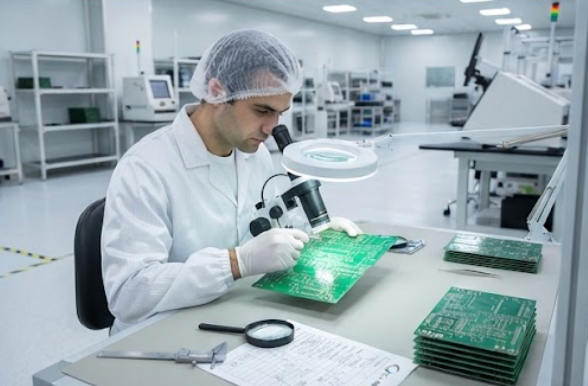
Once components are mounted, PCB Assembly (PCBA) quality inspection shifts the focus to solder joint integrity, placement accuracy, and the cleanliness of the final board. The two standards that dominate this stage are IPC-A-610, the most widely used acceptance criteria for electronic assemblies, and J-STD-001, which governs the materials and process requirements for soldered electrical and electronic assemblies. Together they cover everything from wetting and fillet shape to the handling of moisture-sensitive components. Where IPC-A-610 answers the question of whether a joint is acceptable to ship, J-STD-001 answers how the assembly should be built in the first place, which is why procurement teams routinely cite both in the same contract.
In a modern inspection workflow, automated optical inspection verifies component presence, polarity and alignment after reflow, while in-circuit testing validates the electrical behavior of each node. Functional testing then powers up the assembled board to confirm it behaves as designed under real operating conditions, exercising the product against the same loads it will face in service. Boards that must survive harsh environments receive additional inspection, including X-ray verification of BGA and QFN solder joints hidden beneath the component body. Every result is logged against a traceability record, which is exactly what compliance auditors expect to review during a customer audit. This documentation discipline transforms quality inspection from a simple pass-fail checkpoint into a repeatable, evidence-based system that supports root-cause analysis when a defect does slip through.
🏭 Process Control from Solder Paste to Reflow
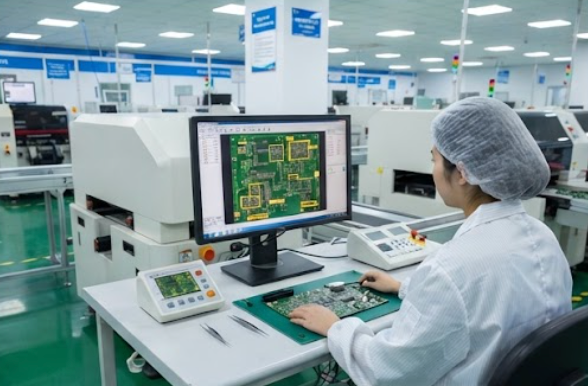
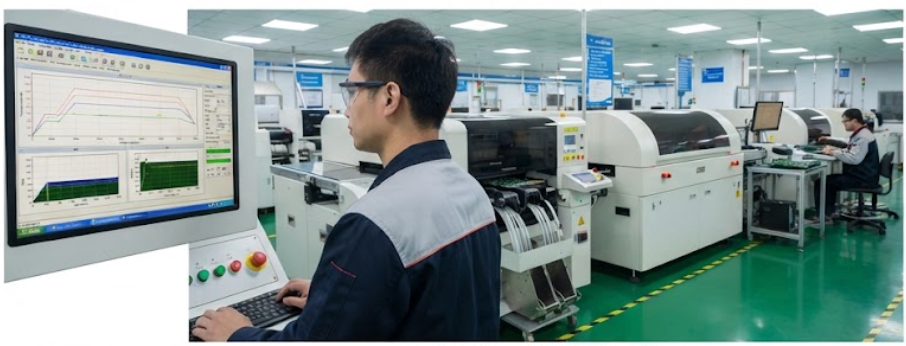
Surface mount technology drives most of today's high-density electronics, and SMT Assembly quality inspection begins long before components reach the placement machine. Solder paste printing is measured with solder paste inspection systems that verify volume, height and position on every pad, catching a common defect source while it is still inexpensive to correct. Placement accuracy is then confirmed with high-speed inspection, and reflow profiling ensures the thermal curve stays inside the window defined by the solder paste manufacturer. Small deviations in paste volume or peak temperature may seem harmless on their own, but in high-density designs they compound quickly into shorts and open joints.
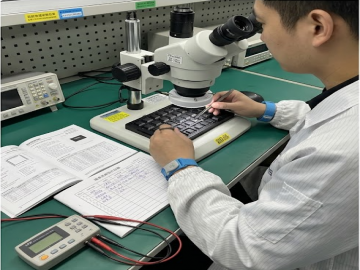
Because surface mount defects such as tombstoning, bridging and insufficient wetting are directly linked to process variation, a compliance-driven line uses statistical process control to keep every parameter stable and to detect drift before it produces scrap. Inspectors trained to IPC-A-610 criteria examine completed assemblies under controlled magnification, classifying each joint against the acceptance levels agreed with the customer. For high-mix production, this combination of SMT Assembly process control and rigorous end-of-line verification delivers the consistency that quality managers rely on when releasing boards to the field. The same data stream that drives daily yield decisions also feeds the continuous improvement program, so the line gets measurably more stable with every production run.
🏭 Where the Three Stages Focus Their Checks
The three stages share the same goal of customer satisfaction, but each one inspects different characteristics and relies on different standards. Fabrication protects the integrity of the bare board, assembly protects the quality of the solder connections, and SMT production protects the stability of the process that creates them. The table below summarizes the primary standards and inspection focus for each service.
| Service | Primary Standards | Key Inspection Focus | Typical Use Case |
|---|---|---|---|
| PCB Fabrication | IPC-A-600, IPC-6012 | Copper plating, solder mask, hole quality, impedance | Bare boards for consumer, industrial and automotive products |
| PCB Assembly (PCBA) | IPC-A-610, J-STD-001 | Solder joints, placement, cleanliness, functional test | Ready-to-integrate boards with through-hole and mixed components |
| SMT Assembly | IPC-A-610, IPC-7525 | Paste printing, placement accuracy, reflow profile | High-density, high-volume surface mount production |
Frequently Asked Questions About Compliance-Driven Inspection
What is the difference between IPC-A-600 and IPC-A-610? IPC-A-600 applies to bare printed boards produced during fabrication, while IPC-A-610 applies to completed assemblies after components are mounted. Both define acceptability criteria in three classes, and both are used together in most quality inspection plans. If you receive a claim about board quality from a fabricator, it will almost certainly reference IPC-A-600; if the discussion is about assembly workmanship, IPC-A-610 is the document being cited.
Why does J-STD-001 matter for PCBA quality? J-STD-001 sets the process and material requirements for solder connections, including flux selection, cleaning and workmanship. It is often cited alongside IPC-A-610 in customer contracts because it addresses how the assembly is built, not just how it looks. Two assemblies can pass the same visual criteria and still perform very differently in the field, which is why process requirements matter as much as cosmetic acceptance for long-term reliability.
How strict should the acceptance class be? Class 3 is reserved for high-reliability products where continuous performance is critical, such as medical and aerospace electronics. Many industrial and commercial boards are produced to Class 2, while consumer products commonly use Class 1 criteria. Choosing the right class affects cost, yield and inspection intensity, so the decision should be made deliberately at the design stage rather than left to chance during production. A product that genuinely needs Class 3 reliability deserves a supply chain that can document compliance at that level.
Conclusion: Build a Compliance-First Inspection Strategy
A compliant quality inspection program is not an isolated checklist; it is an integrated system that spans fabrication, assembly and surface mount production. When every board is judged against IPC-A-600, IPC-A-610 and J-STD-001, and when every test result is documented, customers receive products they can trust and audit with confidence. The standards give you the benchmark, and the inspection workflow gives you the evidence that the benchmark is being met on every shipment. If you are planning a new project or improving an existing supply chain, you can learn more about our manufacturing capabilities and see how our inspection process aligns with your compliance requirements.
Tags: PCBA assembly /PCB quality inspection / SMT process control / IPC-A-600 /
Prev: PCB Fabrication and SMT Assembly Compliance Guide for Modern Production
Next: PCB Fabrication, PCB Assembly (PCBA) and SMT Assembly: Measured Results from a Customer Case