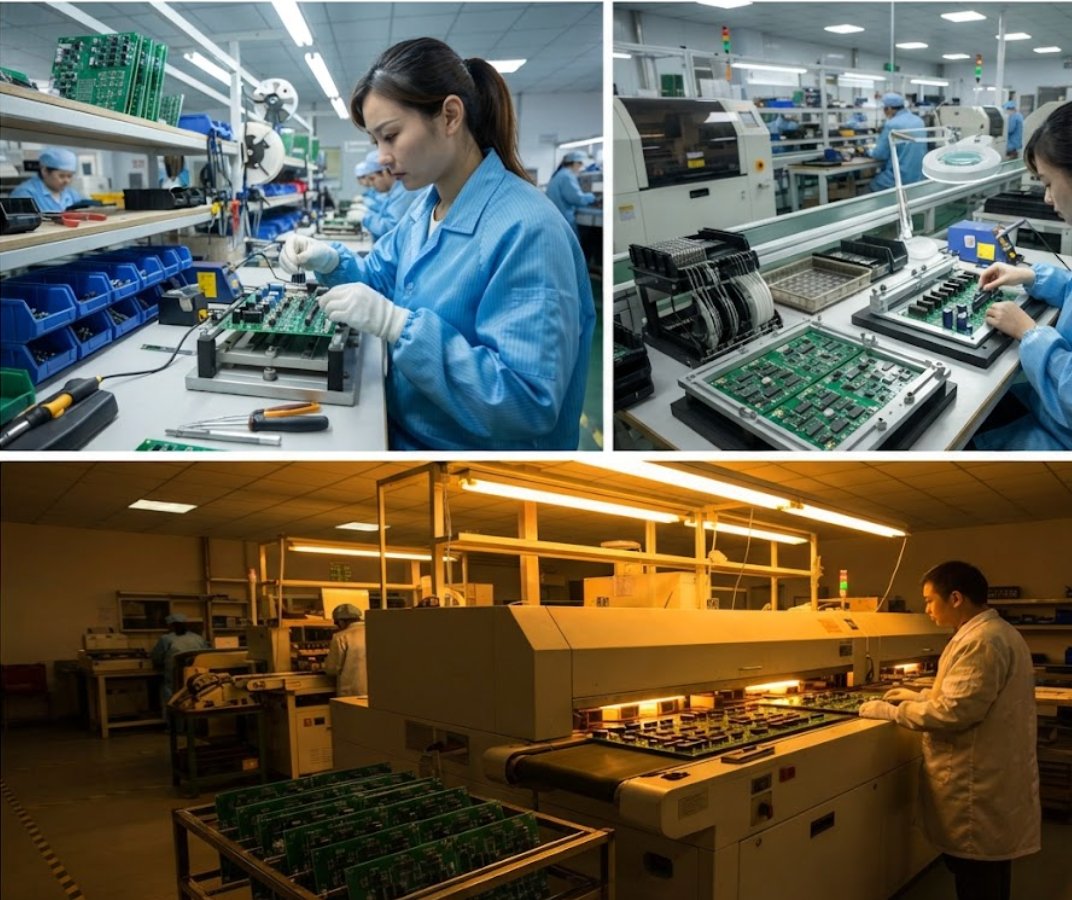

IQC, Supplier Audits & ESD‑Safe Warehousing – How NEWEI Locks In Zero‑Defect PCBA from the First Millimeter of the Supply Chain
Core Manufacturing Capabilities: Discover our advanced electronic manufacturing ecosystem at NEWEI Industrial PCBA& ODM Services.
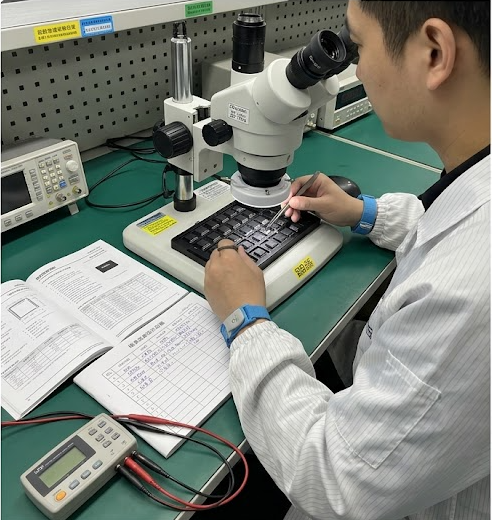
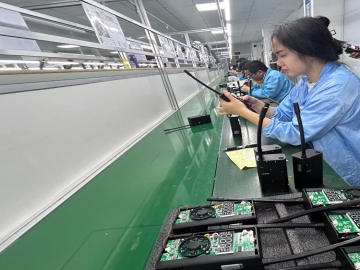
Fig 1 – Incoming quality control (IQC): technician performing 20x magnification inspection of a high‑reliability BGA processor.
My View: A counterfeit IC or a moisture‑damaged QFN does not announce itself. It waits – inside your warehouse – until the reflow oven turns it into an expensive failure. After 15 years in this industry, I’ve seen brand‑new boards scrapped because a single batch of MLCCs had the wrong dielectric. That’s why we treat IQC not as a “check‑box” but as a strategic firewall. This article walks through our actual receiving dock: from supplier audits, to ESD‑controlled shelves, to dry cabinets for MSL3 ICs – the invisible rigor that protects your product before assembly even starts.
IQC, Supplier Audits & ESD‑Safe Warehousing – How NEWEI Locks In Zero‑Defect PCBA from the First Millimeter of the Supply Chain
By NEWEI Industrial · May 2026 · 10 min read
The global electronics supply chain is under relentless pressure. Counterfeit component incidents rose 31% in 2025 (ERAI report), and automotive OEMs now attribute nearly 15% of field returns to latent defects in incoming parts. A single substandard lot of capacitors or a moisture‑soaked MCU can destroy weeks of assembly work. That’s why NEWEI’s quality system starts not at the pick‑and‑place machine, but at the receiving dock – with rigorous IQC, supplier audits, anti‑static warehousing, and dedicated storage for high‑value components.
When dealing with high-mix, low-volume high-reliability electronics, incoming material variance represents the single greatest threat to manufacturing throughput. An undetected error at the gateway cascading down to SMT placement, reflow profile processing, and selective soldering lines will geometricize rectification costs. By engineering a comprehensive risk-mitigation framework at the point of origin, we insulate complex printed circuit board assemblies from systemic supply market vulnerabilities.
🔍 1. Core Component IQC – Catching Defects Before They Enter Production
Every incoming batch – from 0402 capacitors to 1,000‑pin FPGA – goes through our three‑stage IQC protocol (Fig. 1). Stage one is visual inspection under 20x–100x stereo microscopes. Our technicians follow IPC‑A‑610 and customer‑specific accept/reject criteria, rejecting components with deformed leads, inconsistent marking, oxidation, or any sign of re‑tinning. Coplanarity checks are vital here; subtle micro-deformations on Ball Grid Array (BGA) spheres or Quad Flat No-Lead (QFN) pads can result in catastrophic open-circuit faults or intermittent solder joint voids post-reflow.
Stage two is parametric verification. Using calibrated LCR meters, digital curve tracers, and automated semiconductor component testers, we sample key electrical characteristics: capacitance, Equivalent Series Resistance (ESR), inductance, forward voltage, breakdown voltage, and transistor gain. Any deviation beyond ±5% from the component datasheet specification typical value triggers an immediate lot hold, moving the inventory into a physical quarantine zone while a formal Supplier Corrective Action Request (SCAR) is automatically launched through our enterprise system.
Stage three is counterfeit detection. For high‑risk components (broker‑sourced or any non‑direct distribution channel), we execute X‑Ray radiography inspection to compare interior die geometry, lead-frame structures, and bond wire placement profiles against an authenticated, known-good factory reference component. Over the past two years, this extra technical step identified four counterfeit lots of high‑value communications ICs, effectively saving our customers over $200,000 in potential rework expenses, scrap loss, and unpredictable field failures.
📋 2. Supplier Qualification & Random Sampling – Beyond the ISO Certificate
A supplier’s ISO 9001 certificate is a starting point, not a guarantee of execution. True upstream quality assurance requires active structural verification. We maintain a four‑pillar supplier management system designed to enforce accountability across all tier-1 and tier-2 partners:
- On‑site / remote audits – every critical supplier undergoes detailed technical evaluation annually (semi‑annually for automotive electronics supply lines) covering engineering change control, counterfeit prevention practices, and mechanical packaging robustness.
- Lot acceptance testing (LAT) – for new vendors or following a major manufacturing process variation at the silicon foundry level, we subject a 100-piece random sample to complete destructive and non-destructive electrical and mechanical conformance validation.
- Risk‑based AQL sampling – leveraging historical Defective Parts Per Million (DPPM) analytics, our quality team deploys tightened inspection models (C=0 sampling methodology) for high-risk or mission-critical functional components.
- Digital scorecard – updated dynamically every single month tracking real-time IQC reject rates, logistics delivery performance schedules, and engineering corrective action responsiveness. Suppliers dropping below our performance threshold are placed on probation or delisted immediately.
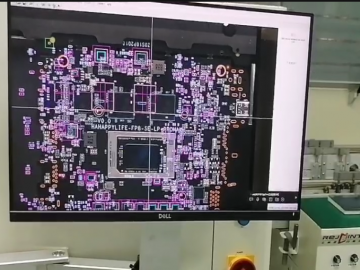
Our incoming sampling station (Fig. 2) uses a barcode‑driven MES workflow. The system randomly selects sample size according to AQL (e.g., General Level II, S‑3), and the technician enters pass/fail for each measurement. Any failure immediately quarantines the entire lot and auto‑generates a SCAR. This closed‑loop process has reduced our incoming defect rate from 1,480 DPPM (2023) to 610 DPPM (2025) – a 59% improvement.
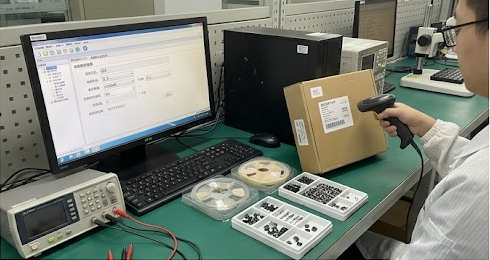
Fig 2 – AQL sampling station: operator scanning a lot code; MES screen displays sample size and pass/fail entry fields.
⚡ 3. ESD‑Safe Warehousing & Full Material Traceability – Every Component Has a Story
After IQC approval, components move into our ESD‑controlled warehouse – conductive flooring, grounding wrist straps, and ionizers at every entry point. Humidity is maintained at 30–60% RH, temperature at 22±3°C. Each shelf is zone‑marked and integrated with our material traceability system: a component’s batch code, MSL level, expiration date, and storage location are recorded in real time. We enforce strict FIFO (first‑in, first‑out) with a digital pick‑list that prevents operators from using expired or older lots.
Electrostatic discharge is the silent killer of modern, high-density silicon architectures. Latent ESD damage might not manifest during initial functional ICT (In-Circuit Testing) or FCT (Functional Testing) stages; instead, it creates microscopic stress fractures in the internal oxide layers of an integrated circuit that cause premature operational breakdown in the field. Our comprehensive grounding networks and continuously monitored ionized air fields guarantee that sensitive items remain in a zero-potential state throughout their storage lifecycle.
The system also locks a material ID if its floor life (for MSL components) exceeds the allowed exposure after baking. This traceability extends to the assembly line: when a finished board fails final test, we can instantly pull the component lot numbers for every part on that board – a capability that automotive auditors now treat as mandatory for IATF 16949 compliance.
🧊 4. Special Material Handling – Precision Chips & Automotive‑Grade Components
High‑value components such as FPGAs, high‑speed ADCs, automotive ASICs, and millimeter‑wave radar chips require extra care. We dedicate a dry cabinet zone (5% RH) for moisture‑sensitive devices (MSL level 2 to 5a). These cabinets are connected to a humidity data logger; any excursion triggers an SMS alert to the warehouse supervisor. For automotive‑grade parts (IATF 16949‑compliant batches), we apply an additional ESD‑tunnel before shelf entry: all reelers and trays are neutralized using ionized air blowers.
When moisture-sensitive components absorb ambient humidity and are subsequently exposed to the extreme thermal stresses of lead-free reflow profiles (often peaking at 245°C to 260°C), internal moisture rapidly expands into high-pressure steam. This leads directly to internal delamination, bond wire shearing, or visible external fracturing known in the industry as the "popcorn effect". By isolating these parts within ultra-low humidity nitrogen or desiccant dry storage units, we completely neutralize this risk vector.
For RF or high‑frequency heavy components (e.g., 5G power amplifiers, mmWave antennas), we store them away from magnetic field sources and use antistatic shielding bags inside closed metal cabinets. A recent customer project – a dual‑channel automotive radar controller – required 600 units of AEC‑Q100 microcontrollers. Due to our strict dry storage and MSL tracking, the whole batch passed reflow without any popcorn effect or delamination. The customer’s reliability lab confirmed zero moisture‑related failures – a result they had not achieved with previous suppliers.
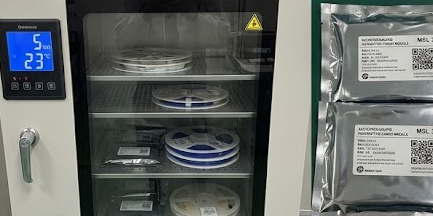
Fig 3 – Special handling zone: dry cabinet (5% RH) for MSL3 ICs, vacuum‑sealed automotive‑grade modules, and ESD‑safe storage bins with RFID tracking.
📊 The Data That Proves Our IQC+Warehouse Ecosystem Works
Over the last fiscal year, our automated IQC protocols and environmental storage infrastructures have delivered measurable operational milestones across all production runs:
- 0.71% of incoming lots rejected – preventing counterfeit, out-of-tolerance, or physically damaged components from ever entering active production loops.
- Reduced assembly‑line “first‑pass yield loss” caused by raw material non-conformance down to a minimal 0.09% (a dramatic fall from 0.58% recorded three years ago).
- Maintained 100% material traceability for every active electronic component integrated across 1,500+ diverse customer build configurations.
- Achieved an absolute record of zero moisture‑related reflow failures for all MSL-rated components over the past consecutive 18 months of manufacturing operations.
The result? A 99.4% overall customer quality rating (based on post‑shipment surveys) and full IATF 16949 + ISO 9001 compliance without any major non‑conformity during official surveillance audits.
🔁 Closing the Loop – From Receiving Dock to Production Line
Great components become great products only if they are managed from first touch to final test. Our IQC, supplier auditing, ESD warehousing, and special material handling are not isolated silos – they feed into our global MES traceability backbone. When you ask for the inspection report of an MCU that went into your medical device board, we reply with a PDF that includes: the incoming IQC micrograph, the supplier audit summary, the warehouse environmental log, and the assembly X‑RAY image.
This multi-dimensional cross-referencing ensures that if any operational anomaly occurs mid-production or out in the field, root-cause resolution can be narrowed down to specific wafer lots or timestamped storage intervals within minutes. This transparency mitigates risk profiles and guarantees compliance with the strict structural regulations governing the industrial controls, medical instrumentation, and aerospace component fields.
This is the level of transparency that wins long‑term partnerships, not one‑off orders. And it’s the reason we invite every potential client to walk our receiving dock and dry storage area – because seeing is believing.
Your components are only as good as the infrastructure that protects them. At NEWEI, we treat every incoming part like a surgical implant – traceable, auditable, and stored with obsessive care.
📞 Contact NEWEI (Newei Industrial)
Tel: +86-18925218989
Email: tiger.wang@richitek.com
Web: https://www.neweiodm.com/
Reach out to our engineering team to request an IQC process demonstration, look over a sample material tracking log, or receive our complete supplier audit package today.
©2026 NEWEI Industrial – From IQC to final shipment, uncompromising component integrity.
Tags: PCBA incoming quality control / ESD‑safe warehousing for PCBA /
Next: No more...