
Electronic Component Procurement, DIP Assembly and SMT Assembly: How Outsourcing Narrows the Border of Quality Inspection
Most procurement managers I talk to share one complaint about outsourcing, and it is never the one you would expect. The certificates arrive on time, the packing list matches, and the first batch still surprises somebody on the floor. The surprise is rarely a defect nobody could have found. It is almost always a defect that sat just outside whoever was holding the check at that moment. Handing over a process moves the work, and the place you stood to watch it.
The useful question is not which standard a partner claims. At the moment your own people are allowed to look, what has already been decided? A team that buys only the parts sees a bag. A team that adds the plug-in step sees a bare board. A team that buys a finished build sees a closed box. Each position verifies something real, and each casts a shadow behind it.
Where the Sending Process Ends and Checking Begins
Picture a purchase order as a line drawn across a process. Everything to the left of that line now happens somewhere else, and everything to the right is still yours to confirm. What rarely gets discussed at the signing stage is that the line also decides the direction of your evidence. Checks that sit early in a build can still influence the outcome. Checks that sit late can only record it. Move the line to the right and you gain volume, headcount relief and a single point of accountability. Move it to the right and you also lose the earlier vantage point, because by the time the goods reach you the decisions behind them have already set.
Incoming Parts: What the Documents Leave Untested
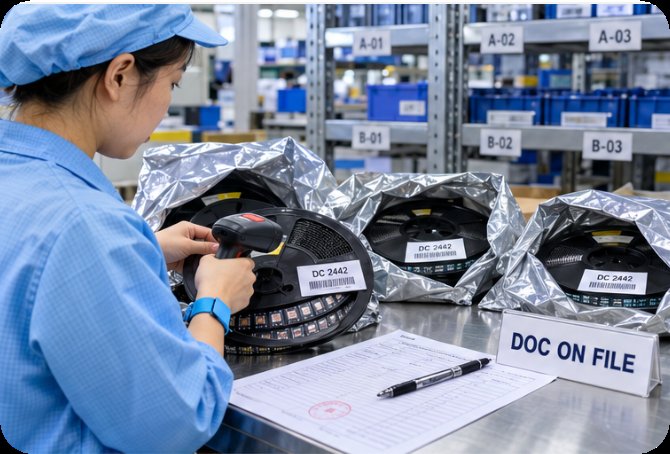
Component sourcing is the step buyers outsource first, and for good reason. Labour, stocking cost and supplier relationships all shift to the partner, and the customer hands over a design package. What shifts with them is the moment of first contact. Handled in-house, the receiving bay is where a part is first touched by someone who answers to your quality system. Outsourced, the first contact belongs to the partner, and what reaches you is a container, a label and a file. A supplier declaration can give you the part number, the date code and the country of origin. It cannot tell you whether the reel inside the bag matches the label outside, because nobody opened it with that question in mind. This is where an aging test solutions programme earns its keep later in the build, and where the sourcing question stops being about price and becomes about who holds the first look at Electronic Component Procurement.
The Board That Arrives Already Half-Built
There is a middle position that catches people out, and it is the one where the plug-in step is outsourced onto boards that were assembled elsewhere. The boards arrive with the surface-mount work finished and the reflow profile locked in. Nothing is wrong with that arrangement on paper, and plenty of programmes run on it for years. The difficulty is comparative. Your incoming check on a half-built board has no earlier state to compare against, so it can only ask whether the board meets the specification, never whether the specification was the right one to hold the process to. A first article that was approved weeks ago at another site is a reference, not a measurement. Teams that understand this treat the half-built board as a risk item rather than a commodity, and they inspect it against a frozen sample instead of a drawing.
What the Plug-in Stage Sees After the Wave
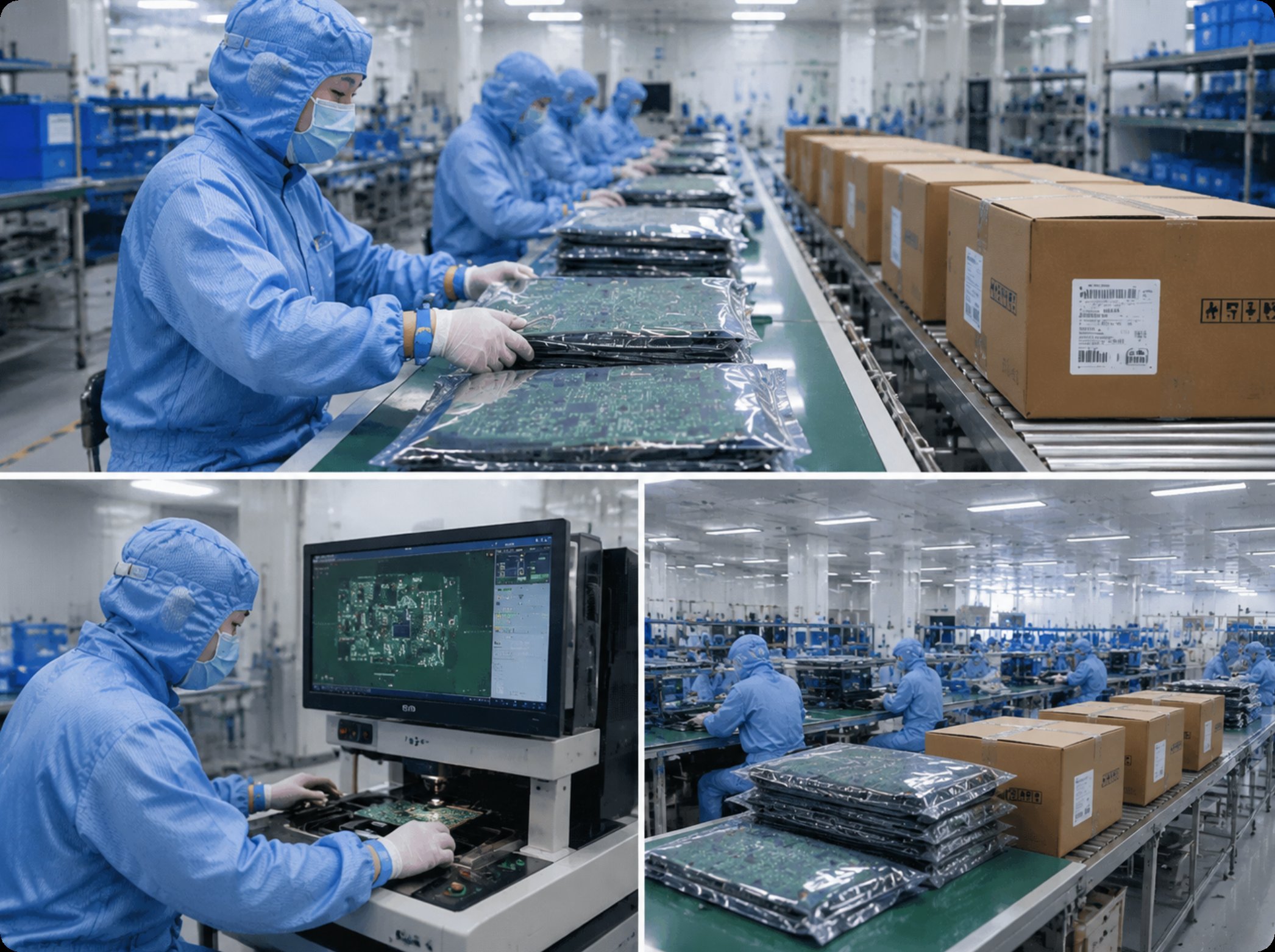
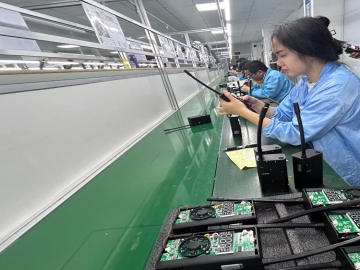
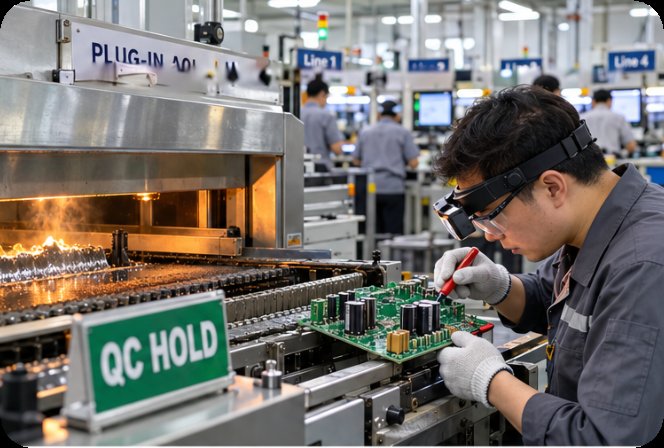
Plug-in work is where inspection gets interesting, because the process itself creates the blind area. Our line runs four plug-in stations, four wave units and fifty-six rework positions, and the plug-in AOI at the end is set to catch reversed, missing and wrong components before anything moves on. That check is fast and unforgiving, and it catches the errors a human eye misses at speed. What it cannot do is look under a body. A wave joint that formed beneath a component, with solder flowing into a gap the camera cannot reach, sits outside any optical tool. This is why the stations are separated by status, with dedicated areas for parts waiting to be plugged, waiting for repair, waiting for QC and waiting for QA release, so a board cannot quietly skip a gate. When the step runs under DIP assembly services that carry their own IPQC and lot sampling discipline, the record of that separation travels with the boards.
Joints the Optical Scan Passes Over
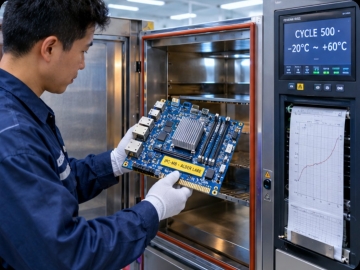
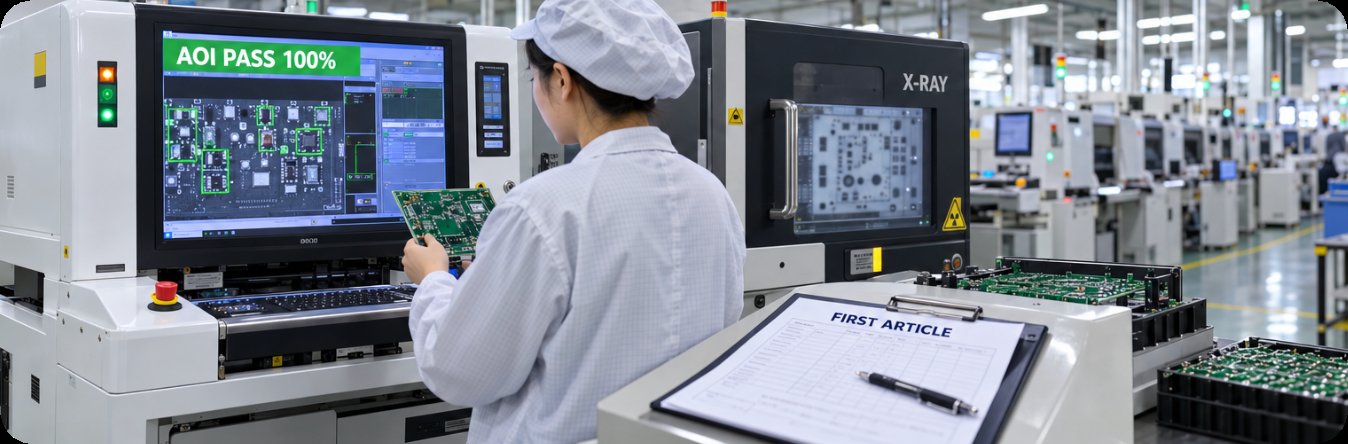
Surface-mount inspection has the deepest toolset of the three, and it still has an edge. A modern line stacks solder paste printing, SPI thickness measurement, multi-zone reflow, AOI and X-ray into one sequence, and the combination catches paste volume drift, placement offset and voiding a camera alone would never see. We run four automatic high-speed lines with this stack, and the certifications behind them, ISO9001:2015, ISO13485 and IATF16949, exist because medical and automotive customers ask for evidence rather than assurances. The edge is that all of it inspects the board as a surface. A joint under a large package, or a connection that only opens after thermal cycling, is invisible to a scan taken on a cold bench. That is why an SMT assembly services programme ending at the AOI image set is half a programme. The other half is a slower test that recreates the conditions the board will meet.
Why Separate Verifications Do Not Add Up
Buyers assume three checks give three times the coverage, and the arithmetic does not work that way. Each check is built for the failure mode of the stage it guards, so the three sets overlap in the middle and leave the seams between stages untouched. A part that is genuine on arrival and damaged by a reflow profile nobody questioned will pass the incoming gate and pass the AOI, and the failure will surface in the field. The seam is not a hole in any single supplier's process. It is a hole in the handover, and it exists because the party who could have caught it did not own the stage on either side.
A single point of responsibility changes that picture in a way no extra station can. When one partner holds sourcing, plug-in and surface-mount under our electronics manufacturing services, the seam stops being a boundary between companies and becomes an internal handover a quality system can be written around. The check moves earlier, because the party running it also owns the step before.
Three Contract Widths, Side by Side
The table below sets out what each width of contract leaves open, stated as the question that stays unanswered rather than as a score.
| Contract width | Where your own check starts | What the partner has already fixed | The question that stays open |
|---|---|---|---|
| Sourcing only | Receiving bay, before anything is placed | Board layout and placement file | Is the delivered part genuine past its label? |
| Sourcing plus plug-in | Before the wave, on a bare board | Placement file and reflow profile | Do joints under a body hold after thermal cycling? |
| Full build | Final inspection, after the enclosure closes | Every process stage up to test | What do you compare against when a field return arrives? |
Read the last column across, and the pattern is consistent. The wider the contract, the later your first look lands, and the more of the answer has to be taken on trust. The narrower the contract, the earlier you can see, but the less of the process you are entitled to change.
What to Settle Before the First Article
None of this argues for bringing everything back in-house. It argues for writing the agreement around the seam instead of around the price. Before the first article is approved, four items are worth nailing down. Ask which party holds the incoming record for components, and in what form it is passed on. Ask where the frozen sample lives for any work that lands on a half-built board. Ask what test recreates service conditions after the bench inspection ends, and who pays when a field return has to be traced back. Ask who owns the image sets, the lot records and the traceability file, because those are the artefacts that survive a dispute.
A partner who answers those four without hesitation is telling you something useful about month twelve, when volumes are up and the original team has moved on. That is a better filter than any capacity slide. For the fuller picture of how the stages fit together, you can learn more about our manufacturing capabilities, then bring the four questions to your next supplier review.
Tags: SMT assembly /DIP assembly /electronic component procurement /
Next: No more...