

Aging Test, Product Assembly and Electronic Component Procurement: Three Gates Around a DIP Assembly Order
Aging Test, Product Assembly and Electronic Component Procurement: Three Gates Around a DIP Assembly Order
A through-hole build gives a DIP assembly line its character, but the line itself is only the middle of the story. Long before a lead is bent, parts have to survive a procurement process that can prove where they came from, and long after the wave has carried the board across its flux peak, two more services decide whether the order leaves as shippable stock. This guide sets out those three checkpoints as they actually run on our floor, so that a buyer reading it can see what to hand each station and what each station will hand back.
The frame matters because a mixed-technology order fails in different places than a pure SMT one. Insertion work is manual, which means the input parts and the output operators both carry more risk per touch. Splitting the deployment into three checkpoints, one before the line, one after it and one before the box, keeps each risk where it can be measured.
Why a Mixed Build Needs Its Own Map
A reflow-only panel moves through the factory as a batch with one inspection signature, so a single quality plan can cover it. A through-hole order does not get that luxury. Its components arrive from more fragile channels, its joints are finished by hand, and its units are boxed only after hours of enforced operation. Three separate services therefore share custody of the same order, and each one answers a question the others cannot: are the parts real, are the hands disciplined, and does the finished unit survive time. Reading them as one connected route, rather than as three line items on a quotation, is what makes an installation plan hold up in production.
The First Gate: Parts That Prove Their Channel
Everything begins with Electronic Component Procurement, because a through-hole order is unusually exposed to the grey market. Large electrolytic capacitors, connector shells and power regulators are exactly the part classes that brokers chase when supplies tighten, and a counterfeit that passes visual inspection will still fail the wave. Our supply chain system answers this with audited and certified suppliers, sample approval for first articles and recognised small-batch specifications before any purchase order is released.
On arrival the gate stays shut until the numbers agree. Every core component lot goes through IQC inspection under AQL sampling, backed by an in-house inspection laboratory, so a reel that cannot show a genuine channel never reaches the insertion benches. Date codes are read against the purchase record, moisture-sensitive parts are checked for bagging and humidity indicators before they are released to the floor, and anything short of spec is quarantined rather than argued through. The order starts with paperwork rather than solder for precisely this reason, and the buyer sees the benefit twice: fewer surprises at wave, and a documented chain of custody when a supplier question comes up months later.

The Second Gate: Hands That Follow the SOP
After soldering, the boards move to Product Assembly, where PCBA, casings, wires and motion parts become a deliverable unit. Through-hole work makes this stage heavier, because hand-finished joints and clip-fixed harnesses leave more room for operator variation than a reflow panel ever does. The countermeasure is procedural: our assembly floor runs at roughly ninety-five percent skilled workers, one person per position, each trained against strict SOP standards with online correction while the work happens. Where a consumer line would tolerate a rotated panel label, an industrial controller with a wired relay cannot, so the correction loop runs at the bench, not at the end of the shift.
Two people carry out a full inspection across the whole assembly process, and any defect they find is analysed the same day rather than binned quietly. A barcode management system registers every good and bad unit, which is what lets the factory trace a complaint back to a single bench without a search party. Certification backs the routine: ISO9001:2015, ISO13485 for medical devices and IATF16949 for automotive electronics all sit on the same floor. For through-hole products the pairing matters more than the badges, because a hand-inserted part that was seated by one trained operator and verified by another is the closest thing the process has to a machine guard.

The Third Gate: Hours That Expose Hidden Defects
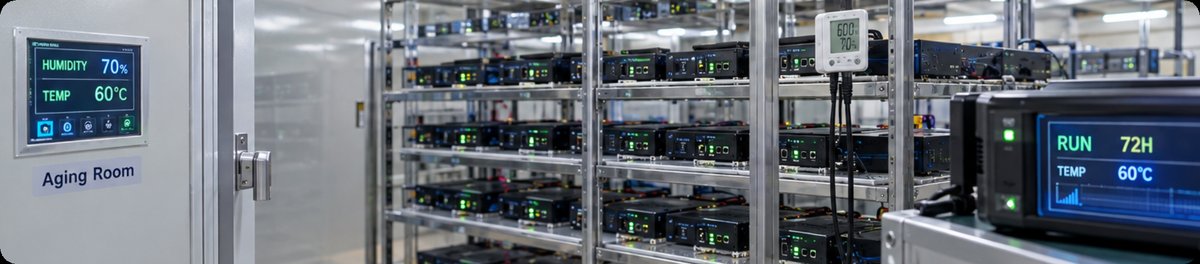
The final gate belongs to Aging Test, the step that catches what neither inspection can see. A weak solder joint or a marginal regulator often behaves perfectly for the first hour of operation and fails on day three, which is why finished units are placed under specific temperature and humidity conditions and run continuously for 72 hours up to 7 days, with occasional continuous on and off impact tests layered on top. The point is not to break units at random but to compress months of field duty into days of bench time, while the product is still cheap to fix.
The profiles are real, not nominal. A medical blood glucose meter board once ran up to 500 simulated cycles over roughly 48 hours at room temperature; a transport camera motherboard held 60 degrees Celsius at 70 percent humidity for 72 hours; solar storage controllers age at ambient before shipment. Where a test cannot be done in the factory, it is entrusted to the China Electronics Laboratory as a cooperative third party, so even exotic duty cycles have a route to evidence. Performance data from every run is recorded and fed back into process improvement, which is what turns an aging report into a revision of the line rather than a filed PDF.
What Each Gate Hands the Next Stage
The three checkpoints are sequenced so that each one inherits evidence instead of assumptions, and hands a narrower set of unknowns to the next. The table below shows the division of labour on a single through-hole order.
| Gate | Service on duty | What it checks | Evidence it keeps |
|---|---|---|---|
| Before the line | Electronic component procurement | Supplier audits; sample approval; AQL sampling on arrival | IQC laboratory records per lot |
| After the line | Product assembly | SOP compliance; station self-check; dual full inspection; barcode trace | Assembly pass rate and per-unit trace records |
| Before the box | Aging test | 72 hours to 7 days under set temperature and humidity; on and off impact | Performance data logs and improvement feedback |
Read as a sequence, the table also explains the cost of skipping a checkpoint. Procurement evidence protects the soldering stage from bad inputs, assembly traceability protects the aging stage from unrepeatable results, and the aging logs protect the customer from receiving a defect that only time could reveal. Remove any one of them and the next stage is running blind.
The Records Each Stage Keeps
What makes the route auditable is that every stage writes something down while the order is still moving. The procurement desk files lot-level inspection results that tie each reel to an approved supplier; the assembly floor keeps per-unit barcode entries linking a finished product to its operators and its test outcomes; the aging room archives performance curves against the agreed profile. When a field failure shows up a year later, the three files read together usually answer the first question within an hour: which lot, which bench, which profile.
Booking the Checkpoints Into One Timeline
For a buyer, the practical question is how these gates sit on a DIP Assembly timeline. The answer is that they overlap rather than queue. Component sourcing starts the moment BOM and Gerber documents are approved, so the first checkpoint is usually open before the bare boards arrive. Assembly planning runs against the same schedule, and aging chambers are booked against the assembly forecast, which is how a mixed-technology order keeps its delivery window from stretching. A long-lead connector identified at the first checkpoint can be waved through with an approved alternative while the boards are still being fabricated, instead of stalling the whole line a week later.
Two habits keep the checkpoints honest from the customer side. First, agree the aging profile at order entry, because temperature, humidity and duration are design decisions, not afterthoughts; the transport camera profile above was chosen by the customer's duty cycle, not by us. Second, nominate which units the barcode system must trace end to end, so the assembly checkpoint keeps the records your own auditors will ask for.
Our EMS Electronic Manufacturing team coordinates all three services under one plan, and you can see how they sit beside PCB Manufacturing on the same campus. If you are mapping a through-hole order for the first time, send the BOM and the duty profile together; the earlier the first checkpoint opens, the more options the other two will still have.
Tags: DIP assembly / PCBA / product assembly /
Next: Shell Mold, PCBA Three-Proofing Paint and PCB Fabrication: The Builds Between a Sample and a Launch