
Electronic Component Procurement, Product Assembly and DIP Assembly: One-Piece Flow Redraws the Inspection Map
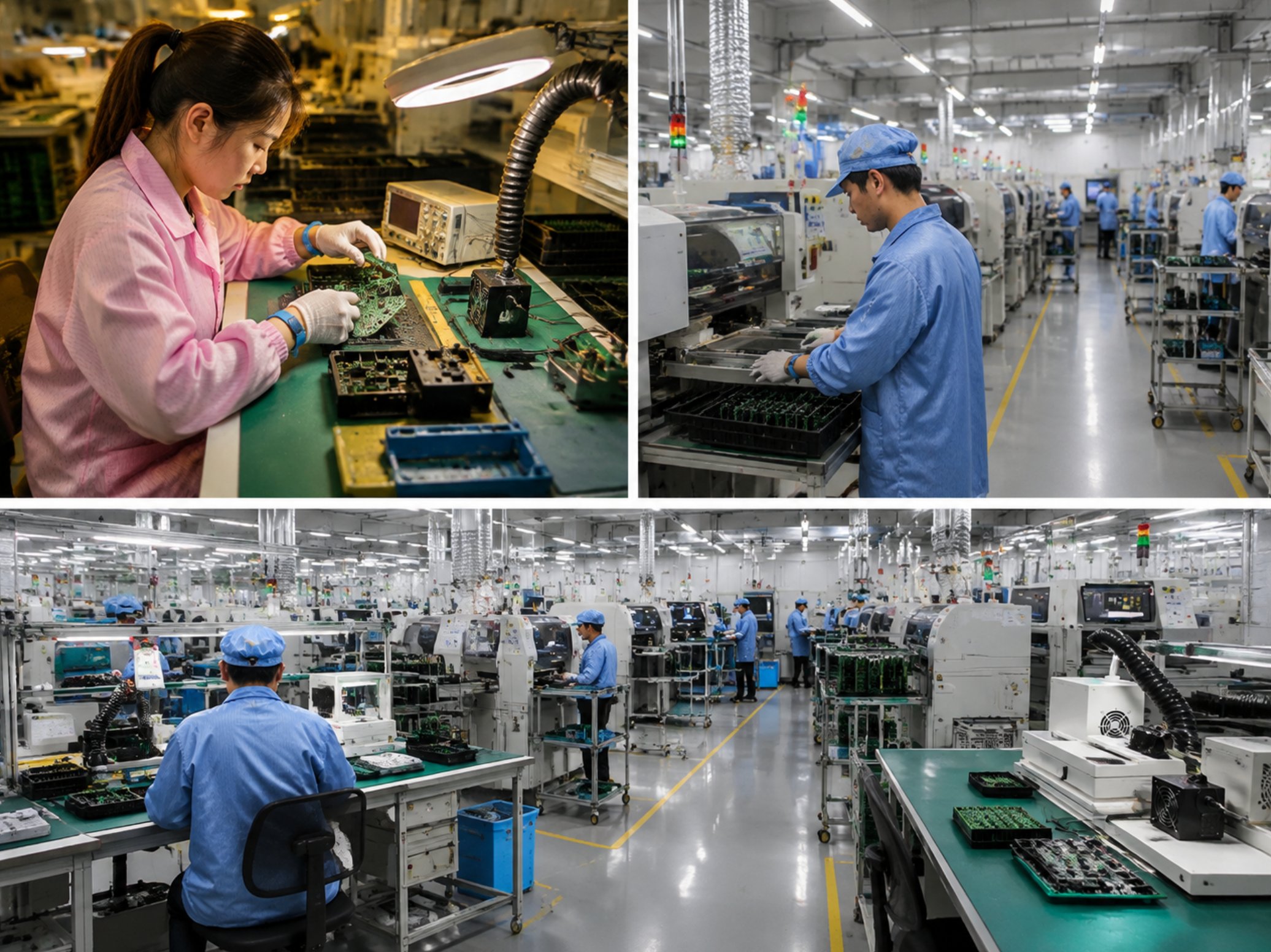
Walk through a mid-size PCBA plant built for batch manufacturing and you will notice where the quality effort sits: a receiving bench stacked with boxed lots, a plug-in area with labeled trays waiting for QC, and a final check point near packing where finished goods queue in trolleys. That layout assumed one thing — boards move in batches, so inspection happens in batches too.
That assumption is quietly failing. Order books across the EMS sector keep splitting into smaller, more varied releases: a few hundred medical controllers this week, a mixed consumer run next week, a automotive sub-assembly after that. As the mix widens, the batch becomes shorter and the cost of finding a defect late becomes higher. The industry's answer is one-piece flow — and it does not just change how boards move. It redraws where the checking happens. At NEWEI Industrial, the shift shows up in three places: how sourced parts are verified on arrival, how through-hole benches handle their queues, and how the final assembly line distributes its four layers of inspection.
Why the Batch-End Check Lost Its Job
Batch-end inspection made sense when a line ran one product for weeks. A QC team could sample the finished lot, and an AQL table would decide whether thousands of units shipped or stopped. The math collapses when the lot shrinks to fifty boards of a new variant. Sampling a small lot statistically protects nobody — if two units carry the same reversed connector, an AQL sample may miss both, and the entire release is too small to absorb a rework loop.
The deeper problem is feedback delay. In batch mode, a defect found at final inspection reflects work done days earlier, across dozens of stations. By then the solder paste profile has changed, the operator rotation has changed, and the root cause is guesswork. One-piece flow exists precisely to shorten that distance: when boards move singly, any defect is traceable to the station it just left. The inspection points must therefore move with the board, or the promise of fast feedback is wasted.
Incoming Parts: From Lot Sampling to First-Piece Confirmation
The first checkpoint to move is the receiving dock. our component sourcing services still run AQL sampling on core components — the laboratory and inspection equipment have not gone anywhere — but in a one-piece flow program, AQL alone is too slow a loop. What replaces it is first-piece confirmation tied to the supplier lot record: the first board of each build consumes parts from a single documented reel or lot, and its results are attributed to that entire receipt.
This changes what procurement must deliver. Price and supply continuity remain the two classic factors, and centralized purchasing with original-factory relationships still secures both — a ten-year cooperative relationship with component makers gives priority allocation and direct technical support that spot purchases from online traders cannot match. But the third deliverable is now documentation quality: reel-level date codes, lot traceability, and fast substitution notices, because in a flowing line there is no staging buffer where a mixed lot can be sorted quietly before it reaches the benches.

The Plug-in Line Stops Parking Boards in Trays
Through-hole work exposes the batch habit most clearly. A conventional DIP area runs on labeled staging: trays wait for plug-in, wait for maintenance, wait for QC inspection, wait for QA sampling. Those queues exist to give inspectors a meaningful pile to sample from. Our DIP assembly services keep the discipline of separated, labeled zones — mixing boards is still the fastest way to destroy traceability — but the one-piece variant moves inspection to the point of work. Plug-in AOI screens every board for wrong-part, missing-part and reversed-polarity errors as it leaves the bench, rather than after a tray accumulates.
With four plug-in lines, four wave soldering machines and fifty-six rear-welding stations, the plant's DIP throughput depends on joints being right the first time, not on catching them downstream. The pass-through rate target shifts from "acceptable at lot level" to "explainable at unit level": if a board fails, the record shows which bench, which shift and which bin of parts it came from. IPQC lot sampling remains for process audits, but the board itself no longer waits in a queue to be judged.

Checks at the Bench Move Into the Flow
Final assembly is where the layered structure was already closest to one-piece thinking. On our product assembly services lines — industrial controllers, consumer electronics, IoT modules and electro-mechanical devices — the sequence runs station self-check, QC full inspection, QA online sampling and OBA open-box checks before packing. Under batch rules, each layer waited for a pile. Under one-piece rules, the self-check travels with the board: the operator who drives the torque screwdriver records the result on that unit's barcode record at that moment.
Two inspectors covering the full assembly process together is a batch-era headline that survives the transition unchanged — human full inspection still catches what fixtures miss on precision and complex builds. What changes is the record. Barcode management registers good and rejected units unit-by-unit, so the assembly pass rate and the customer's outgoing sample qualification rate are computed per order rather than per month. A torque meter reading, a dispensing result, a test-rack verdict: each attaches to a serial number that left the station minutes ago, not to a lot closed last week.

A Table of Old Checkpoints and New Positions
| Check point | Batch-era position | One-piece position |
|---|---|---|
| Receiving (IQC) | AQL sample after pallets accumulate | AQL retained; first-piece confirmation ties each build to a documented supplier lot |
| Plug-in (DIP) | Trays wait in labeled zones for QC and QA queues | Plug-in AOI judges every board at the bench exit; zones kept only for status, not storage |
| Post-wave repair | Defect lot returned to a rework trolley | Unit returns to the bench that produced it; fifty-six rear-weld stations absorb the loop |
| Final assembly checks | QC full inspection on completed trolleys | Two-person full inspection in the flow; results written to the unit's barcode record |
| Outgoing (OBA) | Open-box sampling of packed lots | Unchanged as the last gate, but reads against per-order pass-rate data |
Where Batching Still Makes Sense
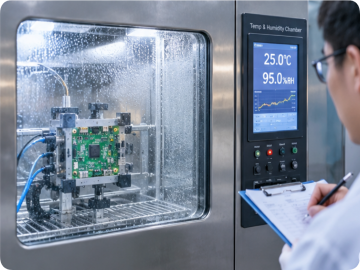
Honesty about limits keeps the trend article useful. Wave soldering is a batch process by physics — four machines run panels in carriers, and the DIP area's washing machines clean batches. AQL sampling on incoming components remains the economical default for commodity passives where unit-level records add cost without adding information. Aging runs, too, gather units into chambers for hours at a time; the inspection plan around burn-in and environmental testing still thinks in lot durations even when everything upstream flows singly.
The realistic trend is therefore not the death of the batch check but a narrower job description for it. Batching survives where equipment cadence or statistics demand it, and it loses the role of being the plant's only line of defense. Factories that kept every check at the end now find their engineers solving yesterday's defects; factories that moved checks into the flow find defects dying at the bench that caused them.
What to Ask Before Signing Off on the New Layout
Buyers evaluating an EMS partner's inspection layout can cut through the brochure language with a few pointed questions. Ask which checks attach to the unit record and which attach to the lot record — the answer reveals whether one-piece flow is practiced or merely advertised. Ask how a reversed connector found at plug-in AOI is traced: to a bench and shift, or to an anonymous tray. Ask what the DIP staging zones contain during a running order — statuses, or storage. Ask to see a rejected unit's barcode history from receiving through OBA, and time how long the lookup takes.
An overview of our manufacturing capabilities describes the certificate layer — ISO9001:2015, ISO13485 for medical devices, IATF16949 for automotive electronics — but certificates describe the system, not the flow. The flow is visible in the questions above, and a partner who welcomes them is a partner whose inspection map has actually been redrawn.
Frequently Asked Questions
1. Does one-piece flow mean AQL sampling disappears?
No. AQL sampling remains on incoming core components and on commodity passives, where it is the economical default. What changes is that small releases no longer depend on AQL alone — first-piece confirmation ties the first board of each build to a documented supplier lot, so a defect found in the flow is attributed to that receipt immediately.
2. How are DIP defects traced without batch queues?
Plug-in AOI judges every board at the bench exit for wrong-part, missing-part and reversed-polarity errors. Each failure links to the bench, shift and component bin it came from, while IPQC lot sampling continues as a periodic process audit rather than the primary defect filter.
3. What stays batch-based in the plant?
Wave soldering carriers, washing machines and aging chambers all run in batch cadence — four wave machines and four washers handle panels in groups, and burn-in chambers hold units for fixed durations. The trend removes batch-end checks as the last line of defense, not the batch processes themselves.
4. How does the customer see the difference in the delivery record?
Pass-rate and outgoing qualification figures are computed per order and per serial number instead of per month. A buyer can request a rejected unit's barcode history from receiving through OBA open-box checks and read the entire inspection trail of that specific board.
Tags: PCBA quality inspection / one-piece flow inspection / assembly inspection /
Next: No more...