
SMT Assembly, Aging Test and EMS Electronic Manufacturing: One Rework Order, Three Apprentices and What Each Line Taught Back
A returned shipment is the most honest audit a factory ever gets. Nobody schedules it, nobody poses for it, and every shortcut taken during the previous eight weeks shows up on the same afternoon. Last month a customer sent back a dozen camera boards with one complaint written three different ways on the same email: intermittent stripes on the image, worse after the unit had been running warm for a while. This article walks that rework order through three workshops on our floor and shows what each one taught the newest person standing at it.
I have watched factories treat a return as a shipping problem. The boards come back, somebody swaps the suspect part, and the box goes out again with a clean invoice. That approach hides the only information worth having. The way we ran this one, the same dozen boards were read three times, by three different teams, and each team wrote down what it saw before touching a screwdriver. What follows is the trace, in the order it actually happened.
The Call That Started on a Monday Morning
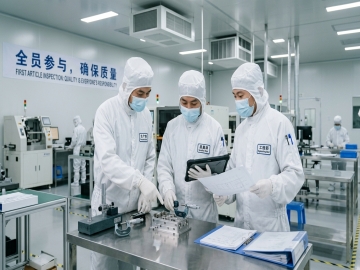
The return landed on a Monday, which is the worst day for a rework order and the best day for a record check. The boards had shipped nine weeks earlier as part of a mixed order that also carried a wearable batch, so the first question was not what failed but which line touched them and when. Our quality team of more than twenty people spans incoming inspection, process inspection and final audit, and the paper trail they keep is what turned a complaint email into a work order inside the same morning. Every board that goes through our PCB circuit board line carries a panel history, and the panel that hosted these twelve was pulled from the archive before lunch.
The customer's description mattered less than the pattern. Stripes that appear after warm-up point somewhere different from stripes that appear at power-on, and the field report said warm-up. That single word decided the sequence of the trace: the solder paste station first, the aging room second, final assembly last. Reversing that order would have produced a tidy story with nothing behind it.
What the Returned Boards Looked Like
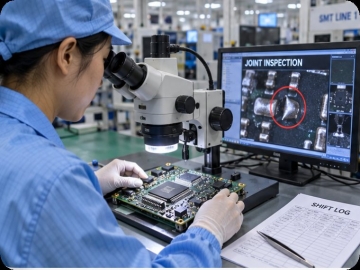
Before anyone opened a diagnostic screen, the boards went onto a bench under a magnifier lamp, and the senior operator asked the apprentice to describe what she saw before guessing a cause. Two of the twelve had a dull, slightly grainy fillet on one connector footprint. The other ten looked clean to the naked eye. That split is the most useful thing a returned batch can tell you, because it says the failure is not uniform, which rules out a whole family of causes that would have hit every board identically.
The second observation came from the serial labels. All twelve came off the same panel position, adjacent columns, which is a printing and placement story long before it is a component story. A mentor will teach a new hand to read the layout map before the schematic, because the map tells you who stood where when the batch ran. This is the part no drawing carries: the knowledge of which station's habits leave which fingerprint.
The Solder Paste Station Keeps Its Own Notes
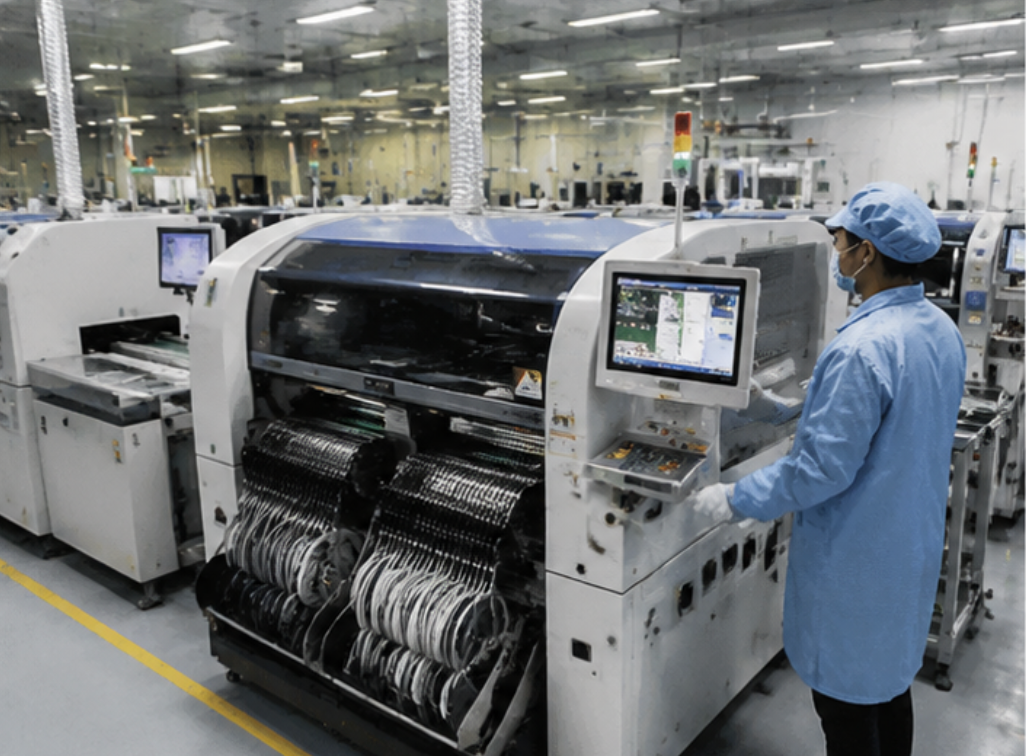
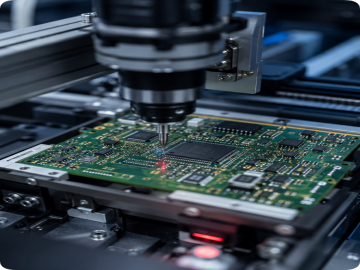
At the paste printing station the trace found its first real clue on the SMT assembly line that had run the panel. The solder paste inspection record for that panel showed a slight downward drift on the two columns the returned boards came from, a drift that had stayed inside the process window and therefore never triggered an alarm. An apprentice looking at the pass-fail column alone would have closed the file and moved on. The mentor instead pulled the trend curve across the whole shift, where the drift was visible as a shape rather than as a number.

What the station offers in writing is a three to five working day turnaround with an abnormal-condition response inside one hour, backed by ten electronics engineers who review DFM points during production. What it offers in practice, on a day like this, is a record deep enough to answer a question nobody thought to ask when the batch was running. Precision work at this level includes 0201 components and BGA packages, where the margin for a quiet paste drift is exactly zero, and the only defence is a record that keeps the trend rather than the verdict. The paste station keeps its own notes, and on this order those notes were the difference between a swap-and-ship and an actual fix.
Forty-Eight Hours at Room Temperature Is Not a Placeholder
The aging test room was next. Our published profiles give the shape of what a board can be asked to survive: medical glucose meter motherboards run up to five hundred simulated cycles at room temperature over roughly forty-eight hours; a transport camera board of the same family as the returned ones runs at sixty degrees Celsius and seventy percent humidity for seventy-two hours; a solar storage controller is asked to charge and discharge through three consecutive cycles in a day. A new technician reads those numbers as durations. The mentor reads them as the specific question each profile was designed to ask.
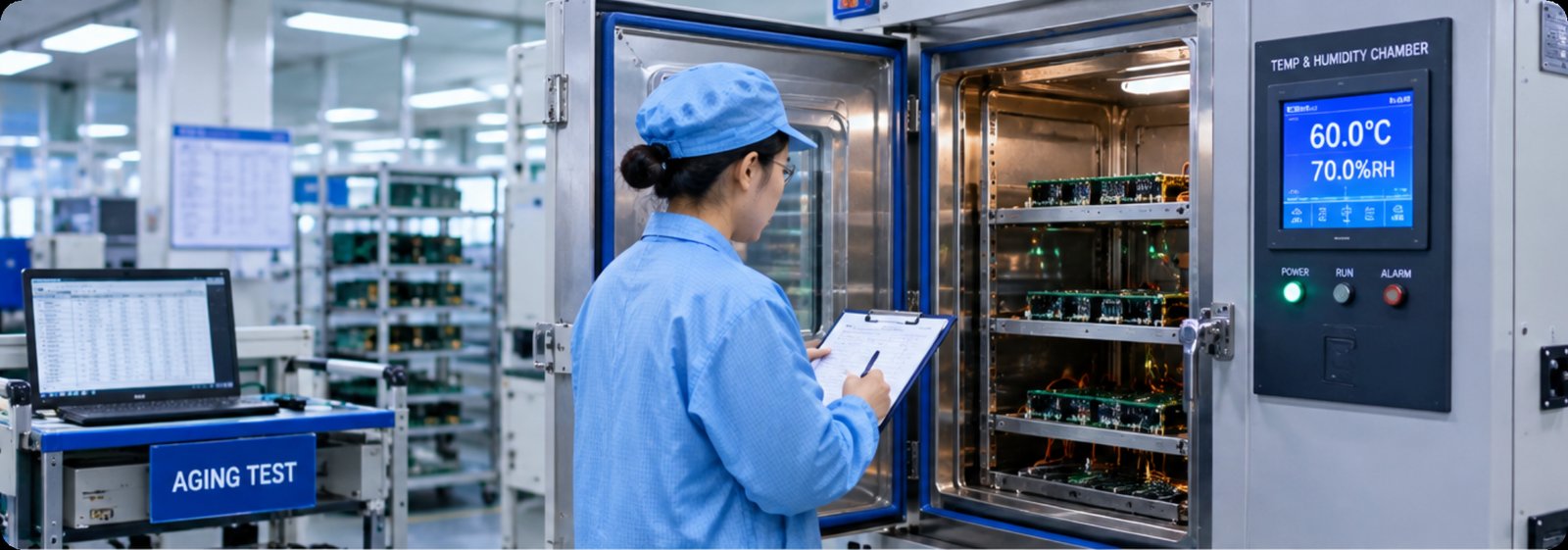
The returned boards had passed their seventy-two hour profile, so the room's job on this order was not to re-run the same question but to ask a narrower one. The chamber log for that batch showed the boards had been loaded in the middle rack position, where the airflow profile differs slightly from the top and bottom positions. Nobody could prove the position caused the stripes, and nobody claimed to. What the log did provide was a reproducible variable, and a reproducible variable is what separates a repair from a recall. Where a test exceeds what the room can run in-house, it goes to a third-party laboratory under cooperation, and the same discipline of writing down conditions applies there too.
Where the Test Rack Is Built Before the Order Arrives
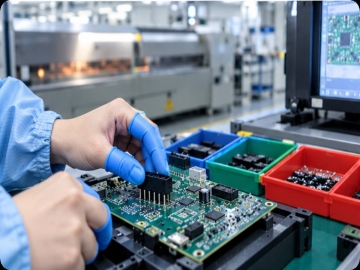
Final assembly carried the last third of the trace. On this floor the functional test rack is not ordered from outside when an order arrives; it is built in-house, on engraving machines, by test-rack assembly engineers who sit with the customer's test points during the design stage. For a camera board that means the rack probes the exact connectors the application stresses, in the sequence the application stresses them. The EMS line publishes a monthly board capacity of fifty thousand square meters, twenty-plus injection machines at a partner mold works, and acceptance to IPC-A-610E Class II, but the rack is the part a returned board actually meets.
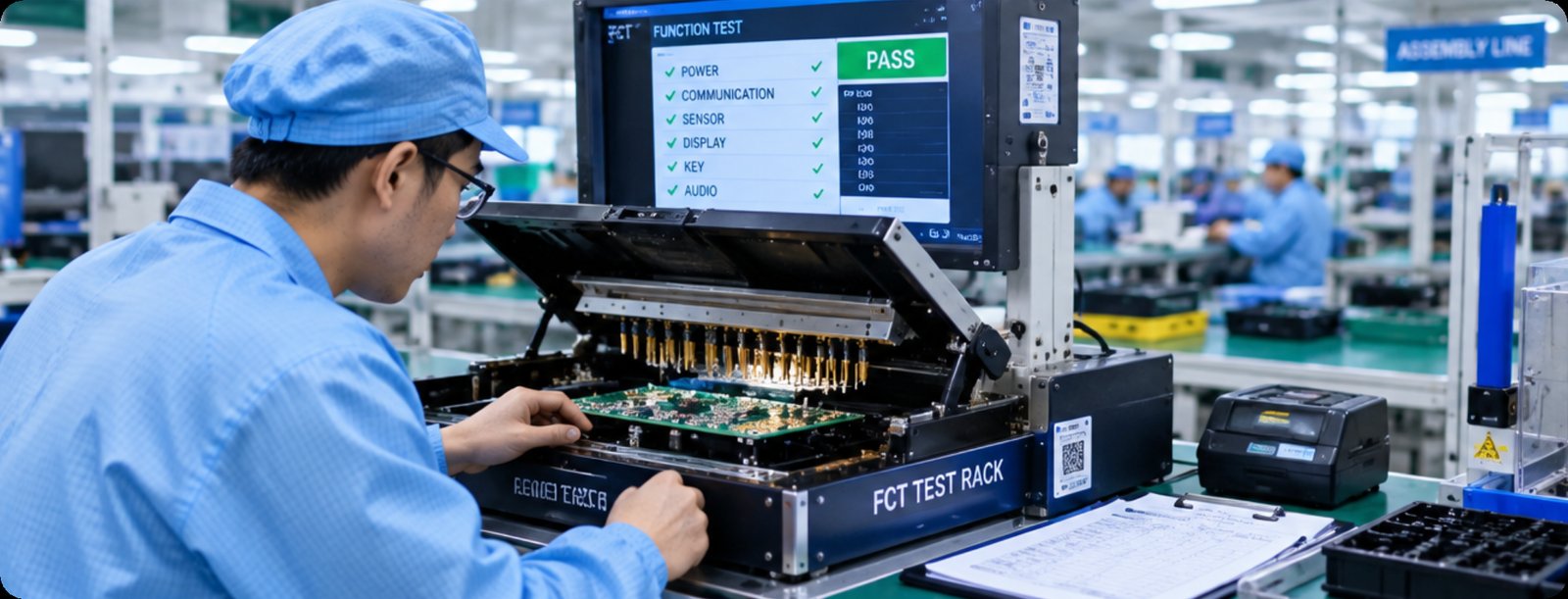
What the rack log added was the timing dimension the other two stations could not see. The twelve boards had all passed functional test on the day they shipped, which nobody disputed. What the log also showed was that their test run had been scheduled immediately after a different product's run on the same rack, a changeover that the fixture revision note listed as routine. Two records, each individually clean, together described a sequence. That is the argument for building racks in-house rather than renting them: the people who built it are the people who can tell you what it was doing last Tuesday.
| Stage | What the service page publishes | Who holds the line | First record pulled after a return |
|---|---|---|---|
| Solder paste and placement | 3-5 working days; response inside 1 hour | Quality team across IQC, IPQC and OQA | SPI trend curve for the whole shift |
| Aging room | 60 degrees C at 70% humidity for 72 hours (camera board profile) | Aging technicians per profile | Chamber log including rack position |
| Final assembly and functional test | 50000 square meters monthly capacity; IPC-A-610E Class II | Project engineer and rack builders | Fixture revision note and changeover sequence |
Read across that table and the real finding of the trace appears: no single station owned the defect. The paste drift set the condition, the aging profile confirmed it was thermally sensitive, and the changeover sequence on the test rack was the only place all three facts had ever been written down on the same day. A return that gets swapped and shipped teaches the factory nothing. This one rewrote the changeover checklist.
Who Signs the Failure Report
The last step of a rework order in this building is a signature page, and the page is deliberately awkward. Three names go on it: the engineer from the paste and placement side, the technician from the aging room, and the project engineer who owns the customer relationship. None of the three can close the file alone. The rule exists because every one of those roles can see a failure mode the other two would explain away, and the report is where those three views have to agree on a single sentence of cause.
The corrective action that came out of this order was small and specific: the changeover note now records which product ran before a functional test, not just which fixture revision is fitted. It cost one line on a form. The apprentice who watched the whole trace later said the form was the most valuable thing she had read all month, which is the kind of sentence a mentor files away and repeats to the next new hand.
What a New Hand Takes Away From the Floor
Each of the three apprentices standing at those benches that week took away a different lesson, and none of them came from a training slide. The one at the paste station learned that a pass is a snapshot and a trend is a story. The one in the aging room learned that a chamber log is only useful if it records where the board sat, not just how long it sat there. The one at final assembly learned that a clean test result describes a moment, not a product.
That is what a rework order is actually for. The customer got twelve working boards back inside the same week, and the factory got a permanently better record. If your next project involves precision boards that have to survive heat, humidity and a long service life, the same three teams and their records are open to you, from the first EMS manufacturing consultation through to the aging profile your application actually needs. For consumer product builds, our Consumer Electronics PCBA line runs on the identical record system described above, which is the only reason a story like this one can be traced at all.
Frequently Asked Questions
1. How quickly can a rework order be traced back to a station?
The clock starts at the one-hour response commitment, but the actual trace runs on records rather than on speed. In the case described here, the panel history, the SPI trend, the chamber log and the fixture revision note were all pulled within the same working day. A factory that cannot produce those four documents cannot perform this kind of trace no matter how fast it answers the phone.
2. Is a hotter chamber always the faster way to expose a defect?
No, and the published profiles show why the choice matters. A medical glucose board is asked for up to five hundred simulated cycles at room temperature over roughly forty-eight hours because its failure mode is cyclical, not thermal. A transport camera board runs at sixty degrees Celsius and seventy percent humidity for seventy-two hours because heat and moisture together are its real environment. Picking the hotter profile for a cyclical failure would produce a clean report that answered the wrong question.
3. Why are functional test racks built in-house instead of bought?
The rack is designed around the customer's own test points and sequence, and it is assembled on-site by engineers who also maintain it. When a return needs the changeover history of a specific rack, the people who built the fixture are the same people who can read its log. Buying a generic rack would have made this trace impossible on the final assembly side.
4. Does a small prototype batch go through the same traceability system?
Yes. The record system is not scaled by order size, and prototype boards are in some ways the easier case because the panel history is shorter. The same MES signage, the same SPI trend archive and the same chamber logging apply from the first sample run, which is also what makes the first mass-production order predictable rather than hopeful.
Tags: SMT assembly / PCBA rework / PCB factory quality /
Next: No more...