

PCB Fabrication, Aging Test and PCB Assembly: Following One Failed Board Home
My opinion up front: a field failure is almost never decided on the day it is found. It is decided weeks earlier, at a stage nobody happened to be watching, and the final test that catches it is only reading out a sentence that was written long before. That is why the most useful question in electronics manufacturing is not "what is broken" but "which stage wrote this fault into the board." A turnkey line answers that question with evidence still warm; a fragmented supply chain answers it with a month of emails.
This article follows one failed board backwards through a full-process build: from the functional test bench where the fault surfaced, back through PCB assembly, back through the bare board itself, and into the aging test racks that should have caught it first. It is the daily work of any EMS electronic manufacturing solutions program, and it is where a turnkey structure quietly earns its keep.
Where a Turnkey Failure Actually Gets Decided
When a unit fails functional test, the fault has four possible homes: the bare board, a component, a solder joint, or the environment the part lives in. Jumping straight to rework before sorting out which home it belongs to is how a ten-minute fault turns into a week of chasing. The discipline that separates an experienced line from a struggling one is sequencing: read the failure signature first, match it against what each stage could physically produce, and only then open a tool. Every stage of a build leaves its own handwriting, and learning to read that handwriting is most of the job.
Copper, Laminate and Hole-Wall Fingerprints
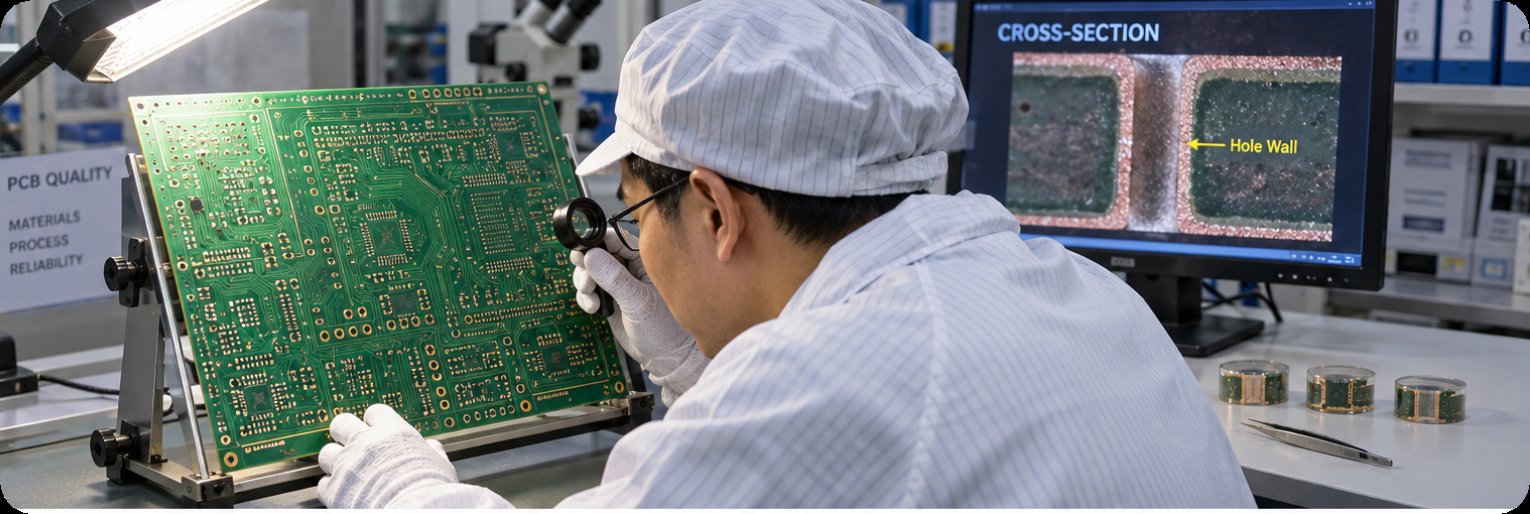
Faults that originate in the bare board carry distinctive signatures. A via that opens only after thermal cycling points at a hole-wall crack. Delamination between layers, measling in the laminate, or a board that warps after the first reflow profile all trace back to fabrication choices: laminate grade, copper weighting, drill quality, plating thickness. None of these can be introduced by assembly, which is exactly what makes them diagnosable. A cross-section photo of the failed via settles the argument in a way no meeting can. When a customer's design moves from prototype to production, we treat PCB fabrication as the first suspect in any intermittent open, because the evidence it leaves is the most physically specific.
When the Component Is the Stranger in the Chain
The third home is the one nobody likes to name first: a part that arrived inside its date code, in a sealed reel, with a certificate of conformance, and still does not behave. Suspect components show a recognisable pattern rather than a single symptom — a batch of units that all drift in the same direction, a value that walks as temperature rises, a part that survives every bench check and drops out under load. What settles it is lot traceability. Because every reel in our stores is logged against the builds it entered, the question "is this part the stranger" gets answered by pulling the batch record for that exact date code, not by swapping parts until the symptom moves. Counterfeit and remarked parts rarely survive that comparison, and neither does a genuine part that has been sitting beyond its shelf-life window.
Solder-Level Clues at the Bench
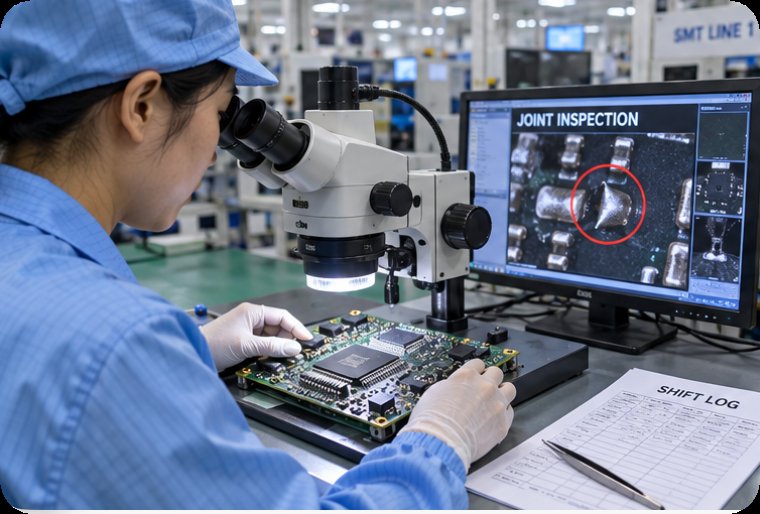
Assembly-origin faults announce themselves at the joint, not the board. Tombstoned passives, cold solder with a dull grainy surface, head-in-pillow on a BGA that passes bed-of-nails but fails functional test — each has a known mechanism and a known cure, from stencil aperture design to reflow profile. What the bench needs is the patience to photograph before touching: an SPI map from the print step or an X-ray of the ball layer turns a guess into a record. The failure log from a single shift, read against the stencil and paste data from that same shift, usually names the root cause without a single board being desoldered.
Why the Soak Gets the Last Word
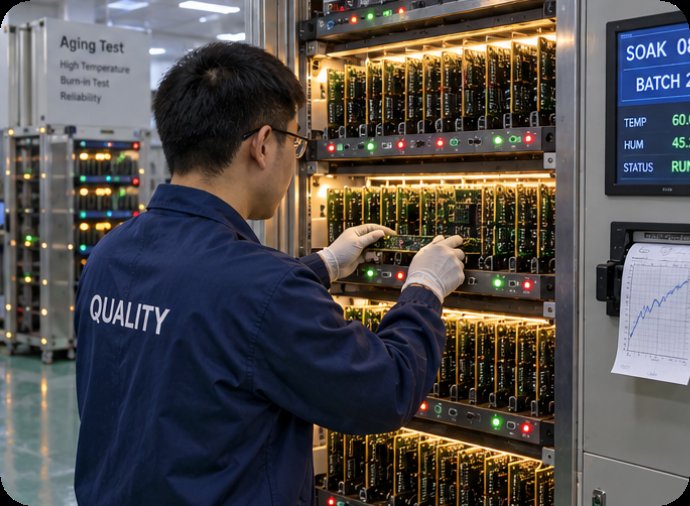
The faults that scare customers most are the ones that pass every bench test and fail in the field two months later. These are almost always marginal parts or marginal joints: a component drifting out of spec under temperature, a joint that conducts at room conditions and resists under load. This is the gap the soak exists to close. Loaded racks, elevated temperature, hours of powered operation — the soak stage compresses months of gentle field stress into a day or two of honest sieve. A unit that survives the soak with stable readings has been interrogated in a way a bench fixture cannot imitate. When a returned unit has no soak history, that absence is itself a finding: the fault class was never screened for.
The Escalation Sheet That Ends the Blame Loop
Every one of these investigations ends in the same place: a single page that states what was seen, where it came from, who owns the fix, and what evidence closed it. We keep the format deliberately plain.
| Failure seen at test | Most likely origin | Service that owns the fix | Evidence that settles it |
|---|---|---|---|
| Intermittent open after thermal cycling | Hole-wall crack in the bare board | PCB Fabrication | Cross-section photo of the via barrel |
| Bridging under a fine-pitch component | Stencil clog or paste volume drift | PCB Assembly (PCBA) | SPI map from the print step |
| Unit passes bench, drops out in soak | Marginal part or weak joint | Aging Test | Rack log with the failure timestamp |
| Field return with no fault found | Coverage gap in the test plan | Program review | FCT coverage list against the failure mode |
The value of the sheet is not administrative. It forces the investigation to end in one of four named homes, each backed by physical or logged evidence, and it stops the failure from being argued about twice.
What a Single Contract Changes
Run the same investigation across a fragmented supply chain and watch what happens to the evidence. The bare board lives with one vendor, the parts with another, the assembly with a third; the cross-sections and rack logs now travel between companies instead of between departments, and every handoff is a chance for the story to blur. Under one turnkey PCB assembly contract, the fab data, the component batch records and the soak history sit in the same building, and the escalation sheet gets filled in days instead of weeks. The difference shows up most clearly in industries where returns are expensive and documentation is audited. An automotive electronics PCBA program lives or dies on traceability of exactly this kind, and so does any industrial hardware range shipped with a warranty behind it.
Send Us the Unit That Came Back
If a board in your fleet is producing a failure nobody can pin down, send the unit and the test data rather than a description. We will run the sequence described above — fabrication signatures, joint-level evidence, soak history — and return the escalation sheet with the evidence attached. The same process stands behind every consumer electronics PCBA program we run, from prototype through mass production, ISO-certified lines, worldwide shipping and a dedicated project manager who owns the answer to your failure question.
Tags: turnkey PCB assembly troubleshooting / EMS failure analysis /
Prev: Aging Test, DIP Assembly and SMT Assembly: What the Line Maintains Between Orders