

Component Procurement, Shell Mold and EMS Electronic Manufacturing: The Crew Behind the Receiving Bay
Most factory tours stop at the SMT line, because placement machines make good video. What they skip is the row of desks between the loading dock and those machines, where a small crew decides whether the rest of the day even happens. Our view is simple: incoming quality is not a procedure you can laminate and post on a wall. It is a set of people, each holding one narrow authority, and the handoffs between them are what keep a bad reel of parts from becoming three hundred defective boards.
That is why we treat staffing as the first specification of our electronic component procurement solutions. Before a single part reaches the EMS Electronic Manufacturing floor, it passes through three desks, and nobody at those desks reports to the person whose schedule they might have to interrupt. Independence is the point. This article walks through a single receiving day, desk by desk, the way our crew actually lives it.
Why Three Desks Beat One Inspection Hero
The instinct at smaller contract manufacturers is to hire one experienced inspector and lean on their intuition for everything. It works until that person takes leave, until volumes double, or until a supplier quietly changes a die revision. We deliberately split the role. One desk receives and verifies paperwork against purchase orders. A second desk performs the physical and electrical sampling. A third follows suppliers back into their own processes when a pattern emerges. None of them can be replaced by the others, and none of them can quietly wave a doubtful lot through to keep the line running.
Desk One: Where Supplier Paperwork Meets the Part
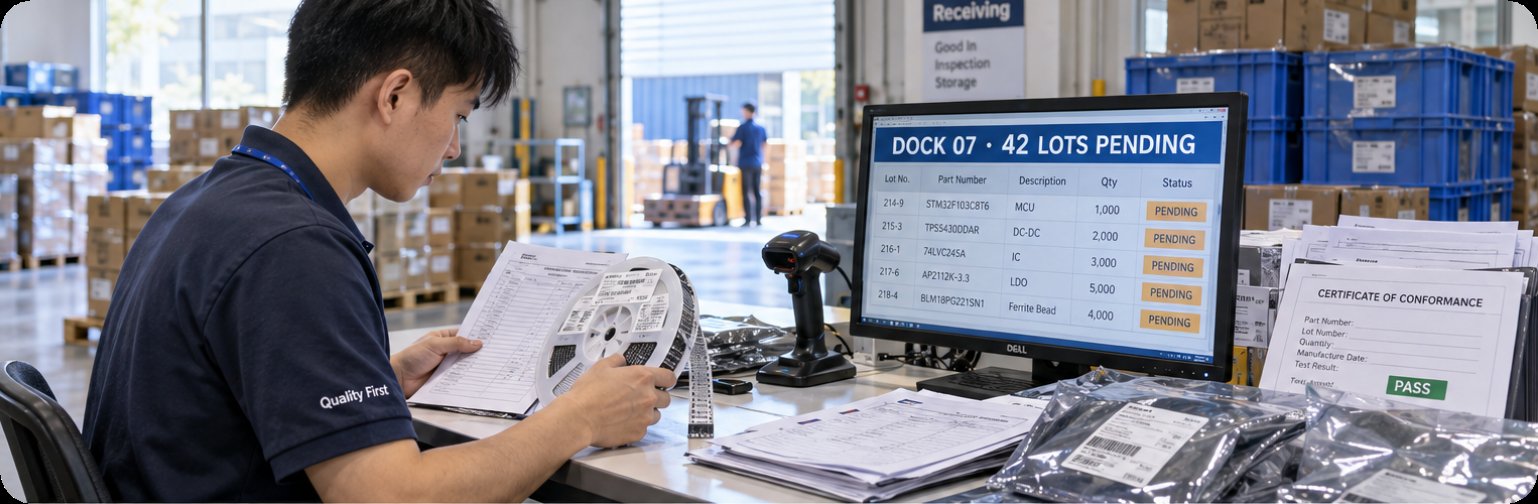
The first desk belongs to the receiving clerk. Their morning is a stack of waybills, certificates of conformance, date codes and moisture barrier bags, each reconciled line by line against the order. Anything unusual goes straight into quarantine, not onto a pending shelf. This desk also feeds the material traceability record that every later stage depends on, so a clerk who rushes here is borrowing time from the whole factory. It is unglamorous work, and we staff it with people who genuinely like order, because the discipline shows up weeks later when a field return needs its exact lot history.
Desk Two: Second Pair of Eyes on Every Lot
The second desk is sampling in the literal sense. The inspector pulls the plan for that part class, unpacks under ESD control, and measures what the drawing says to measure: coplanarity on fine-pitch devices, lead oxidation on passives, marking legibility, date codes against the customer's own allowable window. A bench magnifier settles most questions; anything that survives it goes to the microscope. The verdict is recorded, not remembered. When a verdict is a rejection, this desk writes the nonconformance report that Desk Three will carry into the supplier conversation, which is why the two roles stay separate: the person who found the problem should not also be the person negotiating how much of it to accept.

Desk Three: When Molded Surfaces Join the Queue
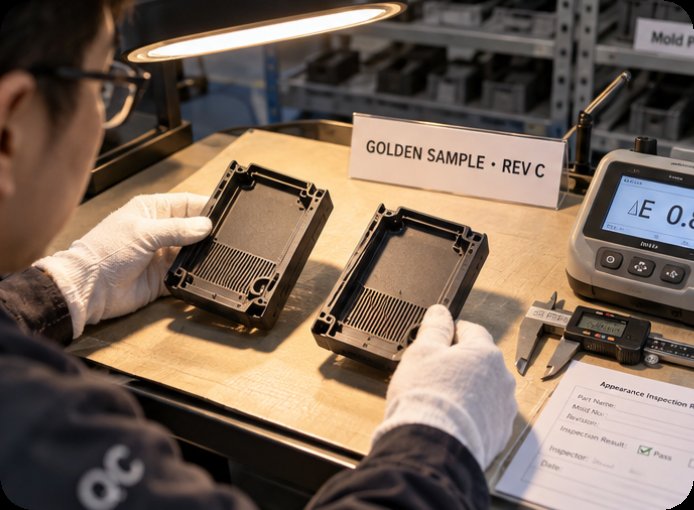
Not everything that arrives is electrical. Enclosures and bezels come in from our own Shell Mold tooling partners, and they fail differently: sink marks a gloss spec would catch, parting-line flash that will fight an assembly jig, color lots that drift between batches. The third desk covers these visually and dimensionally against the tool's sign-off samples. Because Product Assembly depends on housings that seat without force, a cosmetic judgment here is really a mechanical prediction. The auditor who staffs this desk also owns supplier scorecards, so a molding partner with two marginal lots in a quarter gets a visit, not just a flag in a spreadsheet.
The Training Matrix We Actually Keep
Job descriptions do not make inspectors; repetition and checked escalation do. Every desk has a training matrix: which part classes a person is signed off for, who verified the sign-off, and when it gets re-verified. New hires start on the most forgiving part classes with a senior shadowing them for a full month of live lots, and nobody signs a rejection alone in their first quarter. Cross-training between Desk One and Desk Two is encouraged, but the sign-off authorities stay separate even when the same person can fill both chairs. When a customer asks who touched their parts and what that person was qualified for, the matrix answers in one page.
A Table of Who Signs What, and When
| Station | Authority held | Decides during a shift | Escalates to |
|---|---|---|---|
| Receiving clerk | Accept or quarantine on paperwork | Waybill, cert and date-code reconciliation | Warehouse supervisor |
| Component inspector | Pass, reject or bounded concession | Physical and electrical sampling per plan | Quality engineer |
| Supplier-quality auditor | Supplier status and corrective actions | Molded parts, scorecards, follow-up visits | Purchasing manager |
The table is deliberately short. If a station's authority cannot be stated in one line, the role has drifted, and drift is how dual sign-offs and quiet concessions start.
When the Roster Meets Your Product Roadmap
This crew shape scales with what you are building. A run of FT-6200U-V1.0 thin client motherboards leans hard on Desk Two, because memory and networking silicon tolerate very little in the way of handling damage. A medical housing program leans on Desk Three, where surface finish and color consistency are contractual, not cosmetic. Prototypes built through our quick PCB sampling service exercise all three desks in miniature, which is exactly why we would rather meet a customer at prototype volume: the staffing model gets tuned on your real parts before mass production multiplies any weakness.
Leave and order surges are where staffing models usually break, so ours is written for them. When a desk is vacant, the chair sits empty rather than being covered by whoever is free that morning; sampled inspection waits an hour and the line start shifts, not the standard. During a surge we add a trained floater who has already held sign-off on that part class before, never a temp learning the checklist from a laminated sheet. Slower intake on a busy week costs far less than one unqualified pair of eyes approving a marginal lot at full speed.
Ask About the Desks, Not Just the Line
When you evaluate a manufacturing partner, walk past the placement machines and ask to see the receiving bay instead. Ask who staffs it, how long each person has held their authority, and what happens when they disagree with a schedule. If the answers sound like this article, your parts are in decent hands; if there is only one desk and one hero, expect your first quality escape to explain the rest. Bring us a BOM and a target build, and we will show you the roster that would receive it, desk by desk, before you commit a single panel.
Tags: incoming QC staffing / component procurement /
Prev: PCB Fabrication, Aging Test and PCB Assembly: Following One Failed Board Home
Next: No more...