
Aging Bench Numbers Before Shipping: What Custom Industrial PC PCBA ODM Work Must Prove on Test
My position after watching hundreds of batches leave this floor: a datasheet tells you what a board was designed to do, and only the aging bench tells you what it will keep doing. Buyers who compare quotations on unit price alone are comparing promises; buyers who ask for the aging records are comparing evidence. That difference shows up months later, in the field, as either a quiet product line or a warranty queue.
The Batch That Gets Numbers Before It Gets a Box
Last Tuesday the test area ran three boards side by side: an industrial PC motherboard heading into a factory automation retrofit, a smart home control PCB destined for a European lighting brand, and a consumer devices board for a handheld retail terminal. Three different products, three different risk profiles, one shared question from each customer: show me the numbers before we pay the balance.
That request has become normal, and honestly it should have been normal earlier. Consumer electronics PCBA work in particular used to ship on first-article approval alone, with reliability assumed. Now the same electronic devices solutions line that assembles a retail terminal also has to document how it behaves at hour 140 of a heat cycle, because the brand putting its name on the enclosure gets asked exactly that by retail chains. Evidence has moved from nice-to-have to purchase-order line.
Four Aging Profiles and When Each One Runs
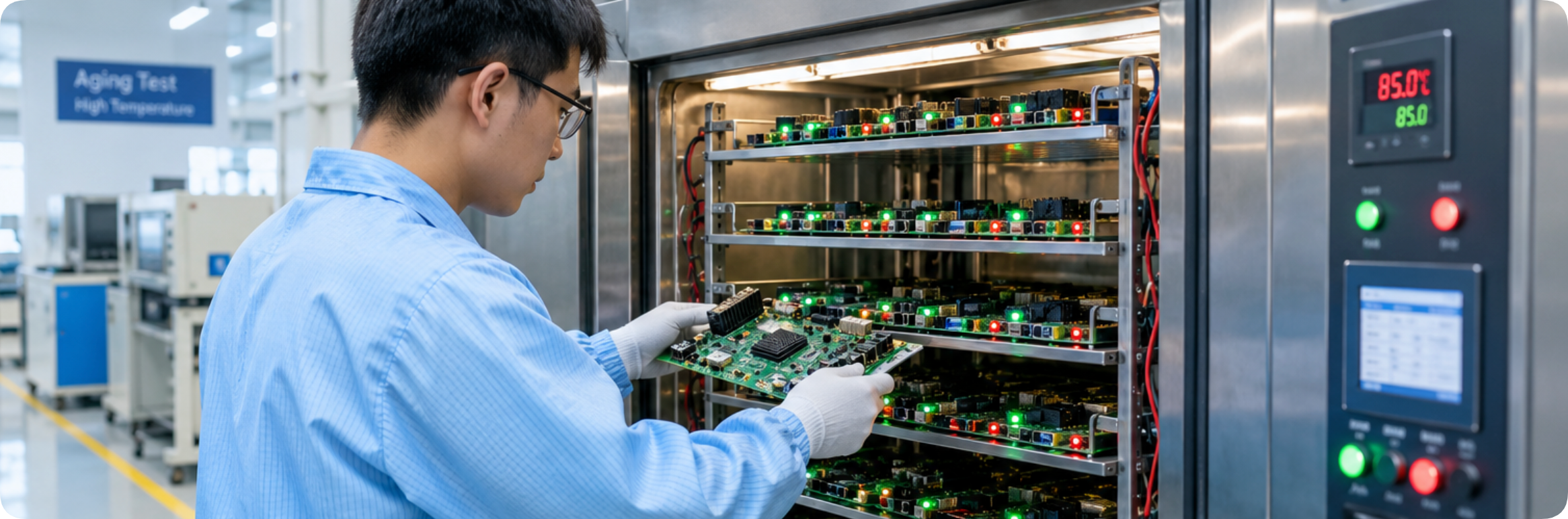
The bench does not run one test. It runs four, matched to how the product will actually live. Room-temperature aging runs the board under continuous normal operation and catches the defects that show up in ordinary use. High-temperature aging pushes the same operation into elevated heat, which accelerates whatever was waiting to fail and exposes marginal components faster than any inspection can. Low-temperature aging covers the opposite corner, the cold-start and cold-run behavior that indoor labs forget. And the alternating temperature-and-humidity profile cycles the board between conditions, which is the closest a bench gets to a product traveling between climates.
Each profile follows the same discipline: set the conditions from the product's real usage scenario, prepare a representative sample group, run the boards under monitored continuous operation, analyze the data when the clock stops, and feed what was learned back into the next production revision. The aging test process on our floor treats that feedback loop as the actual deliverable. A board that passes without teaching anyone anything was a wasted bench slot.
| Board on the bench | Profile assigned | Focus metric | Pass shape |
|---|---|---|---|
| Industrial PC motherboard | High-temperature endurance | Clock stability and thermal curve | Readings plateau through the final hours, never climb |
| Smart home control PCB | Room-temperature, full population | Standby draw at fixed intervals | Every unit's curve stays inside the population band |
| Consumer devices board | Alternating heat and humidity | Insulation readings per cycle | Coated boards hold a quantified margin over reference coupons |
High-Temperature Endurance on Industrial Builds
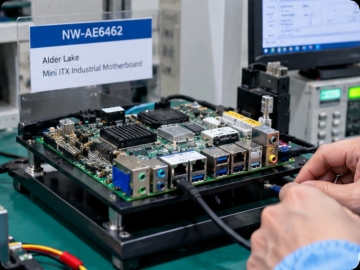
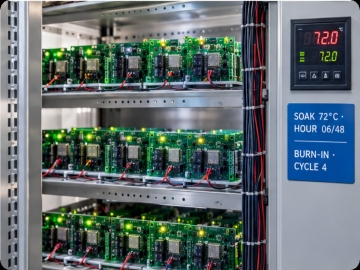
The industrial PC motherboard is the least forgiving customer on the bench, because its destination cabinet sits beside motors and drives that never cool down. Its high-temperature run is the longest of the three boards, powered at full load with every port exercised in rotation, and the pass criteria are stricter than wake-up-and-boot: stable clocks, no dropped frames on the capture interface, thermal readings that plateau instead of climbing. An industrial build that drifts at hour 160 will drift on a customer's wall at week nine, so the bench holds it until the curve flattens or the board explains itself.
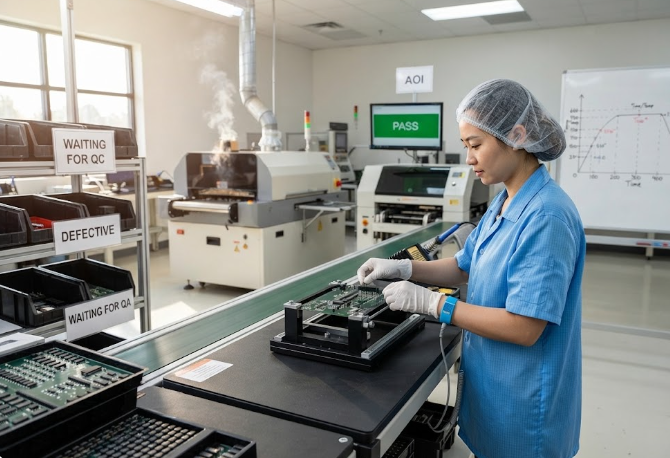
Assembly capability sets the ceiling for that run. The same Custom Industrial PC PCBA ODM line places and reflows boards with BGA spacing down to 0.2 mm and handles components up to 50 by 50 by 15 millimetres on single- or double-sided assemblies, which means the parts most likely to fail hot are placed under a process that can actually resolve them. Fine-pitch work and endurance testing are not separate topics. The tighter the board, the more the aging data matters, because there is less physical margin hiding a marginal joint.

Smart Home PCB: The Quiet Numbers Buyers Skip
The smart home control board never leaves the climate of a living room, so buyers assume the bench is a formality for it. The opposite is true. This product class lives or dies on the boring numbers: standby draw after the latest firmware boot, radio behavior on the edge of range, and the reconnect time after a router reboots at three in the morning. Room-temperature aging is where those surfaces show. A control PCB that warms two degrees more than its siblings on the rack is drawing current from somewhere it should not, and that somewhere becomes a returned product in a season.
For the smart home programme the sample group is wider, not narrower, because the Custom Smart Home Products PCB volume runs in tens of thousands and the cost of a systemic issue compounds per thousand units. The bench keeps every board powered through the full run instead of sampling a few, logs the draw at fixed intervals, and flags any unit whose curve departs from the population. Outliers get dissected, not just rejected. The point of the exercise is a finding the customer can read in one paragraph.
Heat and Humidity Cycling for Consumer Devices
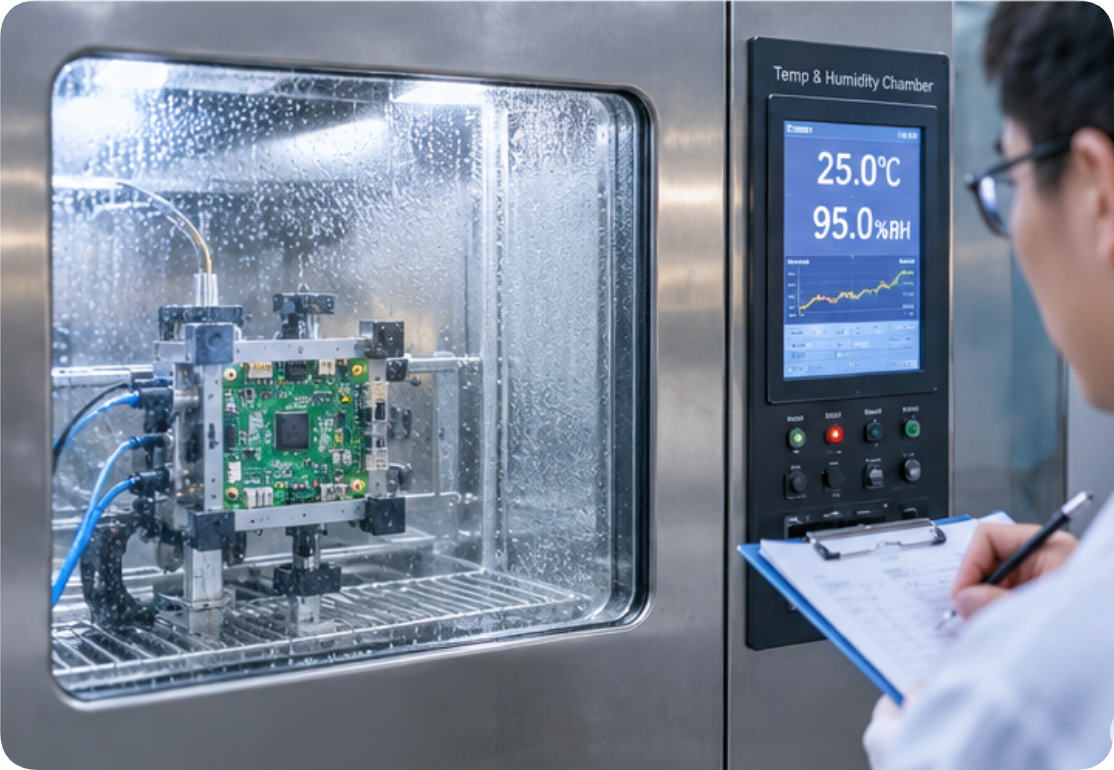
The consumer board gets the profile that most resembles real life at its worst: alternating temperature and humidity, where condensation cycles attack the assembly the way a monsoon shipment or a bathroom installation would. Boards for handheld terminals and personal devices travel through warehouses, cars, and pockets, and the alternating profile finds what constant conditions never will. Moisture-sensitive components that were dried and bagged correctly during our electronics manufacturing services intake stay sealed and behaving; a batch that sat too long before placement shows itself here, on the record, before it shows up in a customer's returns report.
Cycling is also the fairest test of the three-proofing decision. Boards that go through conformal coating come out of the humidity phases with insulation readings that uncoated reference coupons cannot match, and that contrast is quantified, not described adjectivally. When a customer asks whether coating is worth the adder for their device, the answer we hand over is the delta from this exact test, measured on their board, not a generic brochure claim about reliability.
Reading the Report the Way Production Does
A test report earns its keep when production can act on it. The format we settle on is deliberately plain: condition, duration, sample size, pass criteria stated before the run, then the raw curves with only the outliers annotated. Every engineering team reads the criteria first. A run without pre-stated criteria is an anecdote, and anecdotes do not survive a customer's quality department.
The second thing a good report carries is what changed. If hour 90 exposed a marginal oscillator and the fix was a second-source component, the report says so, and the next batch's run references the change. That chain from finding to revision to re-test is what separates a factory that measures from a factory that merely owns equipment. It is also why the reliability conversation belongs in the quotation stage, not after the first failure, and why our PCB manufacturing capabilities discussion starts with how the board will be verified rather than how fast it can be sampled.
What These Results Change in the Next Quotation
Numbers move money in both directions. A clean high-temperature run justifies a tighter enclosure design downstream, because the thermal data says the cabinet needs less headroom. A wide spread in standby draw across the smart home sample group sends engineering back to the power tree before the customer commits to tooling. And the humidity delta quantifies the conformal coating decision instead of leaving it to taste. None of these outcomes is available from a first article alone.
The pattern across all three boards last week was consistent with what the bench teaches every quarter: the failures that reach customers are almost never exotic. They are marginal joints, tired lots, and unsealed paths, and every one of them leaves a fingerprint on the aging record before shipment. Paying for bench time is cheaper than paying for recall logistics, and the quotation that includes verification hours is usually the honest one.
Frequently Asked Questions
1. How long does an aging run take before the numbers mean anything?
It depends on the profile and the product's duty cycle. Room-temperature runs for consumer-class boards typically extend across several days of continuous powered operation, high-temperature runs compress that timeline by accelerating wear, and cycling profiles are bounded by the number of heat-humidity transitions rather than a single clock. The duration is set from the product's real usage scenario at the start, never chosen to fit a schedule.
2. Will you share the raw test data with the customer?
Yes. The report includes the pre-stated pass criteria, sample size, conditions, and the logged curves with outliers annotated. Customers' quality teams get the same record production sees, because the criteria were agreed before the boards went on the bench and nothing in the report is summarized past the point of usefulness.
3. What happens when a board fails partway through the run?
The unit is pulled, the failure is documented with its timestamp and conditions, and the population continues so the run still produces valid data for the survivors. The failed board goes to failure analysis, the finding feeds a process or component revision, and the affected batch is re-represented on the bench after the fix. A failure on the bench is the process working, not the process failing.
4. Do all three product lines share the same bench and the same standards?
The equipment and the discipline are shared; the profiles are not. An industrial PC build gets the longest high-temperature endurance because its operating environment demands it, a smart home board gets a wide-sample room-temperature run focused on draw and radio behavior, and a consumer device gets the alternating climate profile. Same floor, same reporting format, conditions matched to how each product will actually be used.
Tags: smart home PCB / industrial PC PCBA /PCBA aging test / consumer electronics PCBA /
Next: No more...