
DIP Assembly, PCBA Three-Proofing Paint and Aging Test: The Compliance Chain Behind an Industrial Motherboard
DIP Assembly, PCBA Three-Proofing Paint and Aging Test: The Compliance Chain Behind an Industrial Motherboard
The first question a buyer usually asks an industrial motherboard supplier is whether the factory holds ISO 9001. It is a fair question and almost never the right one. A certificate describes a system; it says nothing about whether the profile on this week's reflow oven was logged at four in the afternoon, or whether the coating under a connector body was ever looked at. Compliance in industrial computing PCBA is not a document. It is a chain of evidence that has to hold at every stage between the bare board and the shipping carton.
Three services sit at different points on that chain, and each one fails in a different way. Through-hole work fails quietly, through a mixed board or a reversed part nobody saw. Coating fails invisibly, under a component that never got covered. Reliability screening fails late, in the customer's cabinet rather than on the line. Knowing where each stage is checked, and what proof survives the job, is what separates a quotation you can defend from one you merely hope is right.
A Certificate Is Not a Process
System certifications are worth having. Newei operates under ISO 9001, ISO 14001 and IATF 16949, and holds membership of IPC. What those documents establish is that a repeatable process exists and that somebody audits it. What they cannot establish is the state of any particular lot. Teams sourcing industrial pc solutions for a long-lived deployment need both: the system behind the factory, and the records behind the boards.
The practical consequence is that compliance work has to be planned into a project rather than appended to it. A standard chosen after the boards are built cannot be met retroactively; it can only be waived. That is why the specification conversation belongs in the enquiry, not in the quality report.
Our view: a compliance claim should always be traceable to a record somebody else can read. If a stage cannot produce a document, treat it as unverified, whatever the certificate on the wall says.
Class 2 or Class 3: Decide Before the Quote
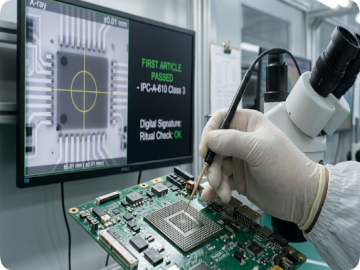
IPC-A-610E sorts electronic assemblies into acceptance classes. Class 2 covers dedicated service products, where continued function is expected and minor imperfection is tolerated within limits. Class 3 covers high-reliability products where uninterrupted service matters and the assembly must keep working in the environment it was built for. Most control boards are quoted to Class 2. Rail signalling, medical and energy-monitoring programmes frequently push to Class 3.
The classification is not a label added at the end. It changes inspection frequency, solder-joint acceptance limits and rework rules. A board that fails a Class 3 joint criterion is not simply reworked; the rework itself has to be recorded and re-inspected. Choosing the class after the quotation means choosing it after those costs are already locked in.
What Incoming Inspection Can and Cannot Prove
Everything arriving at the plant is verified before it is used. Bare boards supplied to the factory undergo 100% electrical testing, and components are placed on a bare board for a solder-pad and through-hole fit trial before the first panel is committed. Incoming boards go through a reflow pass purely to check for yellowing or deformation, and stencils are laser-cut to the design rather than adapted from a library.
That work proves the parts are new, compatible and dimensionally sound. It does not prove they will survive ten years in a cabinet. No amount of incoming inspection answers a reliability question, which is why it sits early in the chain and never closes it.
Keeping the Soldering Profile Honest
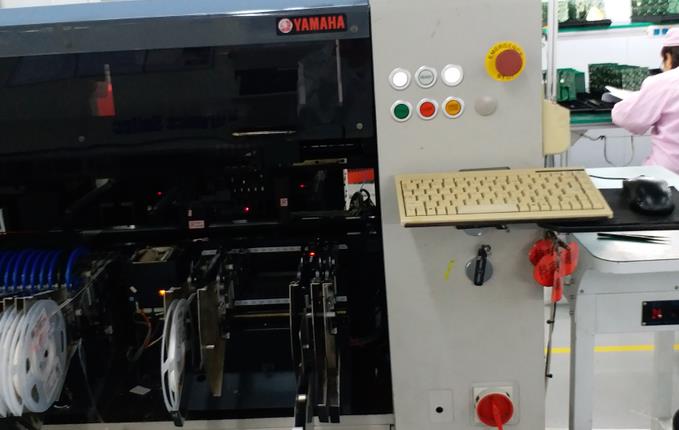
Process control on the line is deliberately boring. A profile meter checks the reflow oven every four hours and the readings are recorded, so drift is caught while it is still a number rather than a defect. AOI equipment screens each batch for wrong parts, missing parts, reversed parts and virtual joints.
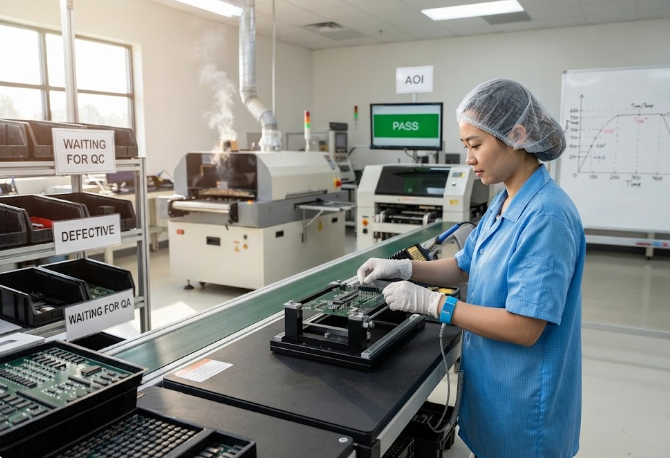
The through-hole stage is where discipline matters most, because it carries more manual work than surface mount and therefore more chances for a board to be misplaced. Our DIP assembly area runs four plug-in lines with plug-in AOI for component and joint inspection, four wave-soldering units and fifty-six rear-welding stations, backed by four washing machines. Operators are trained for speed and consistency, and boards move through separate, clearly marked holding areas for waiting-to-plug, waiting-for-repair, waiting-for-QC, defective and waiting-for-QA, so a mixed lot cannot happen quietly. Strict IPQC and QA lot sampling close the stage.
Coating Specified for the Environment It Will Meet
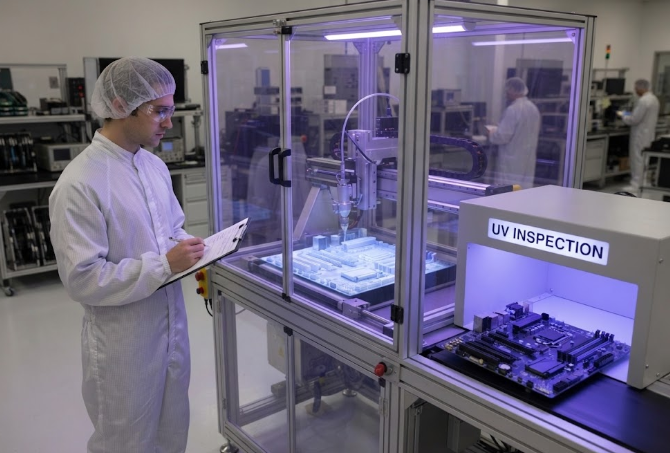
Conformal coating is where a specification either becomes measurable or becomes a slogan. A coating line that includes two spray units, UV inspection and baking in one automated sequence can verify its own coverage, because the UV pass shows where material actually landed. Our PCBA three-proofing paint service exists for boards that will meet temperature swings, humidity, dust, insulation stress or corrosion.
Once cured, the film is transparent and works by exclusion. Insulation, moisture resistance, leakage resistance, impact resistance, dust prevention, corrosion resistance, ageing resistance and corona resistance all come from full coverage rather than from extra thickness in one place. Connectors, test points and press-fit areas are masked for a reason, and those masks belong in the drawing that accompanies the order.
Reliability Data Instead of Reassurance
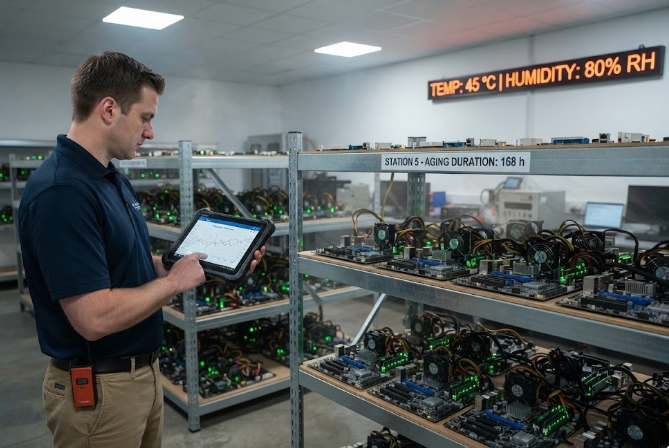
Screening is the only stage that produces evidence rather than intent. Boards are placed under defined temperature and humidity conditions and run continuously for between 72 hours and seven days, with occasional on-off impact cycling, while performance is logged. Failures found this way are analysed back into the process rather than simply scrapped, and the same facility can extend the programme to drop, vibration and salt-spray work when the deployment calls for it.
An aging test result is a data sheet with a date on it. That is a different class of evidence from a statement that a product is reliable, and it is the form most procurement teams actually need when a project is audited a year later.
Records a Customer Can Reconstruct
Read as a chain rather than a list, the stages above produce something a customer can rebuild without asking the factory to explain itself.
| Stage | Reference point | Factory action | Evidence retained |
|---|---|---|---|
| Design release | Acceptance class agreed in writing | DFM review and new-product introduction meeting | Class declaration, DFM report |
| Incoming goods | 100% electrical test on bare boards | IQC, pad fit trial, reflow deformation check | IQC log, test records |
| Soldering | Profile logged every four hours | AOI, plug-in AOI, wave soldering, IPQC and QA sampling | Profile charts, AOI reports |
| Protection | Coverage verified, not assumed | Automated spray, UV inspection, baking | UV coverage images, thickness record |
| Screening | 72 hours to seven days per customer spec | Aging test with continuous performance logging | Aging logs, failure analysis |
| System | ISO 9001, ISO 14001, IATF 16949, IPC member | PDCA improvement, programme burning and functional test plan | Certificates, audit trail |
The table is only useful if it maps onto a real board. Take a FPA-N10A2E Intel Alder Lake-N motherboard headed for a fanless edge cabinet. Its low power envelope is a design decision, but its compliance position is a set of records: the class it was built to, the profile it was soldered under, and the screening data showing it ran for a week before it shipped.
Who Signs Off, and What They Sign
Ownership is the part of a compliance programme that no certificate describes. New-product introduction meetings bring sales, engineering, production, procurement and quality into the same room to assess process difficulty and identify the control points that matter for that product. Programme burning and functional testing are planned against the actual chipset, and test fixtures are issued by engineering rather than improvised on the line. Underneath all of it sits PDCA improvement, the mechanism that turns a corrected defect into a changed procedure.
In practice this is what a plant-wide standard buys. Automation cells running motion control, vision systems and gateways that stay powered for years. Signage and self-service terminals that must survive dust and cleaning fluid. Medical and energy-monitoring boards where a single interruption is not an option. A factory building our electronics manufacturing services under one compliance chain can serve all of them from the same records.
The simplest improvement most buyers can make is to write the standard into the enquiry: the acceptance class, the coating requirement, the screening duration and the records they expect to receive. Ask for it at quotation and it is a line item. Ask for it after delivery and it is a negotiation.
Tags: DIP assembly / three-proofing paint / industrial motherboard /
Next: No more...