
PCB Fabrication, Aging Test and EMS Electronic Manufacturing: Where Compliance Is Really Decided
My view up front: the compliance failures that hurt a contract electronics programme rarely start at the soldering machine. They start three handoffs earlier, on a loading dock or in a supplier file nobody has opened in two years. Buyers spend their audit budget on the production floor, then find the root cause was a reel of parts that was never really anyone's responsibility.
The short version: a component is only as traceable as the weakest handoff it survives. Supplier approval, receiving, inspection and storage each destroy different evidence when done badly, and fixing one of the four leaves you with a clean file and the same field failure.
Before production, a part passes through four windows of custody. In each one somebody owns it, a standard says what must happen to it, and a record is meant to survive.
| Window | Custody | Governing standard | Record worth demanding |
|---|---|---|---|
| Supplier approval | Buying and supplier quality | ISO 9001 clause 8.4, externally provided processes | Vendor list entry, sample recognition report, signed specification |
| Receiving at the dock | Warehouse | J-STD-033 handling, ANSI/ESD S20.20 static control | Log with lot code, date code, sensitivity level, seal condition |
| Incoming inspection | IQC laboratory | ISO 2859-1 sampling, IPC-A-610 acceptance criteria | Sampling plan, measured values, non-conformance and disposition |
| Storage and release | Warehouse and line supervisor | J-STD-033 floor life, ANSI/ESD S20.20 | Dry-pack reseal log, floor-life clock, kitting verification |
Why the Lowest Quote Always Skips Supplier Approval
The first window is the easiest to cut because it produces nothing you can photograph. Auditing a supplier, recognising samples and signing off specifications all cost engineering hours before any order is placed, and a quotation that skips the work is genuinely cheaper, for a reason you discover eighteen months later.
Recognising a sample means running a part through the checks the production lot will face, then freezing that specification so future deliveries are judged against it rather than against memory. Without one, every incoming lot is compared to whatever the last accepted lot looked like, and drift becomes invisible. What slips through is consistent: reclaimed parts sold as new, contradicting date codes, and second-source substitutions nobody characterised. A buyer running an electronic component procurement programme through a partner with a real supply chain system gets those audits as part of purchasing, not as a favour.
The Dock Is Not a Shelf
Receiving is where good compliance data goes to die. A lot can arrive flawless and still be spoiled by four hours on a concrete apron in a humid month. The physical checks are unglamorous: barrier bag seals, the humidity indicator card inside, the sensitivity level marking, the date code against the purchase order, and whether the shielding bag is intact rather than punctured and taped over.
What is scarce is not the checking but the logging. A record capturing lot code, date code, sensitivity level and seal condition on one line turns a later field failure into a ten-minute lookup. The same record rebuilt from memory is worth nothing, and that is what most buyers end up with.
A Sampling Plan Is Only as Good as the Bench Behind It
Every factory claims incoming inspection. Far fewer can show which sampling plan was applied to which family of parts, or a calibration certificate for the instrument behind the numbers.
A working mechanism does four things. It applies a defined sampling standard to core components instead of eyeballing a carton. It measures what predicts failure: value and tolerance for passives, plating and insertion for connectors, decoded marking rather than the label for semiconductors. It keeps a laboratory able to run those measurements. And it writes a disposition alongside the non-conformance, because the point of inspection is the decision that follows.
Moisture and Static Do Not Announce Themselves
These two hazards sit in the fourth window, and in most factories nobody owns them. Moisture sensitivity is a clock, not a condition. Once a dry-packed part leaves its bag a floor life begins, pausing only when it is resealed with desiccant or baked on the schedule for its sensitivity level. A reel opened on Monday and fed on Friday has spent its budget, and the damage appears as internal cracking after reflow rather than anything visible at inspection.
Static control is the same invisible discipline. Wrist straps never tested, ionisers never cleaned and storage humidity that is whatever the weather provides all pass a visual audit. The real test is whether that environment is specified, monitored and recorded, and whether the people handling parts can name the sensitivity level in their hands without looking it up.
Bare Boards Come With Their Own Paper Trail
The circuit board is a purchased component too, and a capable fabricator publishes process limits rather than adjectives. Those limits tell you whether a design sits inside the house capability or outside it, which is why layer count, minimum line width, aspect ratio, copper weight and panel size matter more than any claim about quality.
Capability at the top of the range reaches forty-layer builds, eight millimetre finished thickness with a four-tenths minimum, a fourteen-to-one thickness-to-diameter ratio, ten-ounce copper and panels up to 2000 by 610 millimetres, with three-mil line width and spacing available for dense designs. Blind and buried vias, resin plug holes, gold fingers and laser drilling all fall inside the envelope, and quality systems covering ISO 9001, ISO 13485 and IATF 16949 mean the same records exist for a medical build as for an automotive one.
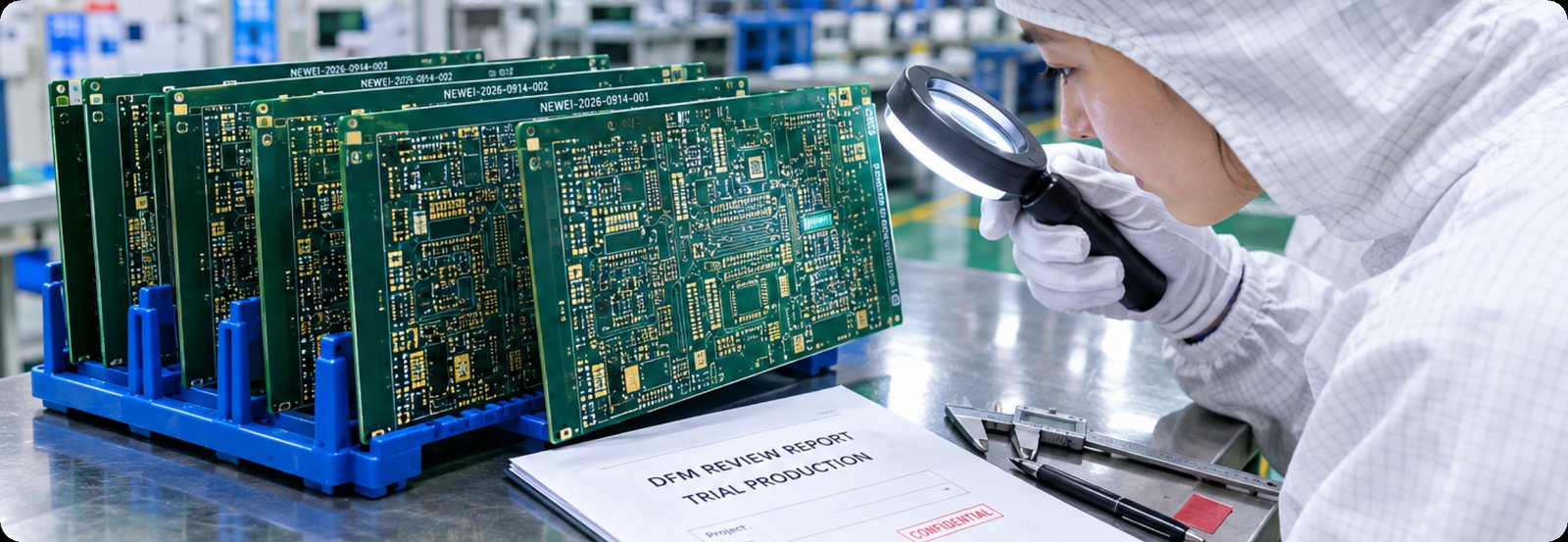
The artifact most buyers forget to request is the trial production report. A fabricator running rapid sampling should return a design-for-manufacture review with the boards, listing what the artwork failed to account for. It costs nothing extra and it is the most useful document in the first-window file. Programmes that specify a twenty-four-hour turnaround and insist on it get quick sampling of PCB circuit boards that generates knowledge rather than only hardware.
Burning In What a Sample Cannot Show
Inspection is a verdict on a moment: it can tell you a lot met specification on the day it was tested, but not how that lot behaves after two hundred thermal cycles, or which units hide an early failure. That needs time under controlled conditions.
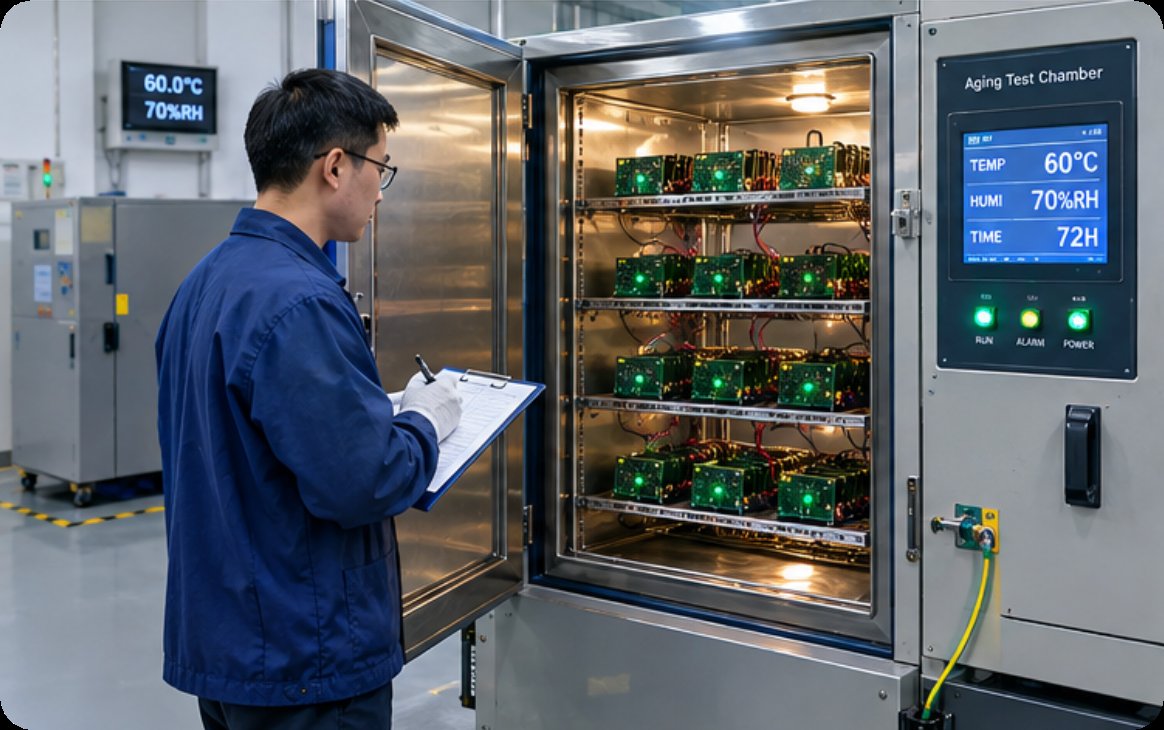
A proper programme defines a temperature and humidity profile and keeps the product running, recording performance throughout. Durations in real builds run from seventy-two hours to a full week, matched to the product rather than the calendar: a transport camera board held at sixty degrees Celsius and seventy percent relative humidity for seventy-two hours, a glucose meter assembly through five hundred simulated measurement cycles at room temperature. The value is not the pass stamp but the early failure screening, and the failures that point back at a process step, which is why our aging test services describe a profile in hours and degrees instead of offering reassurance.
One Partner, One Set of Records
The four windows stay sealed only if records survive the transitions between them. Split a programme across a purchasing agent, a fabricator and an assembly house and there is a seam where a document is lost, which is exactly where a field failure investigation stalls. Consolidation is not a discount strategy; it is a records strategy.
| Service | Where it sits | Compliance evidence produced |
|---|---|---|
| PCB Fabrication | Bare board, before any component is placed | Process limit sheet, material declaration, design-for-manufacture review |
| Aging Test | Finished assembly, after functional verification | Profile in hours and degrees, performance data, failure analysis feeding a process change |
| EMS Electronic Manufacturing | Whole chain, design to finished goods | Lot genealogy across purchasing, fabrication, surface mount, testing and assembly under one quality function |
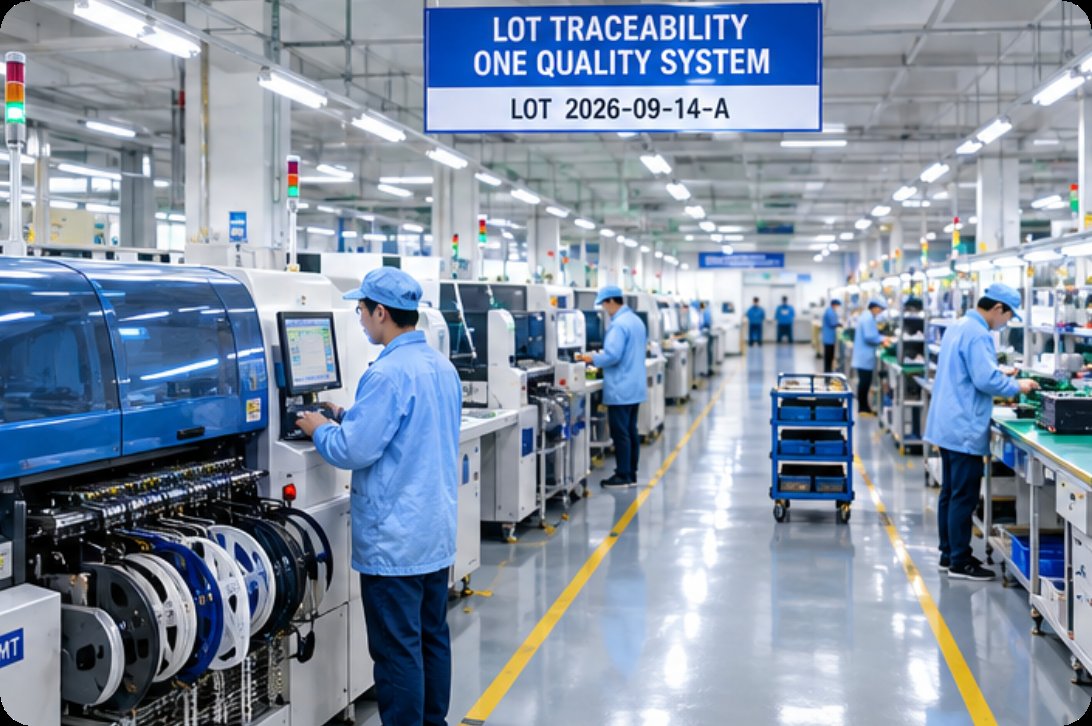
A one-stop flow covers design support, component purchasing, bare board production, surface mount, through-hole insertion, testing, conformal coating, assembly and screening, with critical operations kept in house rather than brokered out. Through-hole boards, flexible circuits, high-density interconnect and carbon film boards all run on the same floor, with monthly capacity around fifty thousand square metres and systems registered to TS 16949 and UL. When inspection, fabrication, screening and assembly report into one quality function, a non-conformance found at the bench is visible the same day to whoever controls the process behind it. Running the chain through our electronics manufacturing services makes "where did this lot come from" one query instead of three emails.
What to Put in the Enquiry
Most compliance problems are cheaper to prevent at quotation than to argue about after delivery, so write the requirements into the enquiry and let them become priced line items: the acceptance class and sampling standard you expect, the handling and storage conditions for sensitive parts, the duration and profile of any screening, and the records you expect with each shipment.
Add one more, a named contact for quality rather than sales, because asking for that person before the first order reveals how the supplier is organised. Partners keeping SMT assembly, testing and final build under one roof find the question easy, and their answer arrives as evidence rather than reassurance. Compliance is decided long before the first board reaches the machine, so decide it at the enquiry and let the four custody windows close themselves.
Tags: traceability / EMS electronic manufacturing / IQC /
Next: No more...