
From FQC to Global Dispatch: How NEWEI’s Final Quality Control, ESD‑Safe Packaging & FIFO Warehouse Protect 10k‑Unit Mini PC Deliveries
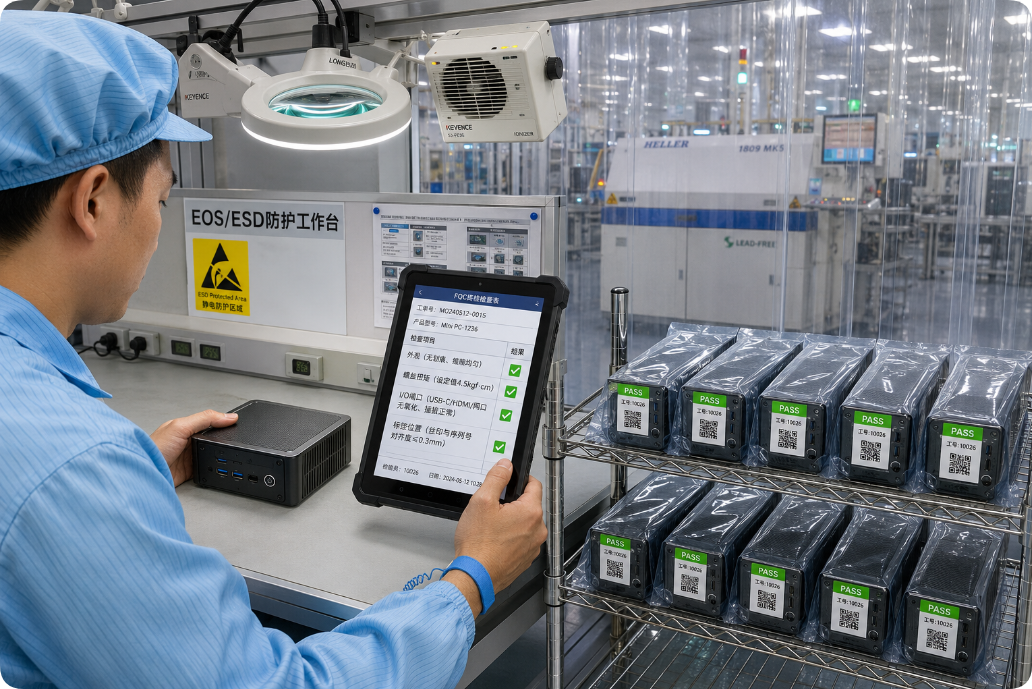
Fig 1 – NEWEI FQC station: Final visual and functional verification of industrial mini PC hardware before electrostatic‑safe packaging
Industry Insights from the Factory Floor:
Too many electronics brands focus entirely on SMT line speed and functional testing, only to suffer costly field failures caused by poor handling during the final stages of manufacturing. A double-sided motherboard that aces circuit testing can still be rendered useless by improper electrostatic discharge (ESD) wrapping, unmonitored warehouse humidity levels, or unorganized outbound shipping routines. For a high-volume 10k‑unit mini PC order, the line between hitting your market launch window and absorbing a multi-week delay comes down to logistics execution. This technical breakdown explains our strict Final Quality Control (FQC) checkups, automated ESD‑safe vacuum sealing, FIFO-driven warehouse management, and expedited order distribution systems—the vital steps that protect your product hardware from production line to target destination.
From FQC to Global Dispatch: How NEWEI’s Final Quality Control, ESD‑Safe Packaging & FIFO Warehouse Protect 10k‑Unit Mini PC Deliveries
By NEWEI Industrial · Updated: May 2026 · Technical Logistics Insight
The global small-form-factor computing market is expanding rapidly, with projections placing the mini PC sector at $7.23 billion by 2032, reflecting an 11.5% CAGR. This growth is propelled by an enterprise shift toward fanless industrial systems, smart classroom hardware, and edge AI processing nodes. However, when managing a 10,000‑unit mini PC delivery schedule, high-yield assembly is only half the battle. True product reliability is secured during post-production routing: Final Quality Control (FQC), ESD-safe vacuum sealing, First-In, First-Out (FIFO) warehousing, and container logistics.
Missing a single enclosure screw, neglecting an ESD ground strap, or allowing a brief moisture spike in inventory can turn an premium production run into an expensive hardware recall. For global tech buyers who count on precision Custom PCB Assembly Services, working with an ODM partner who treats protective packaging as an exact engineering discipline is essential. Below is an inside look at how NEWEI safeguards high-value electronics shipments while guaranteeing on-time arrival metrics.
📦 1. Final Quality Control (FQC) – The Essential Human Inspection Layer
Once a completed mini PC clears In-Circuit Testing (ICT) and Functional Testing (FCT), it moves directly to our dedicated FQC station (Fig. 1). While automated optical systems excel at tracking solder joint tolerances, human-guided FQC protocols isolate minor cosmetic defects, tactile irregularities, and physical structural anomalies that automated cameras frequently miss. Our FQC technicians follow an interactive digital assembly checklist hosted on industrial rugged tablets, inspecting every unit across several key checkpoints:
- Enclosure Integrity & Seating: Verifying tight seam tolerances, checking for surface blemishes, and measuring exact screw torque specs via calibrated electric drivers.
- Interface Hardware Verification: Checking alignment of USB Type-C, HDMI, and dual Gigabit Ethernet ports to prevent internal PCB stress during peripheral connection.
- Component Auditing: Confirming laser-etched serial numbers, regulatory compliance badges, and custom customer branding stickers match master design layouts.
- 30-Second Hardware Boot Check: Executing a quick power-cycle boot directly into the BIOS framework to verify RAM capacity detection, internal storage interface visibility, and active cooling fan RPM profiles.
Every single failure discovered during this final audit is instantly logged into our Manufacturing Execution System (MES). The unit is tagged and routed via a secure lane back to diagnostic repair, ensuring tracking transparency. On a recent 10,000-unit enterprise mini PC order, our factory-floor FQC team reached a 99.2% first-pass yield, with all minor tracking or cosmetic issues fully resolved within a 24-hour window.
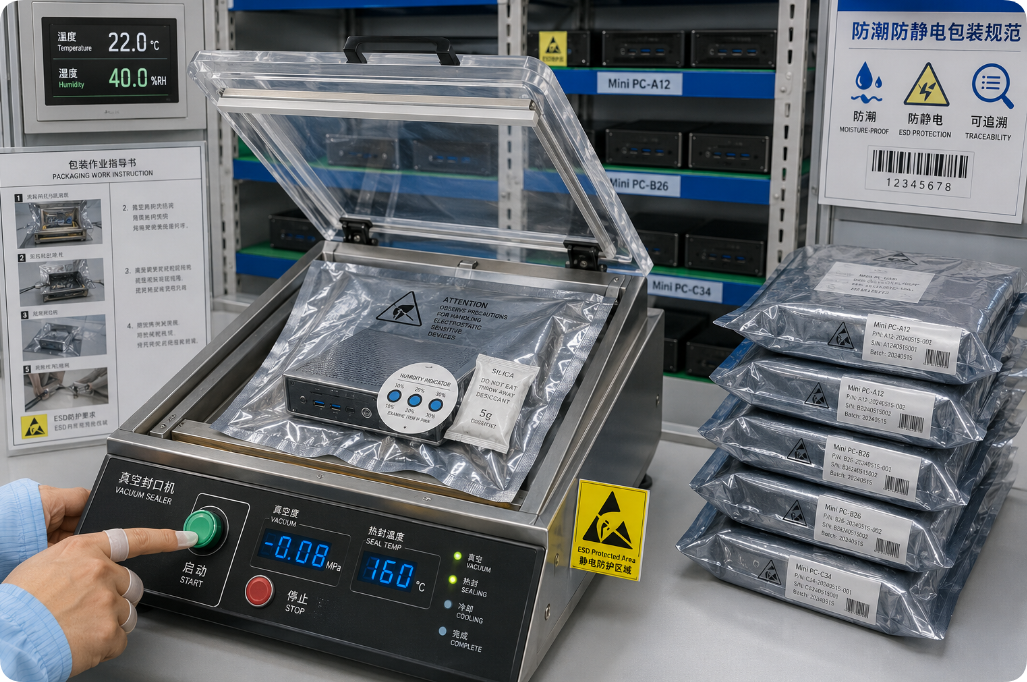
Fig 2 – Automated ESD‑safe vacuum sealing line: Moisture‑barrier bags with humidity indicator cards and desiccant packs
🛡️ 2. ESD-Safe Vacuum Packing & Controlled Storage – Eliminating Moisture Risk
Immediately following FQC clearance, units pass directly to our integrated ESD-safe vacuum sealing line (Fig. 2). Long-distance maritime shipping introduces significant environmental challenges, including rapid ambient humidity fluctuations and salty air exposure. To isolate the hardware from these factors, we pack each computer using multi-layered Moisture Barrier Bags (MBB) certified under MIL-PRF-81705 regulations, yielding a Water Vapor Transmission Rate (WVTR) below 0.02 g/m²/day.
Our systematic sealing method contains multiple levels of protection:
- Active Desiccant Inclusion: A 5g active silica-gel packet is placed inside to absorb any residual ambient air moisture trapped inside the container before sealing.
- Relative Humidity Verification Cards: A high-contrast relative humidity indicator card is included, giving end-destination receiving teams immediate visual confirmation of internal environmental safety.
- Traceable Data Labeling: Sealed barrier enclosures receive a unique product tracking barcode that links the unit back to its original raw material lot numbers, SMT line profiles, and testing history.
Packed boxes are moved directly into our climate-controlled finished goods facility. This warehouse maintains a strict floor resistance threshold below 1×10⁹ ohms, ambient temperatures regulated to 22±3°C, and relative humidity bounded strictly between 30% and 60% RH. We apply a rigorous First-In, First-Out (FIFO) stock rotation strategy via our automated Warehouse Management System (WMS). Assisted by localized RFID asset tracking, our logistics team can pinpoint and pull any targeted product pallet from the warehouse floor in under 30 seconds.
🚚 3. Bulk Order Dispatch & Rush Turnaround Workflows – Meeting Hard Deadlines
Staging a 10,000-unit PC hardware delivery demands precise, step-by-step supply chain synchronization. Our outbound verification program kicks off 48 hours before container loading. The WMS generates an automated picking manifest aligned with our FIFO timeline rules. Workers scan individual exterior codes to confirm that the serial numbers exactly match the destination customs paperwork. Items are nested securely in pre-molded, static-dissipative Expanded Polyethylene (EPE) foam enclosures, packed into double-wall heavy corrugated cartons, outfitted with structural corner edge shields, and bound to export pallets using heavy-duty plastic strapping. Every outgoing pallet receives an active GPS-tracked telemetry tag, granting customers real-time updates on location coordinates and transit conditions.
For urgent supply requests—such as a surprise demand spike requiring 1,000 finished mini PCs delivered to a port inside 72 hours—NEWEI utilizes a designated fast-lane production workflow. When active, our MES dynamically re-allocates an isolated packaging cell, giving that order top priority from the FQC check phase down through the final vacuum heat-sealing process.
Over the past calendar year, our production facilities have successfully executed 12 high-priority emergency orders exceeding 5,000 units each, cutting standard factory turnaround times by an average of 35%. This structured agility allows us to sustain an on-time delivery (OTD) rate of 98.9% for rush shipments and a 99.7% OTD rate for standard scheduled bulk contracts.
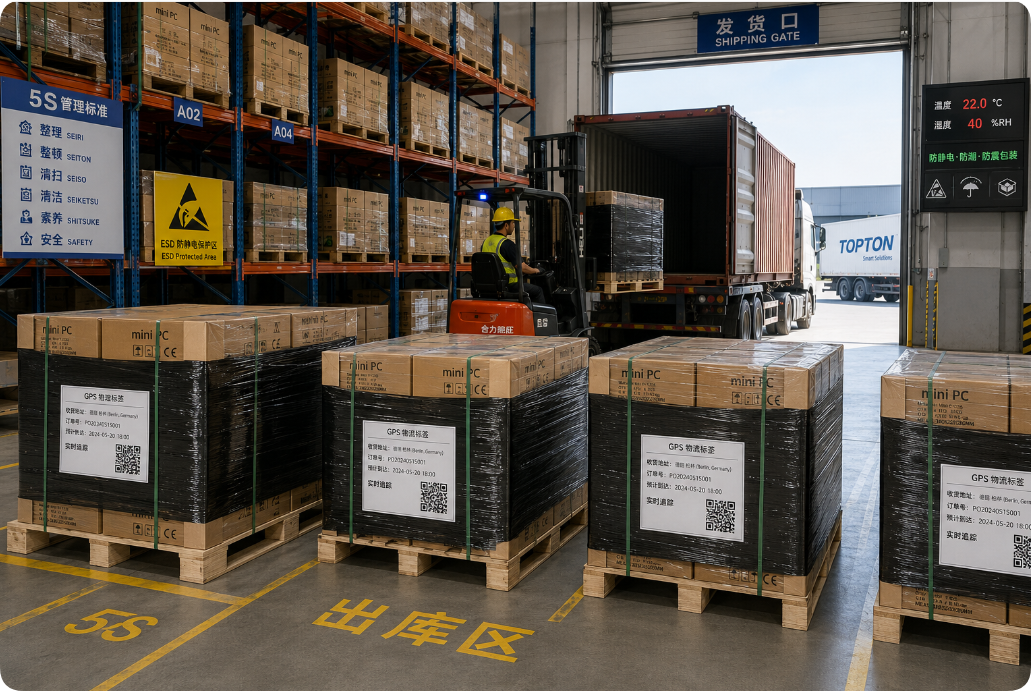
Fig 3 – Ready‑to‑ship pallets of mini PC: ESD‑safe cartons, edge protectors, and GPS‑enabled shipping tags
📊 4. Integrated Operations Performance Data
Our centralized MES collects and processes performance metrics across every stage of the post-FQC processing cycle:
| Operational Metric Name | Measured Performance Level |
|---|---|
| Packaging Line Throughput | 450 finished computing units / hour per line |
| Warehouse Inventory Accuracy | 99.8% verified via automated daily cycle tallies |
| Average Dock-to-Ship Staging Time | 4.2 hours total for a complete 10,000-unit batch |
| ESD Transit Physical Damage Incidents | 0% over a 3-year operating window |
| Aggregate On-Time Delivery (OTD) | 99.4% cross-project baseline average |
To maximize accountability, NEWEI offers corporate clients access to an encrypted tracking portal. This platform lets procurement teams independently track their orders as they progress—following a batch from its initial FQC registration stamp through to the moment the container truck clears our loading dock gates. This verifiable transparency helps build long-term relationships with international hardware distributors, technology integrators, and enterprise OEMs worldwide.
Secure Your High-Volume Electronic Product Supply Line
Hardware reliability isn't fully established when an engineering build passes its final diagnostic test—it's established when the shipment arrives safely at your distributor's receiving dock, damage-free and precisely on schedule. The team at NEWEI treats post-production packaging, static protection, and freight handling with the same engineering rigor we bring to high-speed SMT assembly and automated testing.
📞 Contact NEWEI (Newei Industrial)
Tel: +86-18925218989
Email: tiger.wang@richitek.com
Web: https://www.neweiodm.com
Reach out to our logistics team today to request a comprehensive supply chain capabilities review, review factory compliance documents, or discuss expedited production routing options for your upcoming volume mini PC project.
©2026 NEWEI Industrial – From component-level FQC to final-mile fulfillment, we protect your hardware assets and your market timeline.
Tags: Mini PC FQC final quality control / ESD‑safe vacuum packaging /