
PCB Fabrication and PCBA Three-Proofing Paint: Who Covers Whom When Leave Overlaps
A staffing sheet on our coating floor carries eleven names in an ordinary week. Only six of those names sit inside three fixed groups; the other five move between benches as orders arrive. The distinction never appears in the headcount column. It lives in a coverage rule that states which two people are not allowed to be absent on the same shift, and it is the first document we rewrite when a product family changes. That rule has to hold for board making, conformal coating and wearable board assembly at once, because all three benches run in the same week with the same pool of people.
The reason is short to state and awkward to schedule. A board leaves one bench with a record attached, and the next bench needs somebody who can read that record and somebody who can look at the physical board at the same instant. Where one operator holds both jobs, the record turns into a formality that is filled in afterwards. Box Build Product Assembly & Packaging Service is the last bench in that route, and it is also the place where an unmatched record finally becomes visible, so we write the rule backwards from there rather than forwards from the first machine.
Why a Headcount Never Shows the Second Signature
Counting operators answers one narrow question: how many people are on the floor. It does not answer which decisions require a second person to be present at the instant they are made. On the three benches described below, that second person is not a supervisor who signs a form at the end of the day. The person stands beside the first operator while a Gerber file is compared with a drilled sample, while a masking decision is checked under a UV lamp, and while a tray of small boards is recounted. Each of those moments takes minutes, yet each one decides whether the rest of the shift can continue unattended.
We keep the rule as six cells instead of as a list of names. A name can leave the company; a cell stays attached to a decision. When somebody books leave, the sheet is checked against the cells first and against the headcount second. A week with eleven names and one broken cell is short-staffed. A week with nine names and every cell covered is not. Buyers who ask to see the roster are shown the cell sheet instead, because the cell sheet is what the production plan actually depends on, and a roster printed on Monday is already out of date by Thursday.
Gerber Files Arrive Before a Shift Is Settled
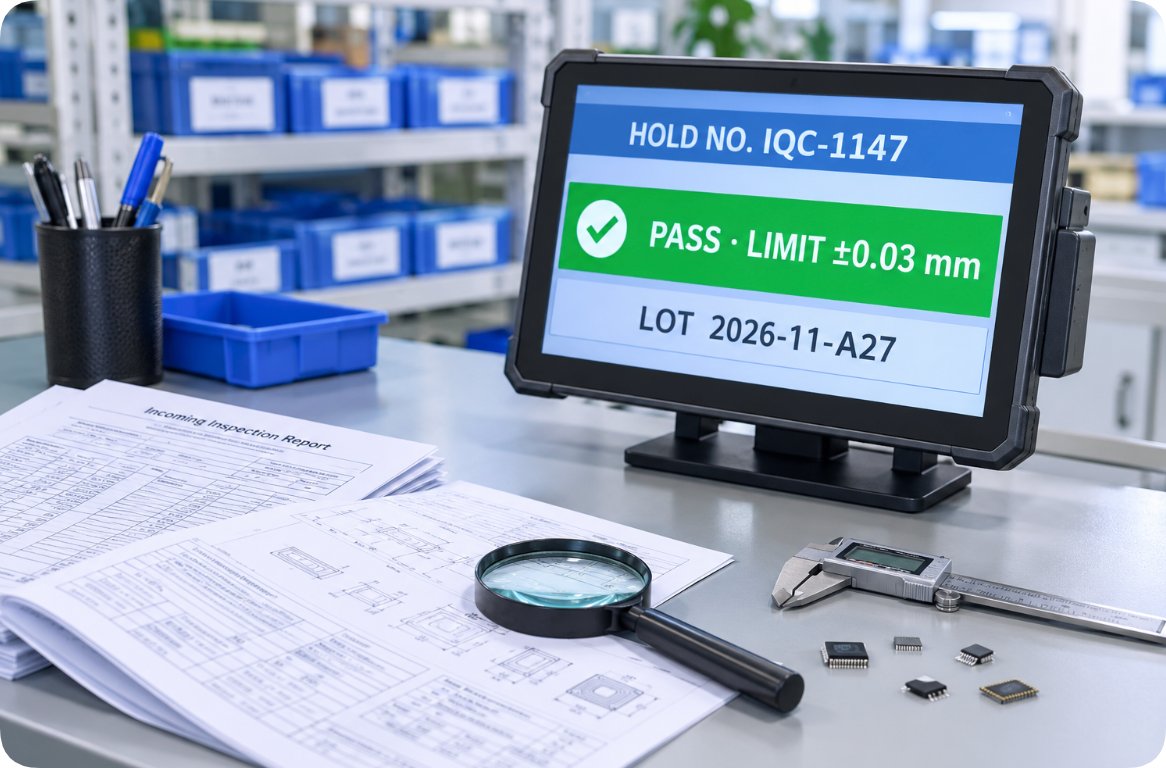
Quick Turn PCB Prototyping & Board Manufacturing is the page that publishes the 24-hour sample window, the separate-sample rule and the design-for-manufacture checks that return as a trial production report. All three are two-person events. One engineer reads the Gerber file and the DFM notes; a second person holds the drilled sample and checks the mechanical holes, the gold fingers and the panel edge against that same file. The published capability list gives the tolerances that make the check concrete: drill accuracy of +/-0.025 mm, a PTH aperture tolerance of +/-0.03 mm, a minimum mechanical hole of 0.15 mm and a minimum line width and spacing of 0.065 mm. Reading a tolerance and measuring a board are different acts, and a sample window counted in hours leaves no queue in which one person can do them one after the other.
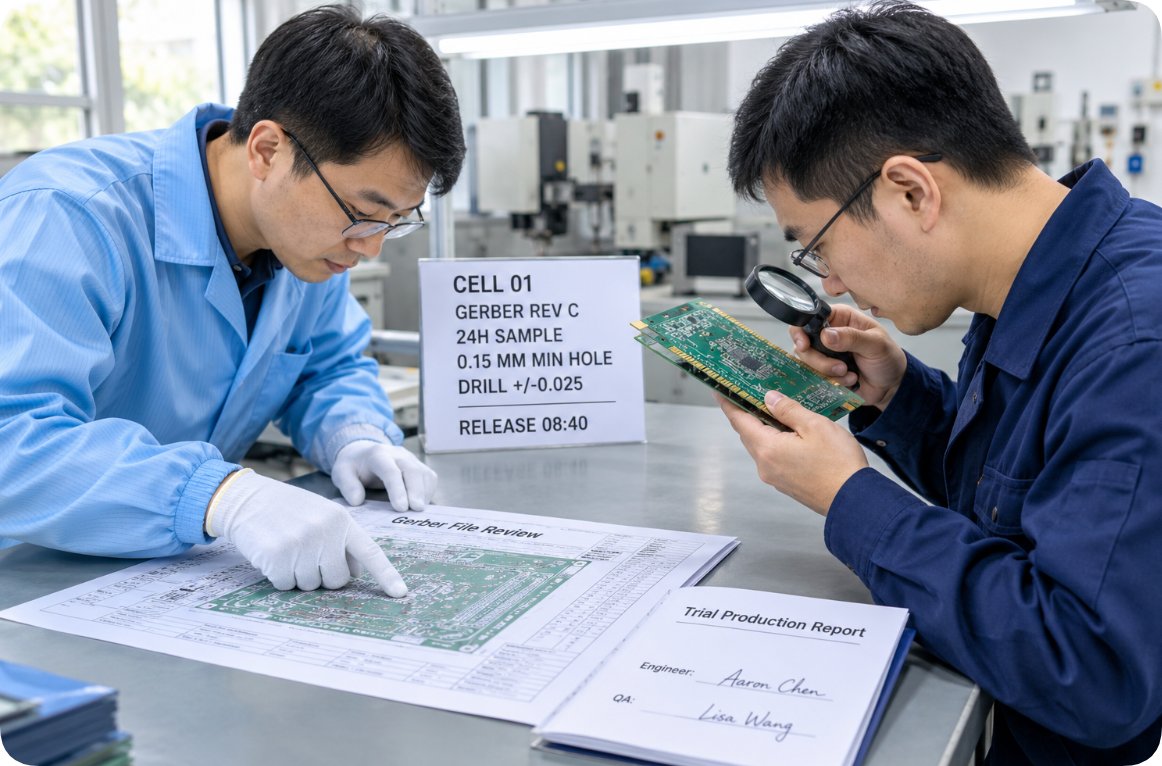
The cell sheet therefore fixes a first reader and a second measurer for every sample release, and it treats a trial production report as unfinished until both names are on it. The 1-36 layer range, the HDI and blind buried hole options and the 40-layer maximum change what the second person looks for; they do not change the need for a second person. A 0.4 mm board and an 8.0 mm board demand different handling, and both demand one set of eyes on the file and another on the board. ISO9001, ISO13485 and IATF16949 are listed on the same page, but the evidence that matters at this bench is a release record carrying two signatures instead of one.
Where the Coating Booth Needs a Witness
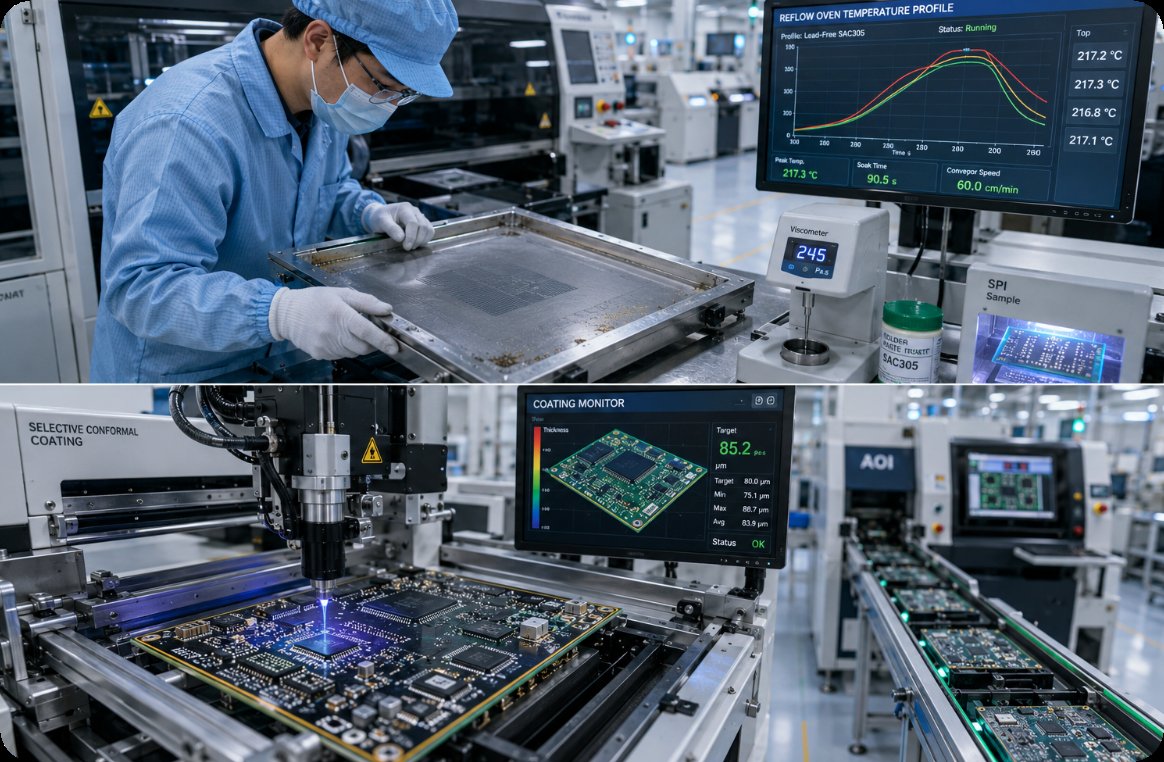
The PCBA Conformal Coating & Three-Proofing Services page describes one dedicated spraying line with two spraying units, UV detection and baking inside a single automatic route. It also gives the figure that shapes the staffing cell: an average spraying time of 0.5-3 minutes per board, with support for boards as large as 550 mm by 470 mm. At that cadence the machine sets the pace, so the operator at the controls cannot also be the person under the UV lamp confirming that a connector, an antenna, a WiFi module or a heat sink was properly masked. Selective avoidance is listed on the page as a capability; confirming that it happened is a separate job.
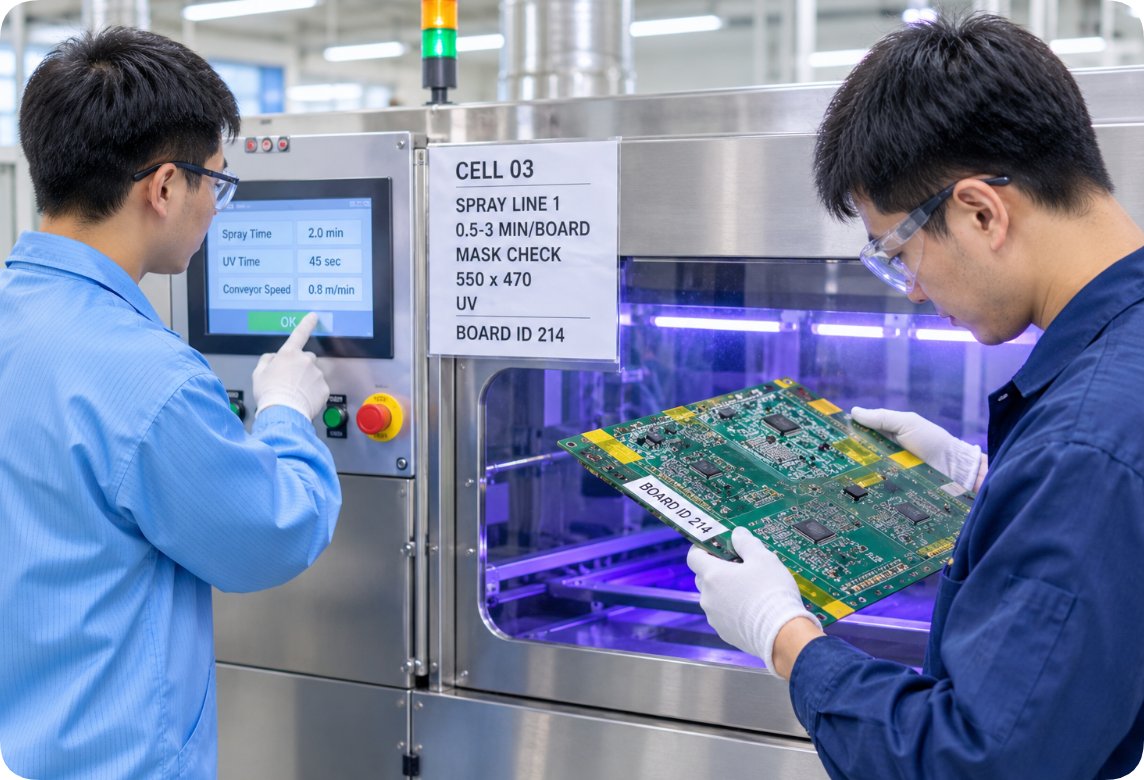
The same page is blunt about why manual spraying was replaced: uneven thickness, impurities in the coating, and material reaching LCD screens and sockets. Every one of those failures is visible at the moment of application and expensive to find later, which is why the second name attaches to the spray decision rather than to a final audit. Double-sided spraying and baking add a further pass over the same board, with a fan-shaped spray for broad areas and a needle spray for dense, high-foot components. Two passes create two moments where the witness has to be present, and one name cannot cover both while the other name is on leave.
Small Wearable Trays Ask for Another Look
Wearable Electronics PCBA Assembly Manufacturer names four board types: VR glasses, massage belt, smart bracelet and Bluetooth headset boards. It publishes no cycle time, no tray count and no inspection staffing for them. Those fields are not published, and this article does not infer them. What the page does establish is a product family built around small boards that arrive in trays, and that changes the shape of the second-person check. Here it is a recount and a second look at orientation, not a measurement against a large-panel drawing.
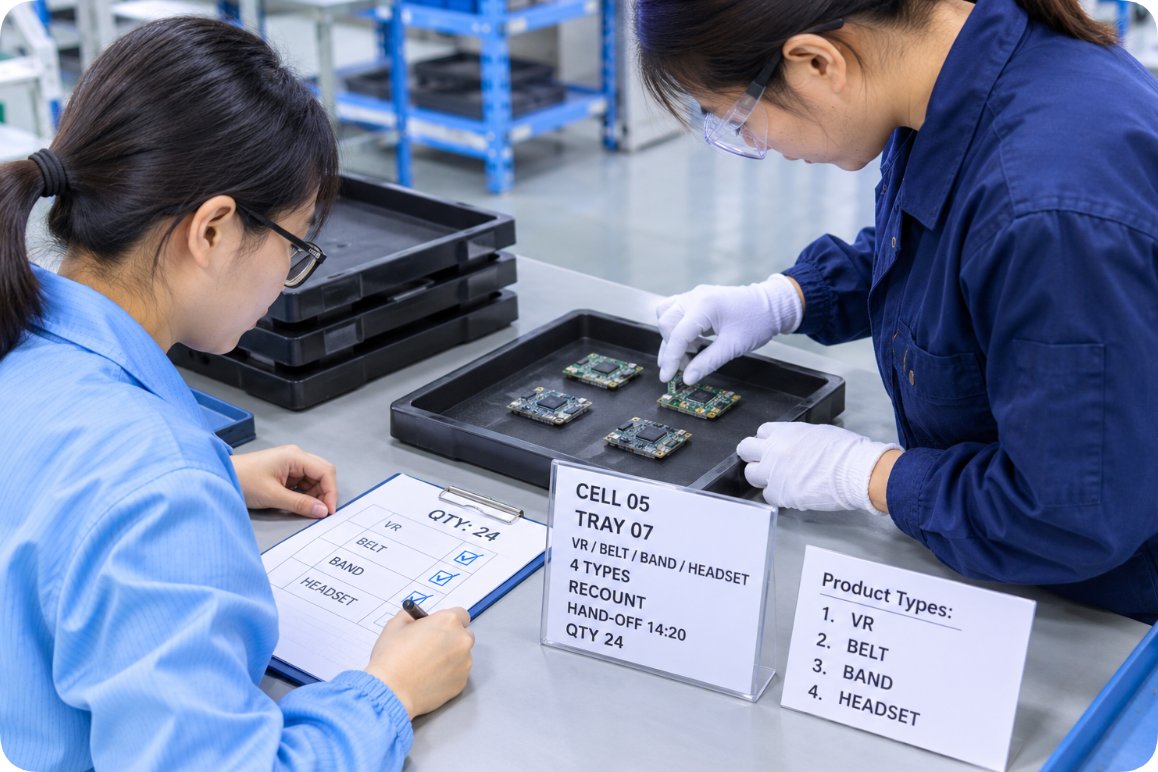
We staff that bench with a fixed counter and a fixed reviewer for every tray hand-off, and we write the tray number on the card that travels with it. The count is trivial in isolation and decisive when four product types share one line, because a mixed tray is exactly the defect a single operator is least likely to notice while loading the next tray. Writing this cell does not require a published cycle time. It requires the moment where the tray changes hands, and that moment is visible on the floor regardless of which fields the service page chooses to list.
Six Cells That Decide Which Bench Stays Staffed
The table below is the whole rule in one place. Each row names a decision, the two roles that have to be present, and the record that survives the shift. Nothing in it is a headcount target, and every row can be checked against a physical card during a factory visit.
| Decision point | First role checks | Second role checks | Why both names are needed | Record left behind | Reviewed by |
|---|---|---|---|---|---|
| Sample release | Gerber file against drill programme | Physical hole, gold fingers and panel edge | 24-hour window leaves no sequential queue | Trial production report with two names | Process engineer |
| DFM note hand-off | Design issue list from the sample run | The board feature that produced each issue | Report is written while the sample is still on the bench | Annotated DFM sheet | Project engineer |
| Spray mask check | Machine programme and spray pattern | Masked areas under the UV lamp | 0.5-3 minute cadence keeps the operator at the controls | Masking card with board ID | Coating lead |
| Second-side pass | Cure state of the first side | Underside coverage and dense components | Double-sided route repeats the same decision | Two-line cure record | Coating lead |
| Wearable tray hand-off | Tray quantity and board orientation | Independent recount at the next bench | Four board types share one line | Numbered tray card | Assembly lead |
| Final pack-out | Completeness of the record set | Physical identity of the lot | Box build is where unmatched records surface | Signed dispatch sheet | Warehouse lead |
A second table separates what the three service pages actually publish from what they leave out. The contrast is the point: the staffing cells come from observable hand-off moments, not from numbers a marketing page never supplied.
| Service page | Published on the page | Not published | Where the staffing cell comes from |
|---|---|---|---|
| PCB Fabrication | 24-hour sample window; 1-36 layers; 40L maximum; 0.4 mm to 8.0 mm thickness; 0.065 mm minimum line; +/-0.025 mm drill accuracy; ISO9001; ISO13485; IATF16949 | Operator count; shift length; per-order cycle time | The instant a drilled sample is compared with its Gerber file |
| PCBA Three-Proofing Paint | One spraying line; two spraying units; UV detection and baking; 550 mm by 470 mm boards; 0.5-3 minutes per board; double-sided spraying; selective masking | Coating thickness; cure time; masking material | The instant masked areas are checked under the UV lamp |
| Custom Smart Wearable PCBA ODM | Four named board types: VR glasses; massage belt; smart bracelet; Bluetooth headset | Cycle time; tray count; inspection staffing; board dimensions | The instant a numbered tray changes hands |
High Precision SMT Assembly Lines Factory is the upstream reference for the first two rows, since a placement line hands its output forward with its own record attached. When that record arrives late, the sample release cell is the one that absorbs the delay, and the coverage rule decides who stays on the bench to absorb it. This is also why we refuse to swap the second name for a signature added later in the day: the record travels with the board, and the two events have to happen at the same moment.
Where Published Capability Lists Fall Silent
None of the three pages prints a staffing number, a shift pattern or a training duration, and we do not manufacture those figures to fill a table. A quotation is built from the customer's BOM and GERBER documents, and the same is true of the labour plan: it is built from the order, not from a published rate card. The service pages are useful for tolerances, equipment counts and board categories. They are silent on who stands where, which is precisely the gap the cell sheet is written to close.
That silence has a practical consequence for a buyer running all three services with one contract manufacturer. The benches share a hold area, and three different queues can converge on the same shelf before pack-out. Turnkey EMS Electronic Manufacturing Services is the natural place to settle who owns that shared space before the first purchase order, because a coverage rule that stops at the bench boundary will break at the shelf instead. We assign the shelf its own reviewer on the dispatch sheet for exactly that reason.
How a Buyer Can Test the Rule During a Visit
The test takes about twenty minutes and needs no presentation. Pick one sample card from the current week and follow it back to the trial production report; both names should be on the same release record, with the measurement values written beside the second one. Then pick a masking card from the coating bench and check that the board ID matches the cure record for both sides. Finally, ask to see how a leave request for one of those six names was handled in the previous month. A working rule produces an alternative name and an unchanged cell, not an empty box and a note promising to catch up later.
Visitors who want the longer version of how a team is split across fixed positions can read how a receiving bay splits three desks, which describes the same discipline at the inbound end of the factory. The principle is identical: name the decision, put two people on it, and let the headcount take care of itself afterwards. Eleven names on a sheet tell a buyer very little. Six covered cells tell the buyer exactly what happens on the day two people ask for the same Friday off.
Frequently Asked Questions
1. How many fixed cells are on the sheet for these three benches?
Six. Two decision points on each of the three benches carry a fixed first name and a fixed second name, and the remaining operators rotate between benches as orders arrive during the week.
2. Which published number puts a second person on the coating bench?
The 0.5-3 minute average spraying time per board. At that cadence the operator running the programme stays at the controls while a second person checks masked areas under the UV lamp, so the two jobs run at the same instant.
3. What does the wearable service page publish about staffing?
Four board types, and no cycle time, tray count or inspection staffing. The staffing cell is written from the tray hand-off moment, which is observable on the floor, and the unpublished fields stay out of both tables above.
4. What should a buyer ask for when a sample is released inside the 24-hour window?
The trial production report with two names on it. One name covers the Gerber and DFM reading, the other covers the physical measurement against the drilled board, and both signatures sit on the same release record.
Tags: conformal coating / wearable PCBA / coverage rule / staffing /
Prev: DIP Assembly and Automotive Electronics: The Extra Trip a New Capability Adds
Next: Custom Smart Home Products PCB and Shell Mold: The Delivery Unit Behind Each Comparison Row