
Shell Mold, Product Assembly and Smart Home PCBA: Which Compliance File Travels With Which Half
My view first, because it saves rework later: a smart home product almost never fails compliance at the moment someone broke a rule. It fails where two suppliers each followed their own rule, and nobody confirmed that the two rules described the same machine. One partner owns the enclosure — the tool, the resin, the first-article dimensions. Another owns the board and its assembly process. The unit ships with a single rating plate, but the evidence behind that plate is split in half, and the seam between those halves is where programmes quietly stall.
The useful mental model: an enclosure carries a materials claim, a board carries a process claim, and the finished unit carries a safety claim. Three claims, two suppliers, one rating plate. Every delay I have seen came from assuming one supplier's paperwork would cover a claim that belonged to the other.
Where the Two Sides Meet
The division of labour is usually described in commercial language — who quotes what, who ships what — but it reads better as a line on the drawing. Everything outside that line belongs to the structural partner: shell mold solutions cover the tool, the resin selection, wall geometry, and every mating feature that holds the board in place. Everything inside belongs to the electronics partner: bare-board fabrication, placement, soldering and the testing that proves the process held.
The line is not decorative. It is where product assembly services take possession of a board and screw it into a housing, and where a compliance argument either closes or opens. When both sides work from the same drawing revision and the same material declaration, the safety file assembles itself. When the revisions differ, the gap stays invisible until a test house asks for a document neither partner thinks it owns.
| Stage | What the partner hands over | What it does not cover | Where it gets challenged |
| Tooling and molding | Resin grade declaration, first-article dimensions, trial-shot findings | Board-level process compliance | First article review and incoming inspection |
| Board fabrication and assembly | Process class, thermal profile record, manufacturability notes | Enclosure fit, safety spacing, drop behaviour | Optical, X-ray and functional testing |
| Final product assembly | Traceability records, pre-shipment sampling result | Component provenance inside a purchased sub-assembly | Aging test and pre-shipment audit |
Read the middle column top to bottom and the shape of the problem appears: each document is complete on its own terms and incomplete as a safety file. The third column is the part most programmes never assign to anyone.
What an Injection Partner Can Put in Writing
An injection molding partner can commit to a great deal, and it is worth being precise about which. Resin grade and supplier of record. First-article dimensions across every critical feature, measured on the production tool rather than a prototype. Trial-shot findings, including any short shot, warp or sink mark that was corrected and how. Those are checkable statements, and they are the ones a structural supplier should be held to.
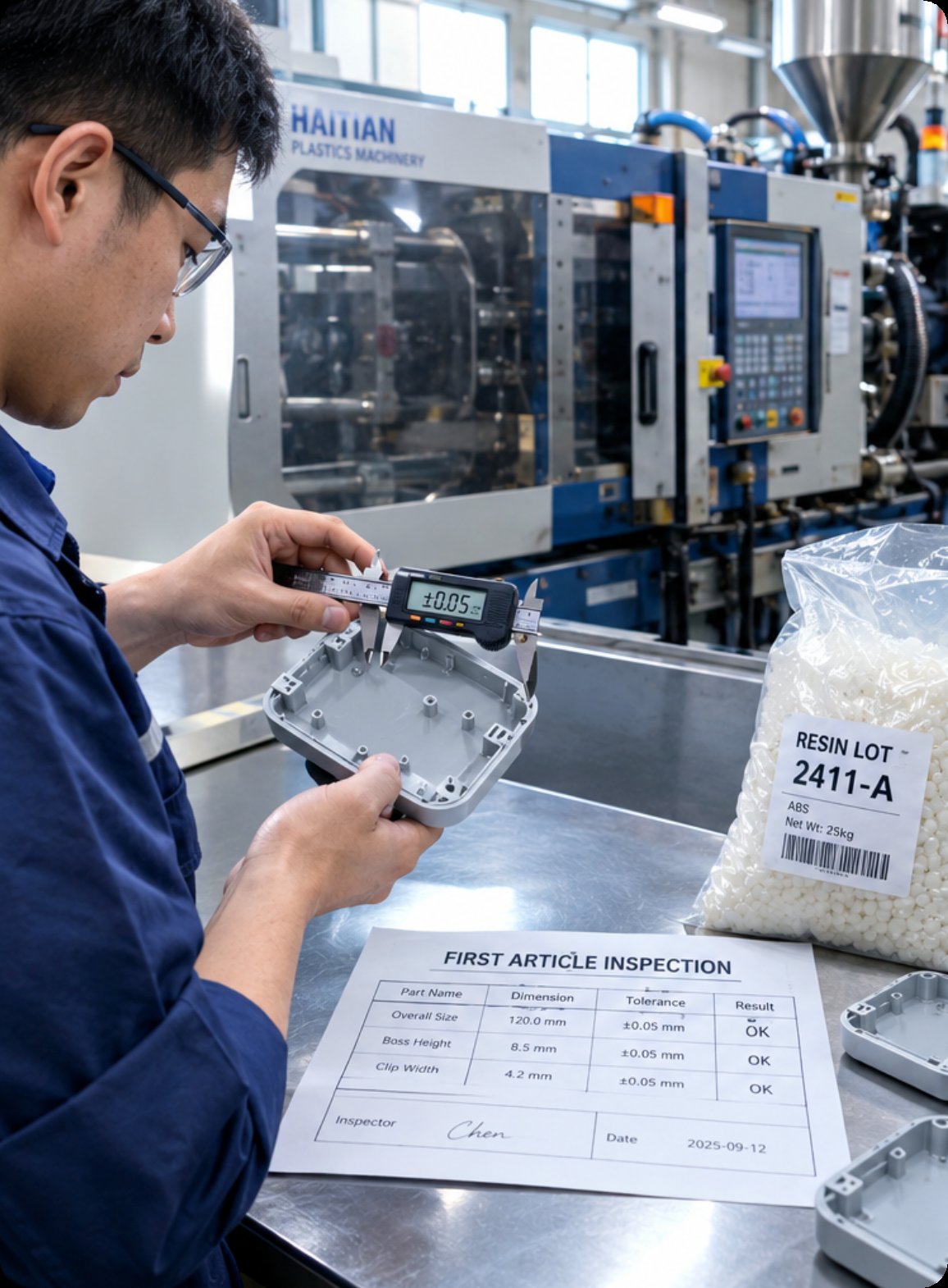
First-article inspection of an enclosure at the molding partner, with the resin lot record beside the tool.
What the same partner cannot put in writing is anything that depends on what is mounted inside. It cannot attest to board-level process class, and should not be asked to. A molding supplier who volunteers an opinion about soldering quality has quietly drifted outside its scope, and drift is expensive to unwind once a rating plate is printed.
A Resin Swap That Expires the Test Report
The most common quiet failure I see is a material substitution. Polypropylene is swapped for nylon to gain stiffness, or a nylon grade is replaced with a higher-temperature polyetherimide for a variant that runs warmer. The change looks like an improvement inside the molding shop, and it usually is one — but it also invalidates whatever material declaration was attached to the earlier build.
Flammability behaviour, dimensional stability under heat and moisture uptake all move with the resin. If a safety file was built around the first grade, the substitution reopens questions that file had already closed. The practical rule is unglamorous: a resin change is a documentation event, not just a production event, and the partner should flag it before the first production shot rather than after the first shipment.
Wall Thickness and Vent Slots Shift the Clearance Numbers
Thermal and electrical spacing are decided by the enclosure, so a geometry revision reaches across the line. Thinner walls conduct heat out faster. Added vent slots change where hot air leaves and how much dust and moisture reach the board. A revised internal rib can move a live conductor closer to a metal insert than the original layout ever intended.
None of this shows up in a visual inspection of a finished unit. It shows up when the board's spacing assumption no longer matches the housing it was qualified in. Any revision that touches wall thickness, venting or the position of metal hardware should trigger a fresh look at the board-level clearance numbers — with both partners in the same conversation rather than two parallel ones.
Trial Shots and DFM Notes Answer Different Questions
These two documents are often treated as one, which is why so much time goes into reconciling them. A trial shot answers whether the tool can make the part as drawn, within tolerance, at rate. A manufacturability note answers whether the board can be built as drawn, at yield, without a workaround. Different processes, different drawings.
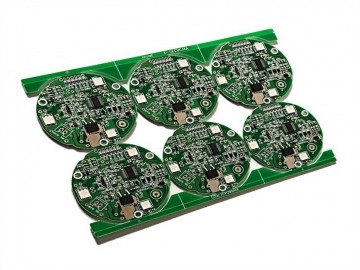
The board-side document deserves its own scrutiny because it is cheap to obtain and easy to ignore. Our quick PCB circuit board sampling service turns a batch around inside twenty-four hours and returns manufacturability findings at no charge, so panel-level problems surface while the drawing is still editable. We also run each board as its own sample rather than combining a dozen designs onto one panel: shared panels hide defects and blur simulation results.
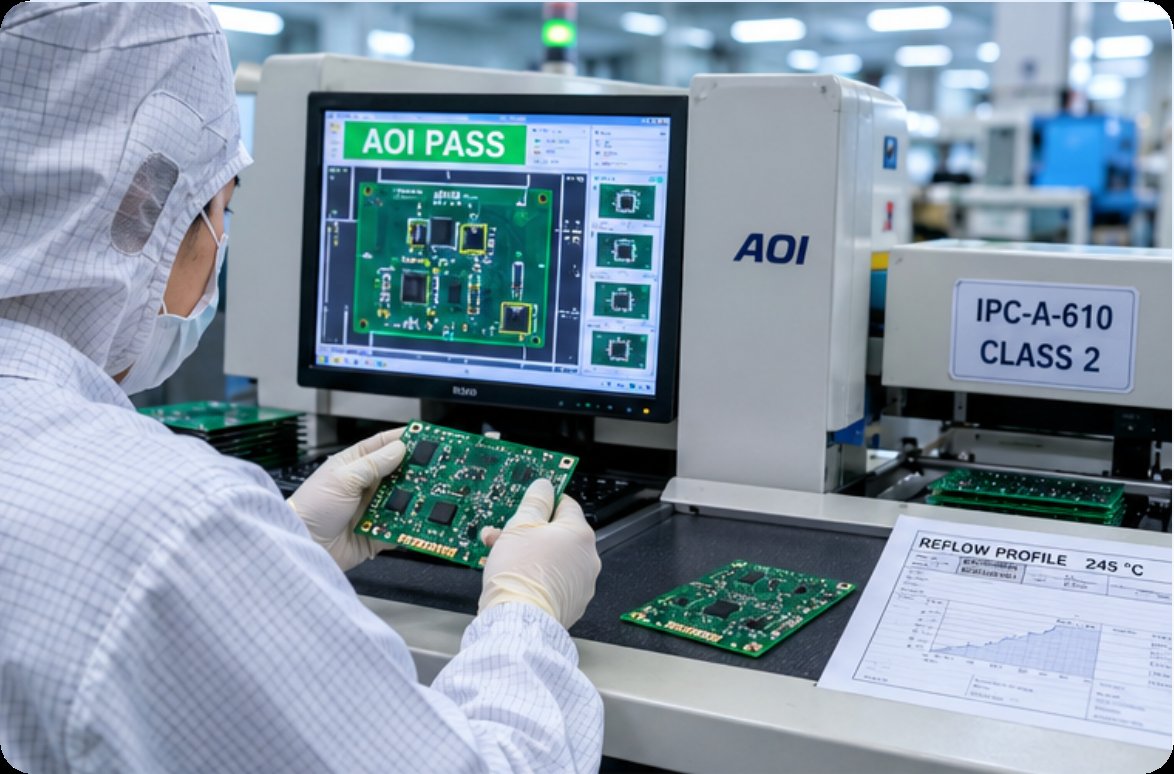
Optical inspection on a smart home control board, before the assembly cell takes the unit.
The two documents meet in one place: the first article that combines them. A trial-shot enclosure holding an actual board is the first object that can be checked against both drawings at once, and worth scheduling deliberately rather than discovering at the pilot build.
Where the Line Picks Up the Unit
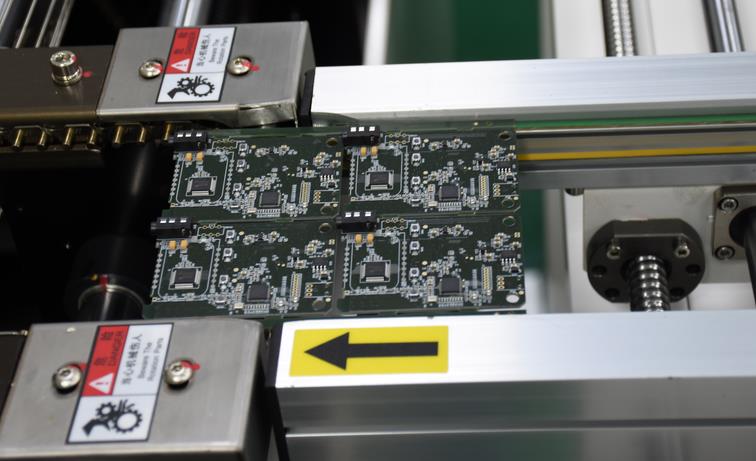
Assembly is where the two halves stop being abstractions. Boards arrive, and they are joined with the casing, the wiring harness, and any motion parts such as a motor, then packed as a finished product rather than a board in a box. This step carries more manual operation than board fabrication does, which is precisely why it needs written work instructions instead of tribal knowledge.
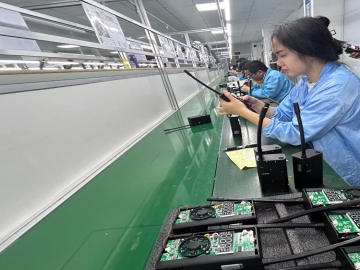
The control chain we run is layered: standard operating procedure at the station, operator self-check, full inspection by quality control, online sampling by quality assurance, and a further sampling audit before dispatch. A barcode system registers good and rejected units alike, so a unit's history can be reconstructed rather than recalled — the mechanism behind Custom Smart Home Products PCB work that has to survive a customer audit, not only a factory one.
One Barcode Across Two Suppliers
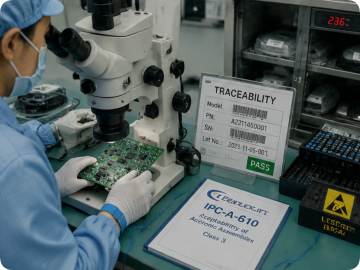
Traceability is where the seam becomes mechanical instead of procedural. A barcode applied at assembly is only useful if it can be tied back to a molding lot and forward to a shipment, which means both suppliers must agree on what the identifier points to. If the structural partner numbers parts by tool and the electronics partner numbers by production order, the two schemes never join.
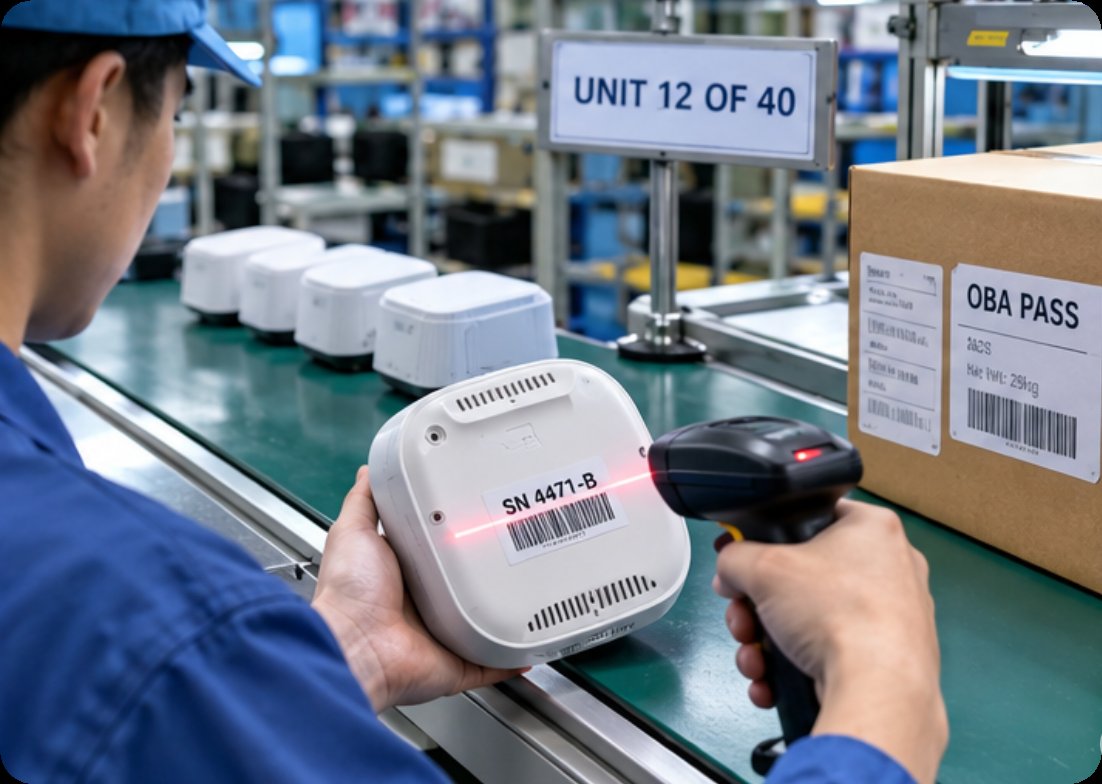
An assembled smart home unit at the traceability bench, scanned against its enclosure lot and board lot.
The fix is a convention agreed before the first production order rather than after the first complaint — one identifier, carried from molding lot through assembly to dispatch, with each partner responsible for the fields it owns. It costs a short meeting and saves a long investigation.
What to Ask Before the Tool Is Cut
Most of the expensive questions are cheap while the tool is still being designed. Ask the structural partner which resin grades they can source consistently, and which substitutions would need a new declaration. Ask the electronics partner which enclosure revisions would force a fresh clearance review. Ask both who holds the current drawing revision — and get it in writing.
It also helps to agree on the closure evidence early. A unit run under controlled temperature and humidity for days, with performance logged, removes most of the argument about whether a design is ready. Our aging test programme runs units continuously for between seventy-two hours and a full week, extends to drop, vibration and salt-spray checks where the application calls for them, and hands work beyond in-house capacity to a partner laboratory. For programmes that want one point of responsibility across tooling, board and finished unit, our electronics manufacturing services keep design, procurement, fabrication, assembly and testing inside a single set of records.
The rating plate on a smart home product looks like a single promise. Treating it as one — asking which half of the evidence supports which line — is what turns two competent suppliers into one defensible product, and it is cheaper to arrange before the tool is cut than after the first unit is boxed.
Tags: product assembly /shell mold / smart home PCBA / compliance file /
Prev: PCB Assembly Cost Breakdown: Where Budget Is Really Committed
Next: No more...