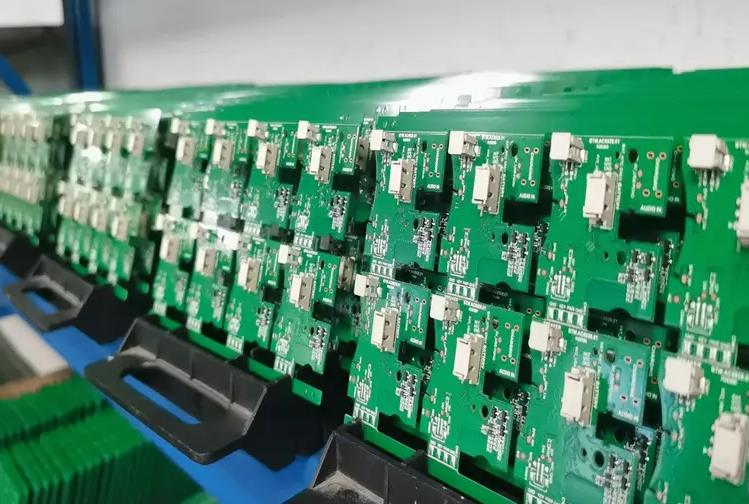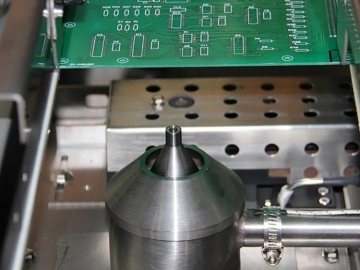

PCB Fabrication and PCBA: Three Lines That Disappeared From the Board Quote
The board quotation has not changed its shape in fifteen years: board quantity, layer count, material, surface finish, lead time, unit price. Buyers still compare suppliers by reading down that list and picking the lowest figure at the bottom. What the list hides is that several of the assumptions underneath it no longer hold. Fabrication houses have moved from taking files and making boards to arguing with the design before a panel is cut, and that shift has quietly removed some of the lines buyers used to compare on while adding others nobody was pricing three years ago. The three that disappeared are the ones that used to decide most awards. Understanding what replaced them is the difference between a quote that looks cheap and a build that actually is. If you are re-specifying a board this quarter, start with PCB manufacturing services and read the three changes before you send the files.
How a File Transfer Became a Conversation
The first change is procedural, and it is the one that reshapes everything downstream. A fabrication order used to begin when a completed Gerber set arrived and end when the boards shipped, with no conversation in between unless something was wrong. That model assumed the design was manufacturable as delivered, which was a safer assumption when tolerances were generous and layer counts were low. It is not safe now. Shops that run modern boards review the stack-up, the annular ring sizes, the copper balance and the drill-to-copper clearances before quoting, and they come back with questions. Buyers who treat that feedback as interference end up with a cheaper quote and a longer revision cycle; buyers who treat it as part of the service get a board that panels cleanly and assembles without surprises. The practical signal is easy to spot: a supplier who never asks anything about your design before quoting is not faster, they are simply going to discover the problem later, on your schedule rather than theirs.
Yield Replaced Speed as the Selling Point
The second change is that lead time stopped being the headline number. Quick-turn turnaround is now close to commodity among competent shops, which means it no longer differentiates, and what has taken its place in serious conversations is first-pass yield on the specific board being quoted. The economics explain why. A board that arrives two days later but solders cleanly on the first pass costs far less than one that arrives on time and needs a re-spin, because a re-spin consumes the schedule, the assembly slot, and the engineering attention that a two-day delay would never have touched. Buyers who have been burned once tend to change how they read a quote: they stop comparing the ship date and start asking what proportion of similar boards pass electrical test without rework. That question is uncomfortable for shops that compete purely on speed, and it is the one worth asking.
Material Grade Stopped Being a Default
The third change sits in the material line, which used to be the most boring row on the sheet. Standard FR-4 was the assumption, and it was only questioned when a design called for something unusual. That default has broken, partly because signal speeds have risen to the point where loss tangent matters on boards that would once have been unremarkable, and partly because thermal and reliability requirements in automotive and industrial applications have tightened. The consequence for the buyer is that the material line is now a design variable rather than a given, and it interacts with everything else: a higher-grade laminate changes the achievable impedance tolerance, it changes the drilling parameters, and it changes what the finished board costs per panel rather than per square decimetre. PCB Fabrication specifications now routinely begin with a material conversation rather than ending with one, and buyers who leave it implicit are effectively asking the shop to choose for them.
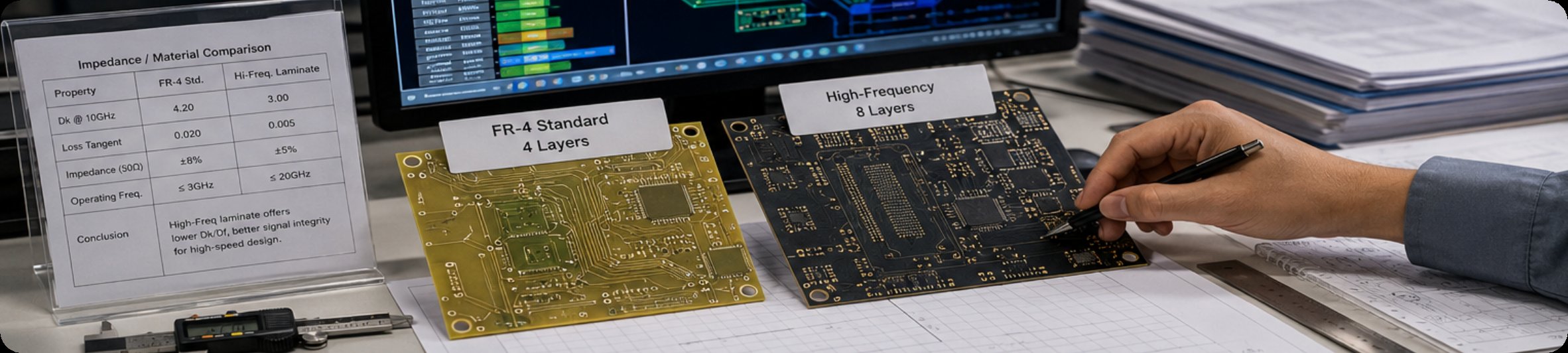
Laminate selection reviewed against impedance targets and thermal requirements before a panel is cut, rather than defaulted to a standard grade.
When the Enclosure Sets the Board Outline
A related shift is that the board outline is increasingly decided by something other than the circuit. Once a device has a moulded housing, the enclosure dictates the board shape, the mounting hole positions, the keep-out areas around connectors, and the maximum component height in each region. Those constraints arrive from tooling that is expensive to change, which means the board has to adapt to the enclosure rather than the reverse. Shops that handle both sides of that relationship can flag a conflict while it is still cheap to fix; shops that only see the board file will build exactly what was drawn and let the conflict surface at assembly. For programmes where the enclosure is already tooled, this is the single most valuable conversation available before release, and it is the one that most often gets skipped because nobody owns it. Shell Mold work and board layout reviewed together remove a category of late-stage change that is disproportionately expensive.

An enclosure tooling drawing reviewed against the board outline, with mounting holes and connector keep-outs resolved before release.
Prototype to Volume Without a Handover
The change that buyers notice most is the collapse of the handover between prototype and volume. Historically these were separate worlds: a quick-turn shop made twenty boards quickly and expensively, then the design was thrown over a wall to a volume shop that had never seen it, and the first production run rediscovered every issue the prototype run had papered over. Programmes that compress this now run prototype and volume through the same process window, with the same material lot strategy and the same test coverage, so that what worked at twenty boards still works at two thousand. The assembly side of that continuity matters as much as the fabrication side, because most prototype failures are assembly failures in disguise: a footprint that tolerates hand soldering but not a reflow profile, or a component placed too close to a panel edge for the depaneling method. PCB assembly (PCBA) reviewed during the prototype phase catches those before the volume tooling is committed.
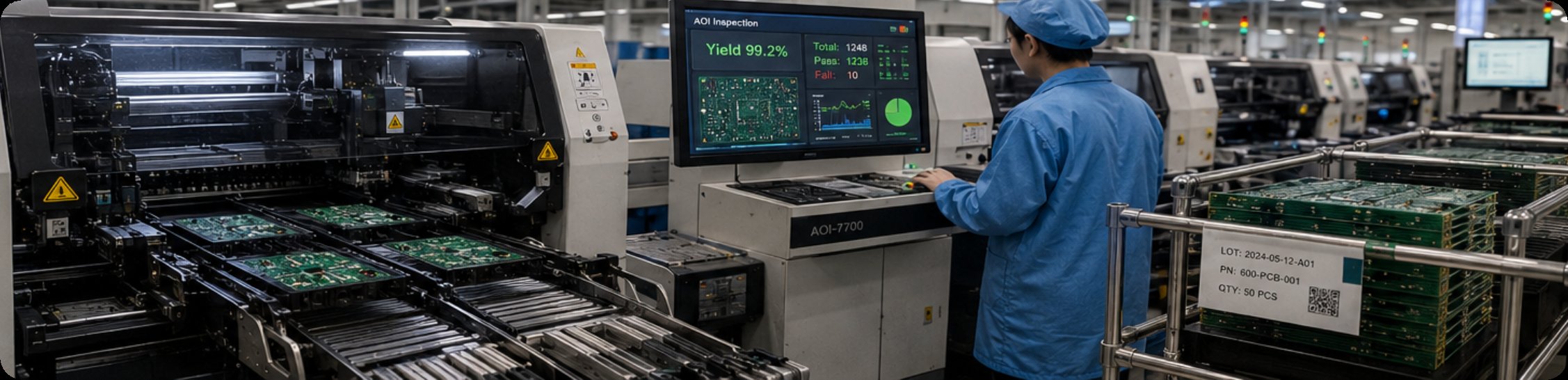
A prototype build running through the same assembly window as the volume process, so the first production run does not rediscover prototype issues.
Traceability Joined the Chargeable Column
The final change is the least welcome and the most predictable. Traceability used to be an internal shop concern: material lots were tracked, coupons were tested, and the reports existed if anyone asked. In automotive, medical and industrial supply chains, those reports are now deliverables, and delivering them costs real money, so they appear on the quotation as line items. That includes impedance test coupons with measured results per lot, material certifications back to the laminate manufacturer, and in some programmes serialised board-level records. Buyers who are used to a bare unit price often read these lines as padding. They are not, and the cheapest way to discover the difference is to ask a supplier to produce a full lot history for a board that was bought on price alone.
What the Revised Sheet Actually Asks
Read together, the changes produce a sheet that looks different at the top from one that looks different at the bottom. The rows that used to decide awards have thinned out, and the rows that now decide total cost are the ones buyers were trained to skim.
| What faded | Why it stopped deciding | What decides instead |
|---|---|---|
| Headline lead time | Quick-turn is commodity among capable shops | First-pass yield on this specific board |
| Price per square decimetre | Ignores laminate grade and impedance tolerance | Material grade matched to loss and thermal needs |
| Default FR-4 | Signal speeds and reliability rules moved | Stack-up reviewed against impedance targets |
| Separate prototype and volume | Handover re-discovers every prototype issue | One process window from twenty boards to thousands |
| Traceability as an internal record | Regulated supply chains require deliverables | Coupon results, material certs, lot history |
| Lowest unit price | Excludes re-spin risk and assembly surprises | Total cost across fabrication, assembly and test |
Choosing a Partner, Not a Price
None of this makes the unit price irrelevant, and it would be dishonest to pretend otherwise. It does mean the unit price is now a weaker signal than it was, because two quotes for the same board can differ by a meaningful margin while describing genuinely different things: one includes a stack-up review and impedance coupons, the other does not, and the gap between them only becomes visible when something goes wrong. The way to compare is to make the scope explicit before the quote, so that both suppliers are pricing the same set of deliverables. Our electronics manufacturing services cover fabrication, assembly and enclosure work under one scope for exactly that reason, and the integration path is documented in a manufacturing implementation guide for combining fabrication and assembly. Buyers who switch to comparing scope rather than unit price tend to find the total landed cost falls, because the expensive surprises were never in the row everyone was looking at.
Tags: PCBA /PCB fab trend /
Prev: DIP Assembly and PCBA Three-Proofing Paint: Why Through-Hole Is Not Retiring Yet
Next: From Shop-Floor Habits to Board Yield: NEWEI Smart Wearable and Device PCBA ROI