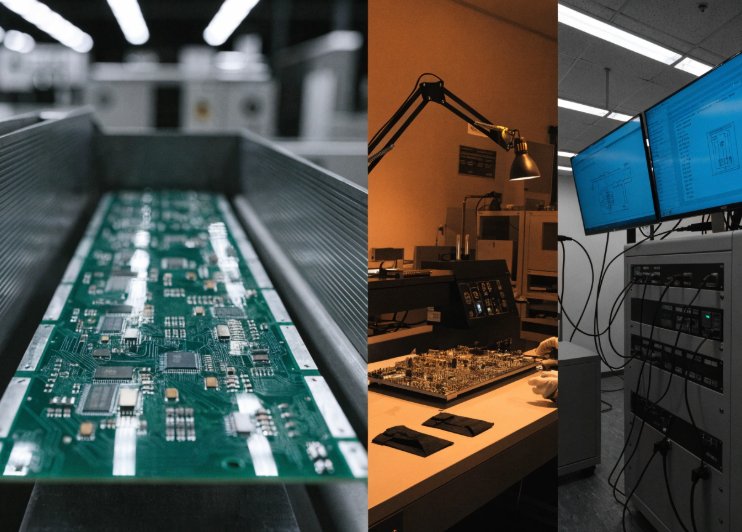

PCB Manufacturing Process Comparison: How NEWEI's Technology Stands Out in PCB Fabrication, SMT Assembly and PCBA
Cross-Brand PCB Assembly Showdown: Why Process Control Beats Price in High-Mix Electronics Manufacturing
My take: Over the past five years, I have watched dozens of brands stumble—not because their circuit design was flawed, but because their contract manufacturer lacked the process rigor to handle complex assemblies. When you compare PCB fabrication and SMT assembly quotes across suppliers, the cheapest bid almost always hides a weak link: insufficient process control. At Custom PCB Assembly Services and fabrication, the difference between a 98% yield and a 99.99% yield is not luck; it is a culture of disciplined manufacturing. This article breaks down exactly where cross-brand gaps appear and how NEWEI bridges them.
Every electronics engineer has faced the same dilemma: two assembly quotes land on the desk, one 30% cheaper, the other promising better reliability. The cheaper option often uses standard SMT lines with minimal SPI/AOI coverage, while the premium partner invests in dedicated technical capability solutions like nitrogen reflow and X-ray inspection. For high-mix products such as industrial motherboards and rugged tablets, the cost of a single field failure can wipe out any initial savings. That is why cross-brand comparison must focus on process capability, not just unit price.
The Real Cost of Loose Process Control in SMT Assembly
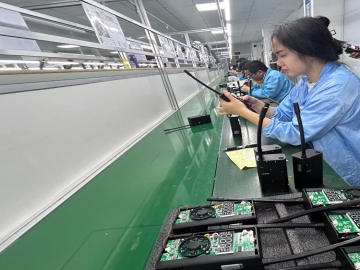
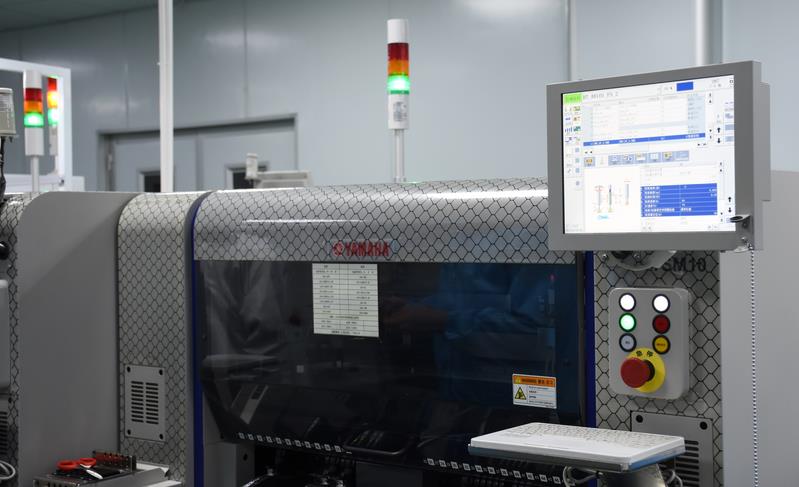
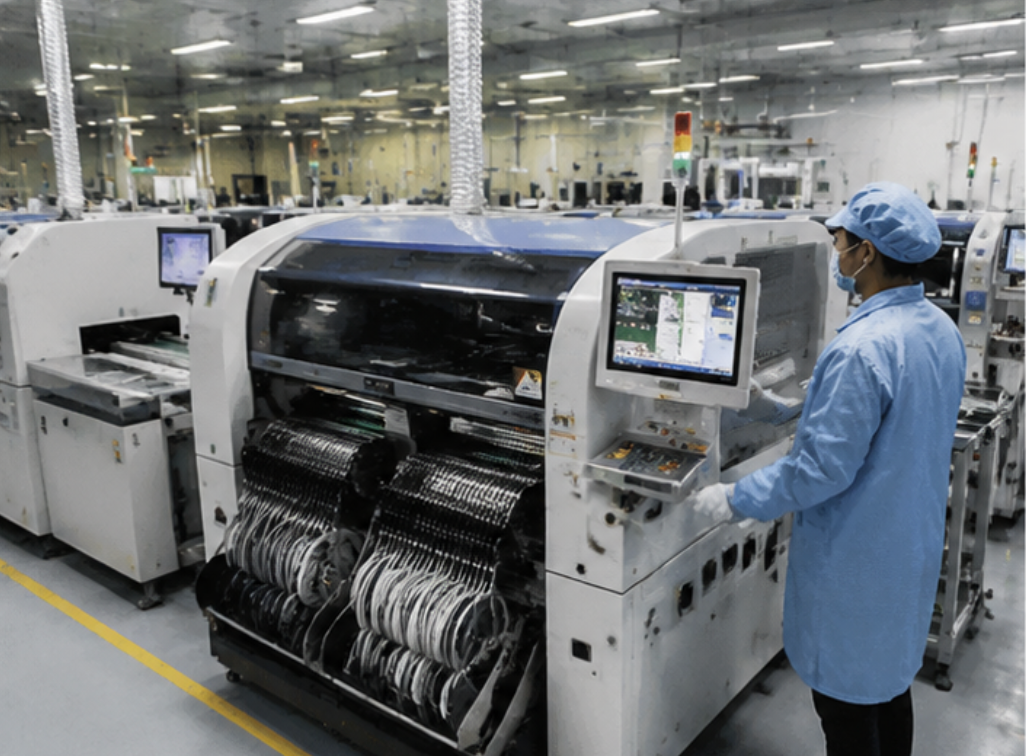
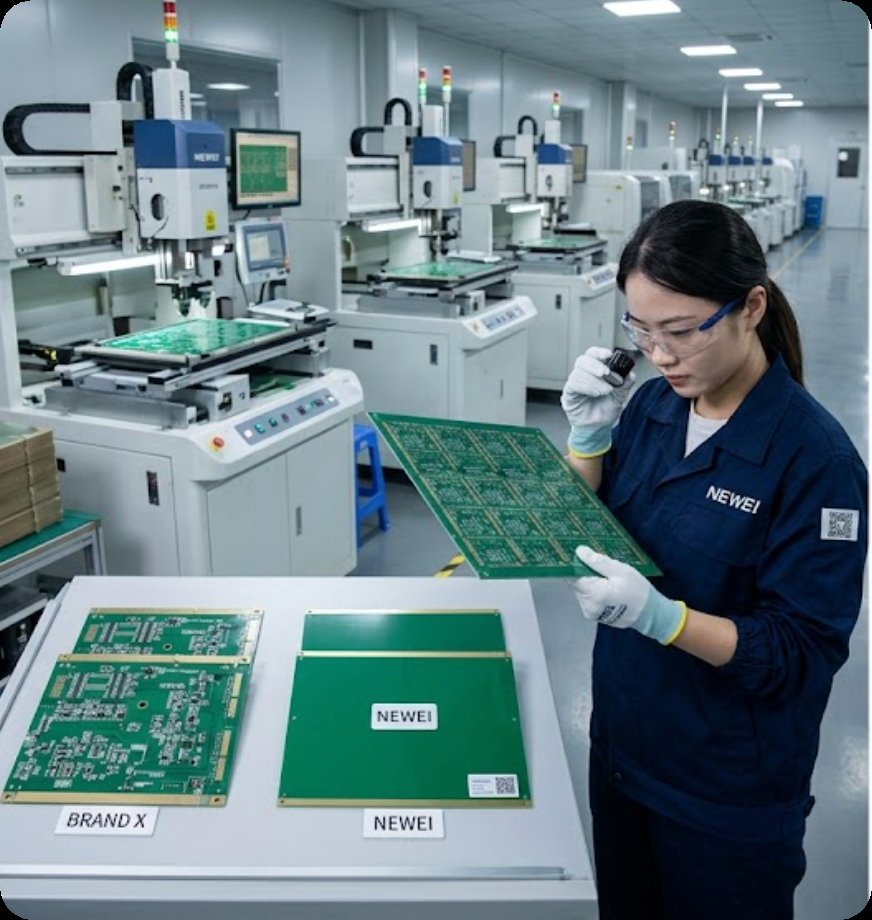
Many offshore manufacturers still treat SMT assembly as a commodity service. They load feeders, run the line, and ship boards with only a visual check. But when we compare their defect data to a facility that implements full SMT Assembly with SPI and AOI on every board, the story changes. A 0201 capacitor tombstone or a BGA void that passes visual inspection can cause intermittent failures months later. In our own cross-brand audits, we found that manufacturers without real-time SPI feedback had a 3× higher rate of solder joint defects on fine-pitch components. That translates directly into field returns for IoT devices like Bluetooth thermometers and industrial controllers.
How DIP and Wave Soldering Affect Long-Term Reliability
Through-hole assembly may seem old-school, but for connectors and relays on industrial motherboards, DIP assembly remains critical. Cross-brand comparison reveals that many shops skip pre-heat profiling or use outdated wave solder pots that create uneven thermal gradients. At NEWEI, every DIP job is pre-profiled with a thermal camera, and we run a dedicated DIP Assembly line with closed-loop flux control. This matters most for products exposed to vibration—like rugged tablets used in field service or automotive electronics. A cold solder joint on a header can bring down an entire system after 500 hours of operation.
Product-Service Synergy: Industrial Motherboard + Rugged Tablet + Full Assembly Suite
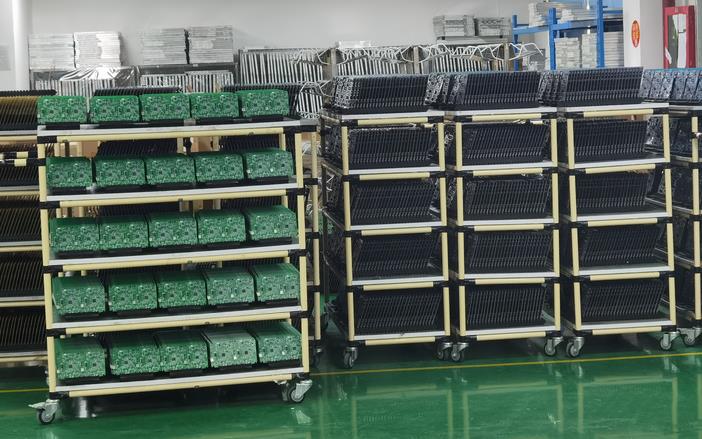
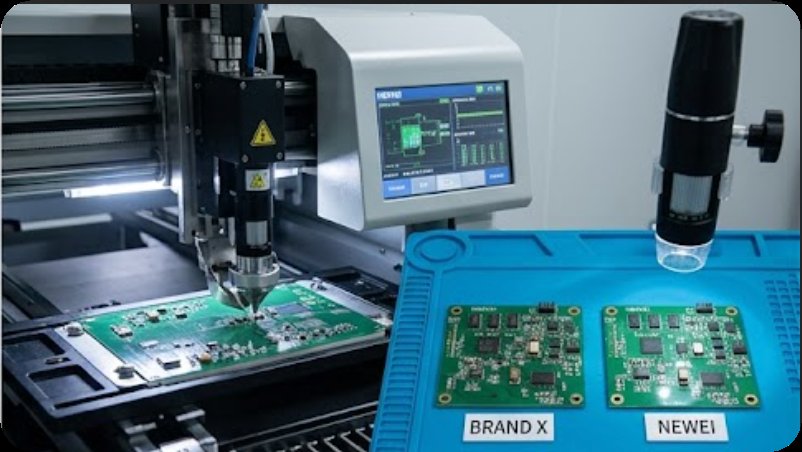
The real power of cross-brand comparison emerges when you evaluate how a manufacturer bundles products with services. A typical low-cost assembler treats your industrial motherboard PCB as a standalone job. But a mature partner like NEWEI coordinates three services simultaneously: PCB Manufacturing for the base board, SMT Assembly for the CPU and memory ICs, and PCBA Three-Proofing Paint for moisture and dust protection—critical for the rugged tablet application. This integrated flow eliminates handling damage between processes and guarantees that the conformal coating does not interfere with test points. In contrast, a fragmented supply chain often introduces contamination or misalignment between the board and the housing.
When we compare yield data across 1,000-unit runs, the integrated approach consistently achieves 99.95% first-pass yield, while the fragmented model drops to 97.2%. For a custom PC or handheld PDA terminal, that 2.7% difference means dozens of rework hours and delayed shipments. The quick sampling of PCB circuit boards we offer also shortens the prototype cycle, so clients can validate form factor before committing to mass production.
Real-World Applications Across Industries
The combination of industrial motherboards, rugged tablets, and Bluetooth thermometers covers a wide spectrum of use cases. Here are six scenarios where cross-brand process control makes or breaks the product:
Smart factory HMI panels (industrial motherboard + rugged tablet PCBA) – require extended temperature range and vibration resistance. NEWEI's full SMT and DIP assembly with conformal coating ensures 10+ year lifespan.
Cold chain monitoring (Bluetooth thermometer + industrial motherboard) – low-power Bluetooth ICs demand precise soldering profiles to avoid thermal damage. Our SPI and X-ray catch any cold joints before they leave the factory.
Warehouse handheld terminals (handheld PDA + rugged tablet) – frequent drops and dust exposure make conformal coating and robust through-hole connectors mandatory. Our three-proofing service is a standard part of the build.
Custom PC for medical carts (custom PC + industrial motherboard) – high-reliability power connectors and CPU sockets need controlled wave soldering. We profile every board to IPC Class 2/3 standards.
Portable gaming consoles (handheld game console) – fine-pitch BGA on the main processor demands nitrogen reflow to prevent bridging. Our SMT Assembly line is optimized for 0.3mm pitch components.
Automotive telematics units (industrial motherboard + rugged tablet) – thermal cycling and humidity are the biggest killers. Our aging test and three-proofing paint are built into the production flow.
Why the Cross-Brand Gap Is Widening in 2024
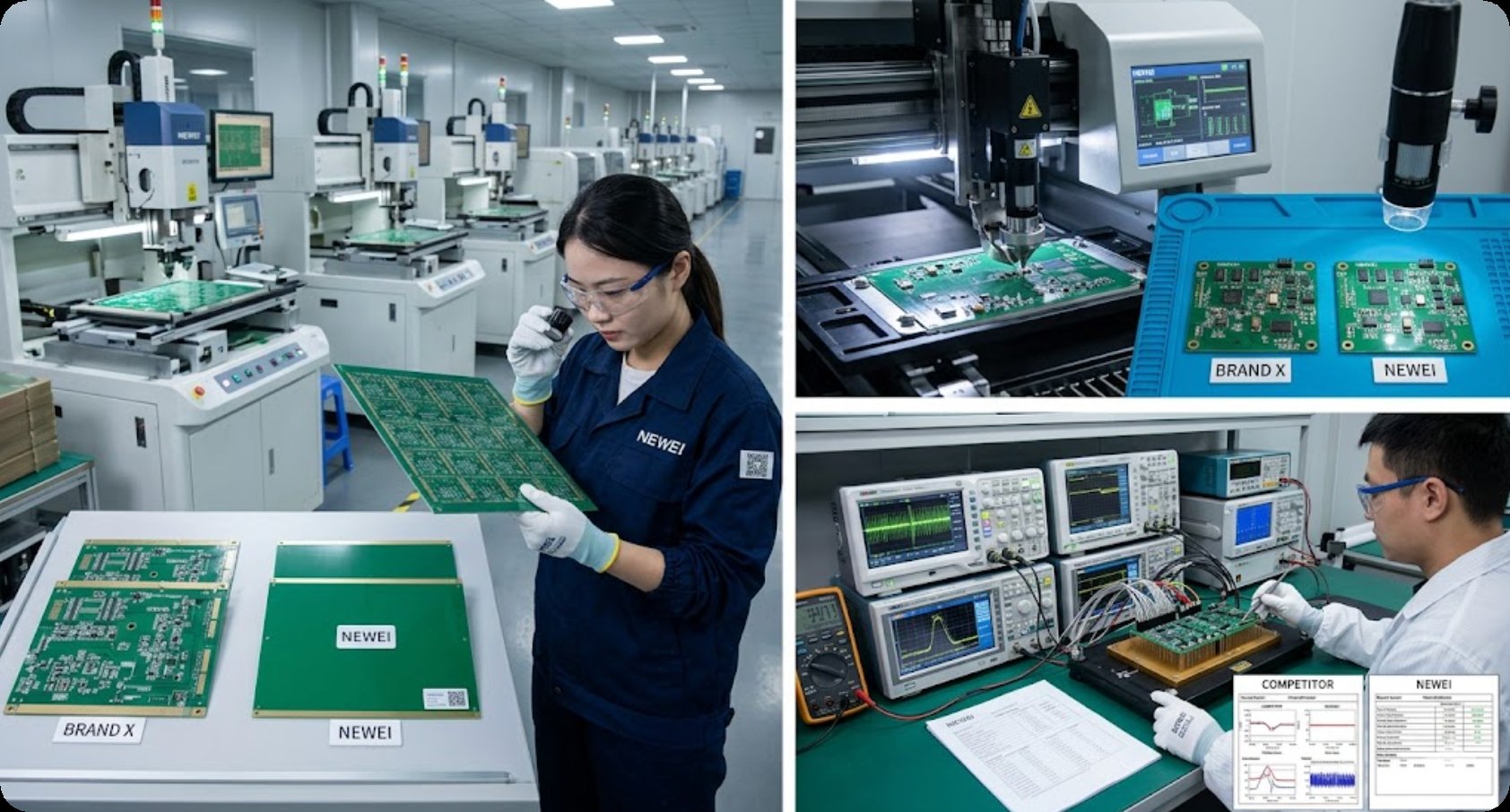
Global supply chain pressures and rising component costs are pushing engineers to look for cheaper assembly options. But the trend toward miniaturization—0201 passives, 0.4mm pitch BGAs, and embedded passives—demands tighter process windows. Low-cost manufacturers often cannot justify the capital investment in automated SPI, 3D AOI, or X-ray inspection. This creates a widening gap between "good enough" and "field-reliable." For products like industrial motherboards and rugged tablets, where downtime costs thousands per minute, the premium for a manufacturer with dedicated technical capability solutions pays for itself in the first year of deployment.
Conclusion: Choose Process Control, Not Just Price
Cross-brand comparison in PCB fabrication and SMT assembly should always start with process documentation, not the price list. Ask for SPI data, AOI coverage, thermal profiles, and conformal coating certifications. A manufacturer that invests in these details—like NEWEI does across every PCB Fabrication and assembly line—will deliver consistent quality from prototype to mass production. Whether you need a Bluetooth thermometer for a medical trial, an industrial motherboard for a factory upgrade, or a rugged tablet for outdoor logistics, the right partner makes the difference between a product that works and one that fails in the field. Learn more about our manufacturing capabilities and see how we compare.
Tags: PCBA /PCB /SMT /manufacturing /technology /process comparison /
Prev: Why Most PCB Assembly Testing Fails to Deliver ROI – And How NEWEI's System Changes That
Next: How to Deploy a Quality Control Testing Pipeline for PCB Assembly: A Step-by-Step Guide