
On a High Precision SMT Assembly Lines Factory floor, The certificate riding in the carton says another. The receiving bench counts a third number. None of these papers is wrong on its own, and none of them will stop a production line by itself. What they do is disagree quietly, and the difference has to be absorbed somewhere. On most shop floors it is absorbed at the bench, in the hour a planner spends deciding whether a short count is worth a hold, or in the rework a smart home assembly takes because a component arrived from a lot that was never quite approved for that customer. This is where the money in incoming quality control actually leaves the building, and it rarely appears on a rejection note.
We build Automotive Grade Electronics PCBA Manufacturing for telematics, vehicle control units, displays and smart mobility devices, and we run Smart Home Electronics PCBA OEM ODM Supplier lines for switches, gateways and connected appliances. Both sit downstream of the same receiving bench. Our Quick Turn PCB Prototyping & Board Manufacturing service turns a 1-36 layer stack with HDI, blind and buried vias, BGA and gold fingers, and a twenty-four hour sample route. Those capabilities set what the bench can check. They do not set what the paperwork agrees on. The rest of this article follows a batch from the dock to the first placement and names the moment each cost becomes fixed.
Three Papers Arrive Before the Boxes Are Opened
The first paper is the order, written weeks earlier by a buyer who was solving a different problem. It carries a part number, a quantity, an agreed price and, if the programme needs it, a named approved manufacturer. The second paper is the certificate of conformance that the supplier prints for the shipment. It mirrors the order in most fields, but it describes the lot that was actually packed, not the lot the buyer imagined when the order was raised. The third paper is made at our bench: the count sheet, the date code read from the reel label, and the moisture indicator state at the moment the carton was opened.
Most teams treat the third paper as a formality because the first two matched at the time of purchase. That is exactly the assumption that costs money. A purchase order can name a manufacturer and a package without naming the lot. A certificate can confirm that the lot met its own published limits without saying whether that lot is the one this customer qualified. The count sheet is the only document that describes the physical boxes in front of the operator, and it is written last. When it disagrees with the other two, the disagreement is real, even if nobody intends to ship a defect.
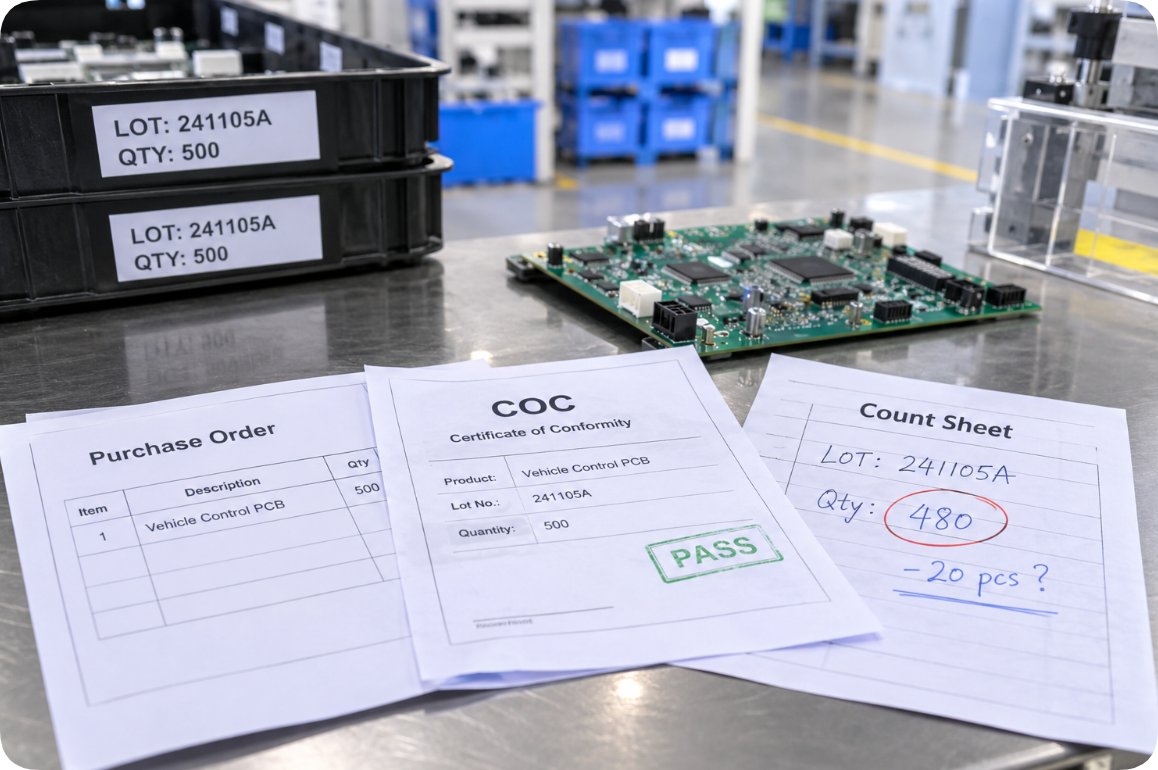
We keep these three papers together in one file rather than in three systems. An BOM Electronic Component Sourcing & Procurement record that can be read beside the receiving entry turns a dispute into a question with an answer. When they live in different inboxes, the same dispute becomes a phone call, and a phone call during a build window is a scheduling decision made without the whole picture.
✅ Where the Order and the Certificate Part Company
The most common split is small enough to look harmless. The order calls for a resistor in a 0603 package from one manufacturer. The certificate confirms the value and tolerance of the parts in the carton, and it is correct, but the reel label shows a different manufacturer. Electrically the part is equivalent. For an automotive programme with an approved manufacturer list, the substitution is a document event that has to be closed before the board can be built, even though nothing about the component has changed.
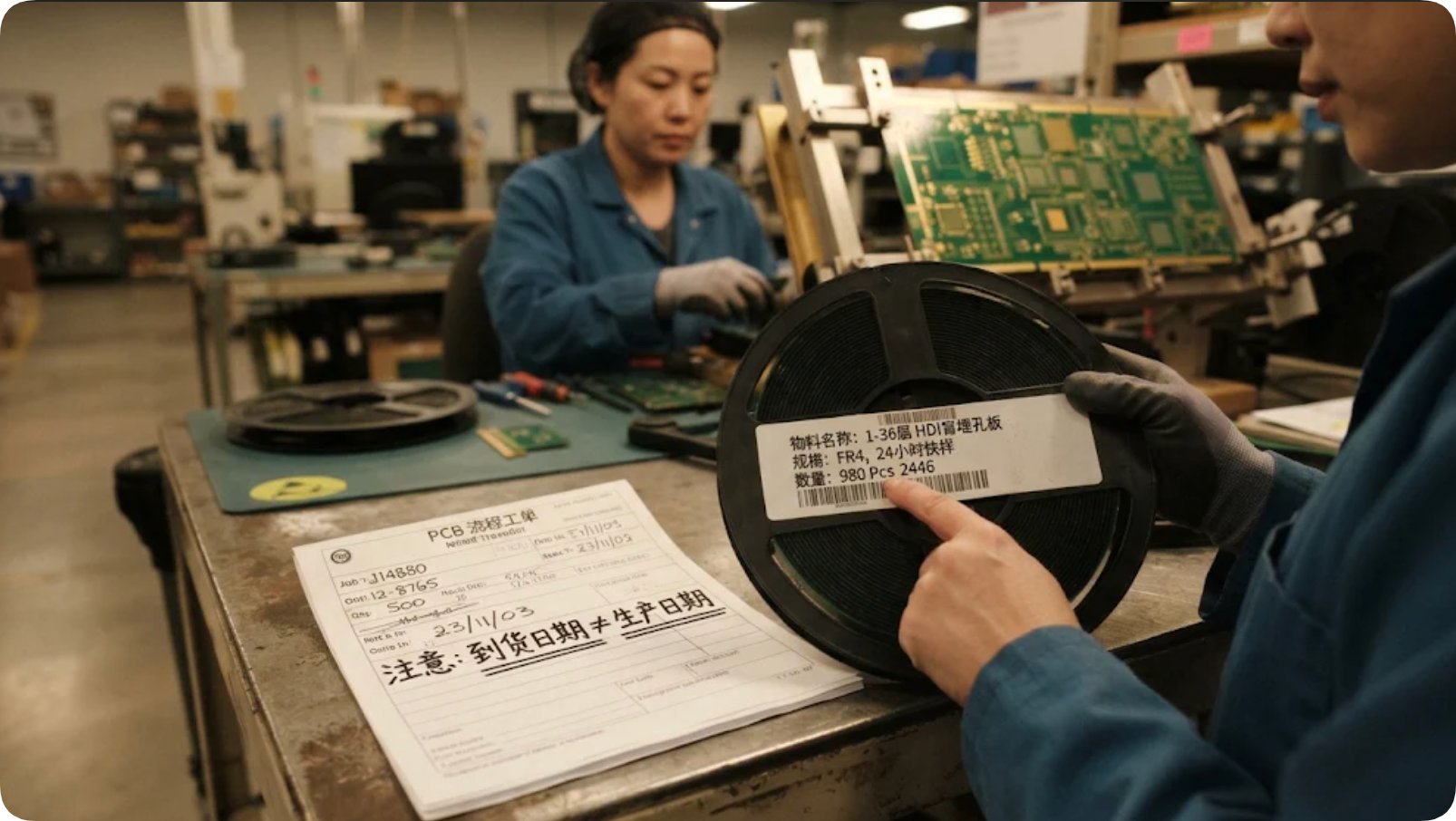
A second split is about dates. The certificate states the date of manufacture. The reel label carries a date code that is twelve months older. Both statements can be true if the parts were held in a controlled store, but the shelf-life budget has been running since the earlier date, not since the shipment arrived. If the line treats the shipment date as the start, it books the material as fresh and discovers the remaining window only after the boards are printed. At that point the cost is no longer a supplier conversation. It is a production decision about whether to use the material under a concession or to stop and wait.
A third split concerns the assembly itself. The order describes a finished programmable device. The certificate describes the bare component. The difference matters when the firmware is loaded on our line, because the act of programming consumes a slot that was not in the original quote. The paper did not lie; it simply described a different stage of the same object. Reading the two side by side before the carton is booked in identifies the missing step. Reading them after the first article has run identifies a board that has to be handled twice.
The Short Ship That Never Reaches the Invoice
A carton arrives with four hundred reels and the count sheet says three hundred and eighty. The missing twenty are not a mystery to anyone who packed the shipment; they were allocated to another customer and the pick list was never updated. The invoice still bills four hundred. If the discrepancy is noticed at the bench, it is a short ship, and the supplier issues a credit against the next order. If it is noticed three days later, when the placement line is already short of parts, the same twenty reels have become an expedite fee, an idle feeder position and a change to the build sequence.
We call this a paperwork difference rather than a material difference, because the money is in the delay and not in the components. A short ship that is caught while the boxes are still on the dock costs one phone call and a corrected line on a document. The same short ship caught mid-build costs a reschedule across every order that shares the machine. The physical shortage is identical in both cases. What changed is how long the paper was allowed to disagree with the box before someone read both.
Over-shipping produces the opposite problem and is harder to see. An extra reel is booked into stock, used on a later job, and only discovered when that job requires a lot trace that the reel cannot support. The cost then appears as a traceability exercise rather than a receiving error. Reading the count against the order on the day of arrival closes both directions of the same gap.
What the Line Absorbs to Keep the Schedule Moving
No operator deliberately accepts a mismatched lot. What happens instead is a sequence of small decisions that each look reasonable in isolation. The planner has a machine free at two in the afternoon. The disposition of one reel is still open. Holding the whole order would leave the machine idle and push two other jobs into the evening shift. The reel is set aside, the board is built with the rest, and the open question is written on a shift note that nobody promises to close before the end of the week.
That shift note is where the cost sits. It is not a scrap charge and it is not a return freight charge, so it never reaches the cost report that management reads. It shows up as a second inspection, as an extra traveller that follows the batch, as an engineer who spends Friday reconstructing which reel went into which panel. None of these activities is wrong. Each is a sensible response to a document that was allowed to stay open. The expensive part is the number of people who touch the batch after the decision was made.
Our Turnkey EMS Electronic Manufacturing Services flow closes this loop by giving the receiving record an owner who can settle the discrepancy at the bench. A named person with authority to accept, return or segregate a lot converts an open question into a closed one within the same shift. The authority matters more than the speed. A fast answer that nobody is allowed to sign is the same as no answer.
A Fourth Paper Sits in the Vehicle Programme File
Vehicle control and telematics programmes add a layer that consumer work does not. Alongside the order, the certificate and the count sheet comes the qualification history: which manufacturer was approved for which part, on what date, against which customer requirement. This fourth paper is usually held by the quality function rather than the receiving bench, which is precisely why the cost appears later. The bench sees a part number. The file sees a permitted source. Only when the two are compared does a legitimate, certified component become an unapproved one for that specific customer.
The consequence is not that the board fails. It is that the programme cannot prove why the board was built with that source. Proof is a deliverable in automotive work, as real as the board itself. A missing link between the reel and the approval file can hold a shipment at the end of the line, after every placement and test operation has already been paid for. Moving the comparison to the receiving bench changes which budget absorbs the problem: a document check at the start, or a finished-goods hold at the end.
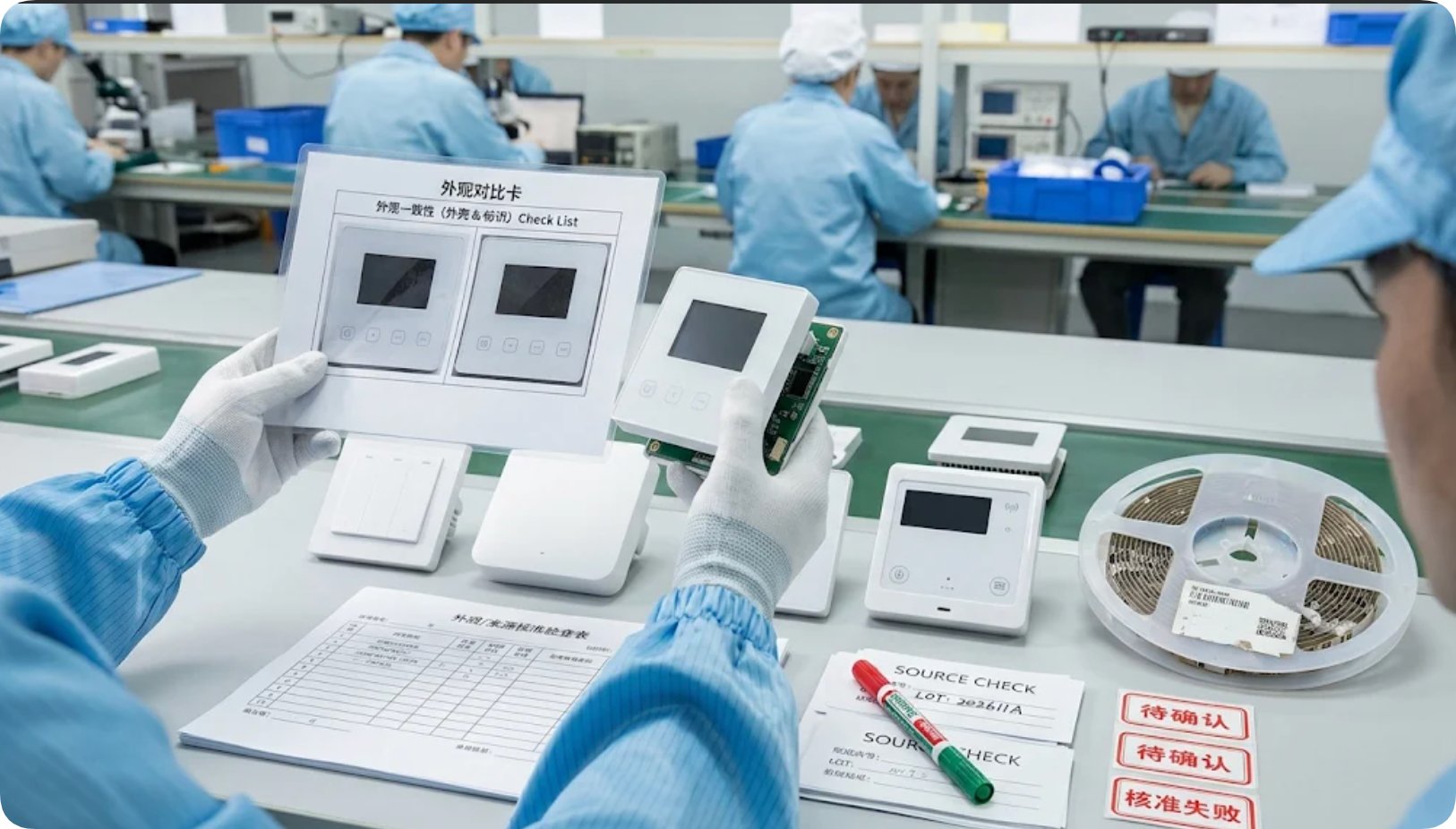
The same discipline helps a smart home build, though the reason differs. A connected appliance programme qualifies a supplier on cosmetic consistency as much as on electrical value, because the housing and the board meet in a visible seam. An equivalent component from an unqualified lot can sit inside a unit that looks acceptable on the bench and is rejected at final appearance inspection. The record that identifies the source is the only evidence that explains the rejection, and it has to exist before the unit is assembled.
💰 A Cost Table Built From the Four Mismatches
The table below is not a price list. It is a map of where money leaves a build when two documents disagree and nobody closes the gap at the bench. The figures are deliberately expressed as the kind of cost that appears on a report, so that the comparison can be made against a real shop-floor budget rather than against an abstract sense of risk.
| Disagreement at receiving | If closed at the dock | If closed after placement | Where the money is recorded |
|---|---|---|---|
| Order names one manufacturer, reel shows another | One disposition note before the reel is issued | Segregated panels, a second inspection and a rebuilt lot record | Inspection hours, not material |
| Certificate date and reel date code differ | Remaining shelf-life budget written on the traveller | Concession decision after printing, or scrap of printed boards | Scrap and engineering time |
| Count sheet is short against the invoice | Credit note on the next order, schedule unchanged | Expedite freight and an idle feeder position | Freight and machine hours |
| Automotive approval file has no entry for the source | Qualification question settled before the build window | Finished-goods hold after all operations are paid for | Working capital and delay |
Read the last column as a single budget line. None of the four rows is primarily a component price. They are inspection, engineering, freight, machine time and working capital, all created after the parts were paid for. That is why a cost breakdown that only examines the bill of materials will always understate incoming quality control. The material was never the expensive part. The paperwork gap was.
Questions to Settle While the Carton Is Still Open
Four questions close most of the gaps before they become costs. Does the reel label name the same manufacturer as the approval file for this customer, not merely an equivalent part? Does the date code on the reel, rather than the shipment date, start the shelf-life clock recorded on the traveller? Does the count on the bench match the invoice line, in both directions? And does the certificate describe the stage of the component that our line will actually handle, including programming or assembly where applicable? Each question takes minutes at the dock and hours to answer once the batch has moved.
The discipline is unglamorous, and that is why it survives poorly in a quote comparison. A supplier can offer a lower piece price while leaving two of these questions unanswered, and the difference will be recovered downstream by someone who is not comparing quotes. We would rather answer the four questions at the bench and keep the line running on a batch whose papers agree. The board that ships on schedule is usually the one whose documents matched before anyone turned on a machine.
A related account of how a mid-build change reaches this same bench appears in a customer BOM change mid-build.