
Most hardware buyers treat an ISO certificate as a static credential on a wall, yet what truly protects a production run is an active clock—the exact moment an operator starts a timer and logs when that window expires. A facility can display every quality certificate in its lobby and still allow a production lot to drift past safe handling limits. Across our manufacturing floor, three operations routinely govern batch integrity—electronic component sourcing, conformal coating, and surface-mount technology (SMT) assembly—and each one begins counting down from a distinct physical trigger.
Those windows do not start when a quote is issued or when a quality manual is signed off. They open at concrete shop-floor events: a carton arriving at incoming inspection, a coating resin being mixed, or a solder paste stencil lifting off a circuit board. Once that event occurs, engineers and operators are actively preserving a documented quality claim rather than merely building boards. Below is how those three clocks operate across a typical Saturday shift and what audit records customers can inspect first-hand.
A Component's Remaining Shelf-Life Clock Starts at Receiving, Not the PO
Procurement teams frequently approach electronic parts sourcing purely around unit pricing and delivery dates. On our receiving floor, incoming materials mark the start of a verifiable shelf-life clock. Every reel or tray carries a manufacturer date code and storage history established weeks or months before delivery—meaning the timer begins at physical receipt rather than purchase-order issuance. Components stored in warm or humid intermediary stock can lose usable shelf life long before assembly begins, a detail no purchase order alone reveals.
Our BOM Electronic Component Sourcing & Procurement workflow verifies genuine supply channels first, audits and qualifies suppliers, validates engineering samples and small-batch specifications, and enforces incoming quality control (IQC) using AQL sampling on key components. AQL inspection turns an unverified part shipment into a dated bench record—establishing exact receiving status before parts enter kitting or placement.
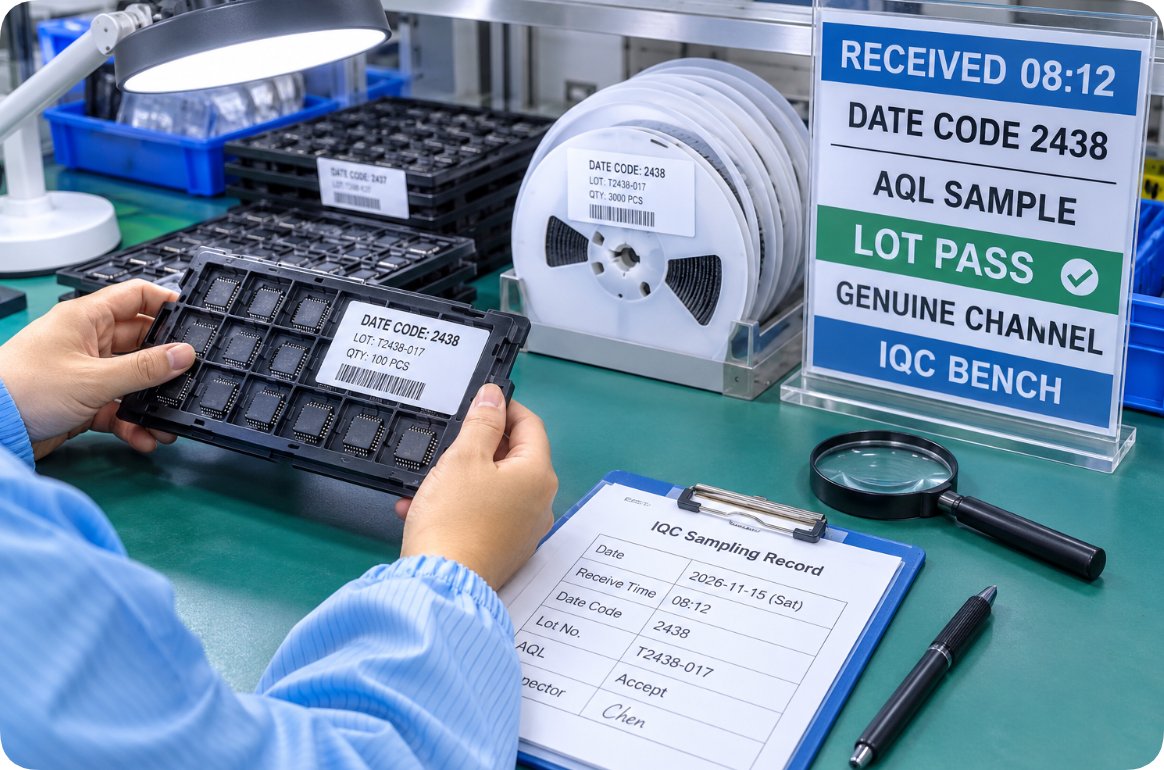
Supply resilience depends on long-term execution alongside cost control. While consolidated purchasing improves commercial terms, decade-long relationships with original component manufacturers and authorized agents help secure allocation priority during tight market cycles. Rather than relying solely on lowest-quote comparisons, we maintain a continuous, timestamped traceability chain linking supplier qualification, sample approval, and IQC bench records for every shipped lot.
Conformal Coating Pot Life: Why Stir Time Beats Visual Guesswork
Conformal coating is often judged visually at inspection, even though its reliability depends heavily on process timing. A circuit board exiting the coating station can appear uniform whether applied well inside pot life or after working life has begun to degrade. Over time, late application can cause uneven film build or allow stray coating material to creep into sensitive keep-out zones such as connectors, sockets, or display assemblies.
Through PCBA Conformal Coating & Three-Proofing Services, we engineer assemblies for real-world environmental demands—including temperature extremes, humidity, mechanical durability, electrical insulation, moisture resistance, and dust protection. Even when manual brushing is used for targeted work, consistency depends on disciplined process timing rather than habit alone. We record the exact mixing/stir time on the production traveller the moment preparation starts.
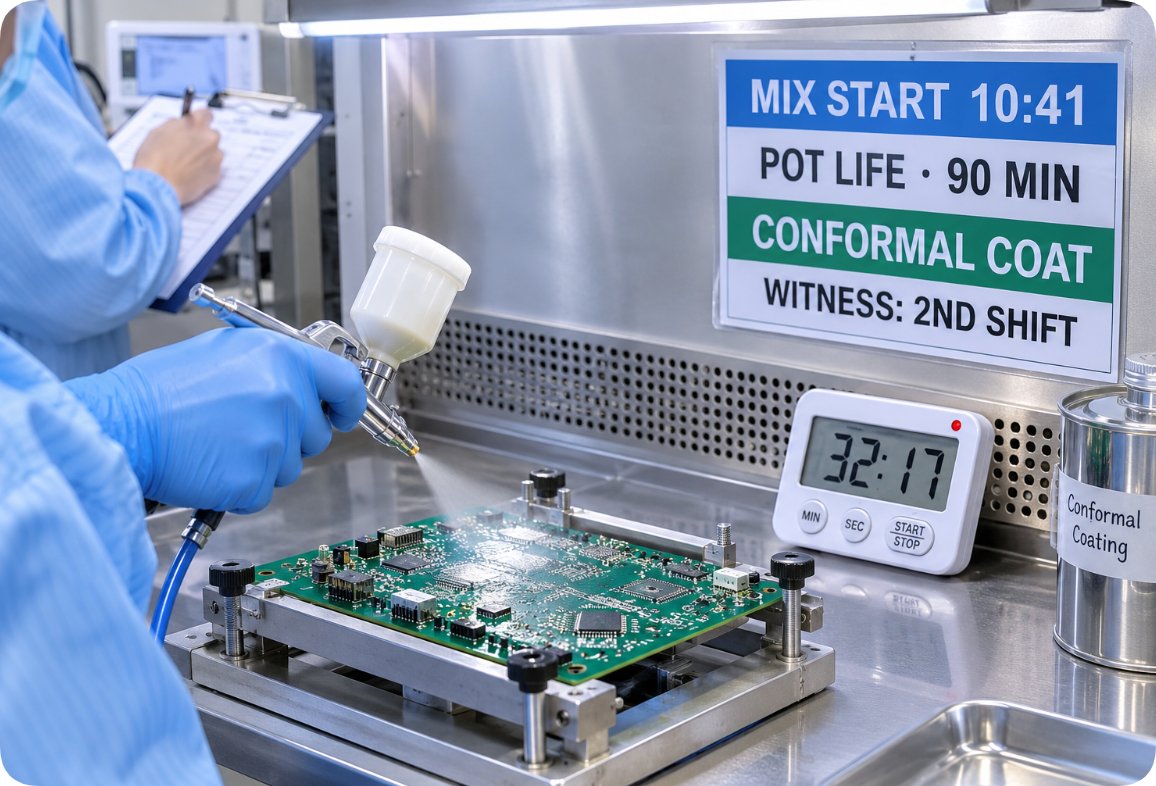
Seasoned operators develop strong visual judgment after coating hundreds of boards, yet ambient temperature and humidity shifts can alter material behavior before viscosity looks obviously wrong. Our floor standard requires the logged start time to govern batch usage rather than informal visual checks—preserving full batch traceability long after boards leave shipping.
SMT Assembly: Tracking Paste Hold Time Between Print and Placement
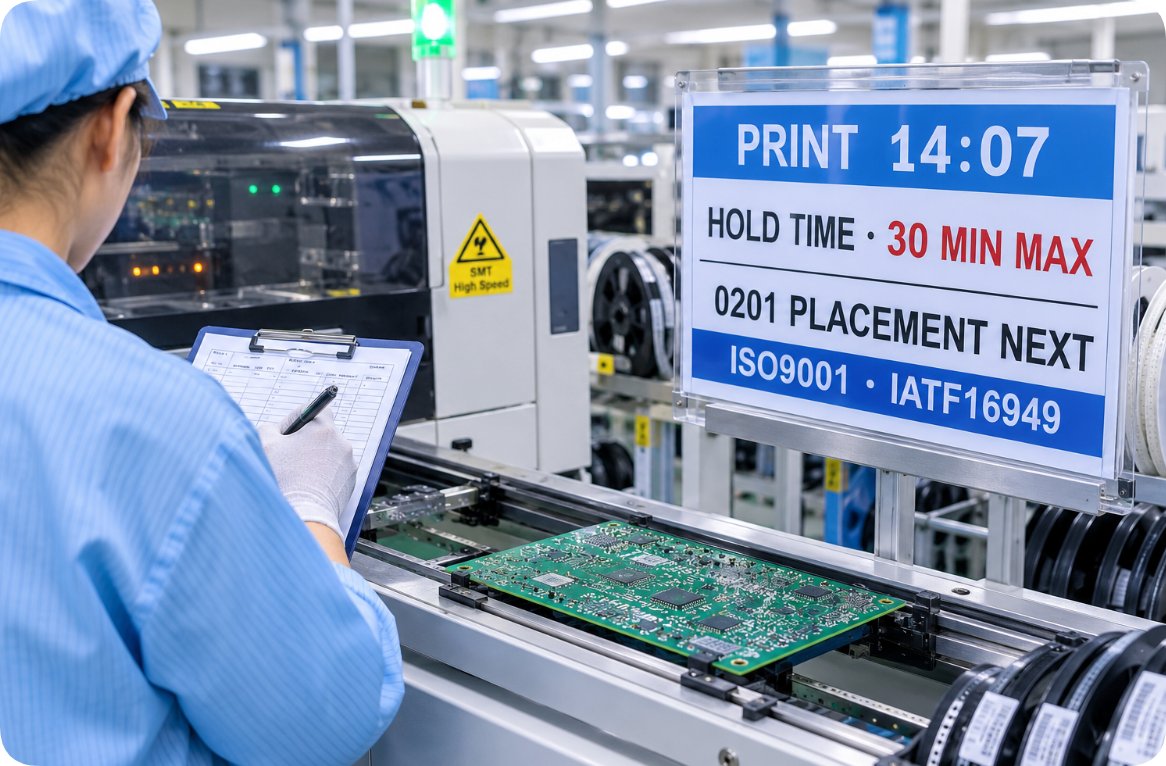
On high-density SMT lines, the operational window between solder paste printing and component placement is tight and easily overlooked during line changeovers. While technicians focus on feeder alignment and pick-and-place nozzles, printed boards waiting in queue continue aging. Our SMT lines place fine-pitch parts down to 0201 package sizes under ISO9001:2015, ISO13485 (medical devices), and IATF16949 (automotive electronics) quality frameworks—certifications that verify system capability while traveller hold-time logs verify execution on every lot.
We issue formal SMT quotations from customer BOM and Gerber files for customer approval, with standard lead times under normal material conditions starting at 3 to 5 working days (excluding national public holidays). Because a quote sheet cannot track live board queues after printing, our High Precision SMT Assembly Lines Factory workflow logs print timestamp and placement timestamp separately on the traveller so any dwell-time drift is flagged immediately for engineering review.
Once pricing is confirmed, customers supply or coordinate BOM components and bare PCBs for pre-production verification before assembly begins. Pre-production verification aligns all three operational clocks across departments—ensuring short-shelf-life parts, time-sensitive coating batches, and printed SMT panels stay synchronized on a shared traveller record that every shift reads.
Side-by-Side Comparison of the Three Shop-Floor Clocks
Each process clock converts physical material behavior into a dated, auditable sign-off. The matrix below summarizes how each window starts, what operators log, and what risk emerges if timing goes untracked.
| Process Area | Trigger Starting the Clock | Recorded Traveller Data | Drift Risk When Unmonitored |
|---|---|---|---|
| Electronic Component Procurement | Carton arrives at receiving bench | Date code, supplier qualification, IQC AQL sampling log | Consumed storage life prior to component placement |
| PCBA Three-Proofing Paint | Coating resin mixture is first stirred | Mix start time, lot ID, operator, environmental target | Uneven film uniformity or ingress into sockets/displays |
| SMT Assembly | Solder paste stencil lifts off printed PCB | Print timestamp, placement timestamp, reviewer sign-off | Solder paste aging prior to initial component placement |
Disciplined logging requires no exotic instrumentation—only clear accountability so recorded timestamps carry weight over casual assumptions. Early board-level milestones are visible through Quick Turn PCB Prototyping & Board Manufacturing, while full-lifecycle records stay unified across Turnkey EMS Electronic Manufacturing Services as programs scale from prototype into volume production.
Two Shop-Floor Near Misses That Proved the Value of Timestamps
In one case, a component lot passed bench sampling cleanly and carried a valid factory date code, yet had already spent extended time in warm storage before delivery. Visual inspection showed no obvious defect, but the logged receiving timestamp revealed how much shelf life remained—allowing planners to assign the batch to a short-cycle build rather than a long-service-life product. AQL sampling alone could not have flagged elapsed storage time without a recorded arrival date.
In a second case, operators mixed a conformal coating batch right before a scheduled changeover. Coverage looked clean at a glance, but a planned pause meant remaining boards would run late into the mixture's working window. Reviewing the logged stir time prompted staff to split the batch and mix fresh material for the remainder of the run—a decision recorded directly on the traveller for customer verification. That same emphasis on documented facts over outward appearance echoes lessons from our earlier review of one rework order, three approaches during line audits.
Audit-Ready Traveller Sheets During Customer Visits
Visiting buyers frequently ask for equipment lists first, whereas complete traveller sheets provide clearer proof of control. Tracing a single assembly from incoming receiving through conformal coating and SMT placement immediately shows who started each clock, who verified it, and what corrective action was taken when a window tightened—revealing real operational discipline under schedule pressure.
We provide complimentary consultation and quotation support, scale seamlessly from prototype builds to mass production under ISO-certified systems, ship worldwide, and assign a dedicated project manager to every account. Those commitments carry strongest weight when paired with dated shop-floor records—from receiving logs and coating stir times to print-to-placement intervals—and connect directly to early board milestones in Quick Turn PCB Prototyping & Board Manufacturing.
How Everyday Operator Habits Sustain Quality Across Shifts
Reliable compliance comes from consistent daily execution rather than post-mortem paperwork alone: logging cartons at receipt, recording coating mix times, and capturing stencil lift and placement timestamps in real time. Assigning clear ownership to the operator performing each step keeps records intact across weekend shifts and rapid changeovers.
Machines and certificates are widely available across contract manufacturers; what sets a dependable EMS partner apart is a culture where documented timestamps outrank guesswork, team members speak up before a window expires, and traveller records stand ready for inspection at any moment.
Frequently Asked Questions
1. Why does a component's validity window start at physical receipt rather than the purchase order date?
The validity window starts when the carton reaches our receiving bench because arrival is when remaining storage life becomes verifiable on site. A purchase order date does not reflect prior distributor storage history, so logging receipt and running IQC AQL sampling establishes an accurate baseline from day one.
2. Can conformal coating meet strict environmental specs when applied manually?
Yes. Manual conformal coating meets temperature, humidity, durability, insulation, waterproof, and dustproof specifications when operators mix within pot life, follow the logged stir start time on the traveller, and protect keep-out zones such as sockets and LCD screens.
3. Which quality standards and component capabilities cover the SMT assembly lines?
Our SMT lines operate under ISO9001:2015, ISO13485 for medical devices, and IATF16949 for automotive electronics, with placement capability down to 0201 components and separate print-to-placement timestamps logged on each board's traveller.
4. Does traveller clock tracking delay standard 3-to-5-day SMT lead times?
No. Under normal material conditions our SMT lead time starts at 3 to 5 working days (excluding national public holidays), and logging timestamps directly during normal workflow steps prevents late-stage rework that would otherwise delay delivery.
5. How does a dedicated project manager support programs from prototype to global shipping?
Each customer receives free consultation and quotation support, a dedicated project manager from prototype through mass production, ISO-backed process records, and worldwide shipping coordination so every build milestone stays transparent.