
From Shop-Floor Habits to Board Yield: NEWEI Smart Wearable and Device PCBA ROI
When people talk about return on investment in electronics manufacturing, they usually open the spreadsheet first. At NEWEI we learned the harder number is the one nobody prints: the habits a team builds on the floor. A disciplined line turns the same machines, the same bills of material, and the same three services into measurably better margin. Those services are PCB manufacturing, the custom smart wearable and electronic device assembly programs, and the procurement discipline that feeds them. If you want to see how a mature plant behaves, start with the process and watch where the small routines live.
Why daily discipline matters more than headcount
A factory culture is not a poster on the wall. It is the set of boring, repeated actions that decide whether a board passes the first time. We track first-pass yield the way a kitchen tracks ticket times. The teams that win are not the ones with the most engineers; they are the ones who agreed, years ago, that a missing torque check is a stop event, not a footnote. That agreement is the cheapest capital a plant can hold, and it compounds quietly across every program that runs through the building.
How team routines cut component procurement lead time
Procurement is where culture shows up first. When buyers, planners, and line leads share one morning stand-up, the component queue stops hiding its risks. A single wearable launch used to wait eleven days for a scarce passive part; after the cross-function routine, the same component is pre-kitted against a rolling forecast. The link is direct: shorter lead time means fewer expedite fees and less dead inventory. You can read how we structure electronic component procurement as a shared discipline rather than a back-office task.

A kit that arrives correct is a line that never stops to hunt for a reel.
SMT and through-hole balance shaped by shared standards
Most of our boards are surface-mount, but the products that survive field abuse still earn a through-hole row where it counts. The standard is not "SMT everywhere." It is "SMT where density wins, through-hole where mechanical stress wins," decided by the same engineering board that owns the yield target. That single rule removes the eternal argument between speed and ruggedness, and it keeps both veterans and new hires aligned without a meeting.
Miniature programs where mindset beats specs
Smart wearable PCBA is unforgiving. The board is small, the battery is close, and the antenna shares the same laminate as the noise. Specs will not save a program when the reflow profile drifts by four degrees. What saves it is a mindset: the operator who treats a tiny solder void as a personal failure, not a quality statistic. That is the difference between a wearable that ships and one that returns. Our custom smart wearable PCBA ODM work lives or dies on exactly this habit, because the margin for error on a 20-millimeter board is measured in microns.
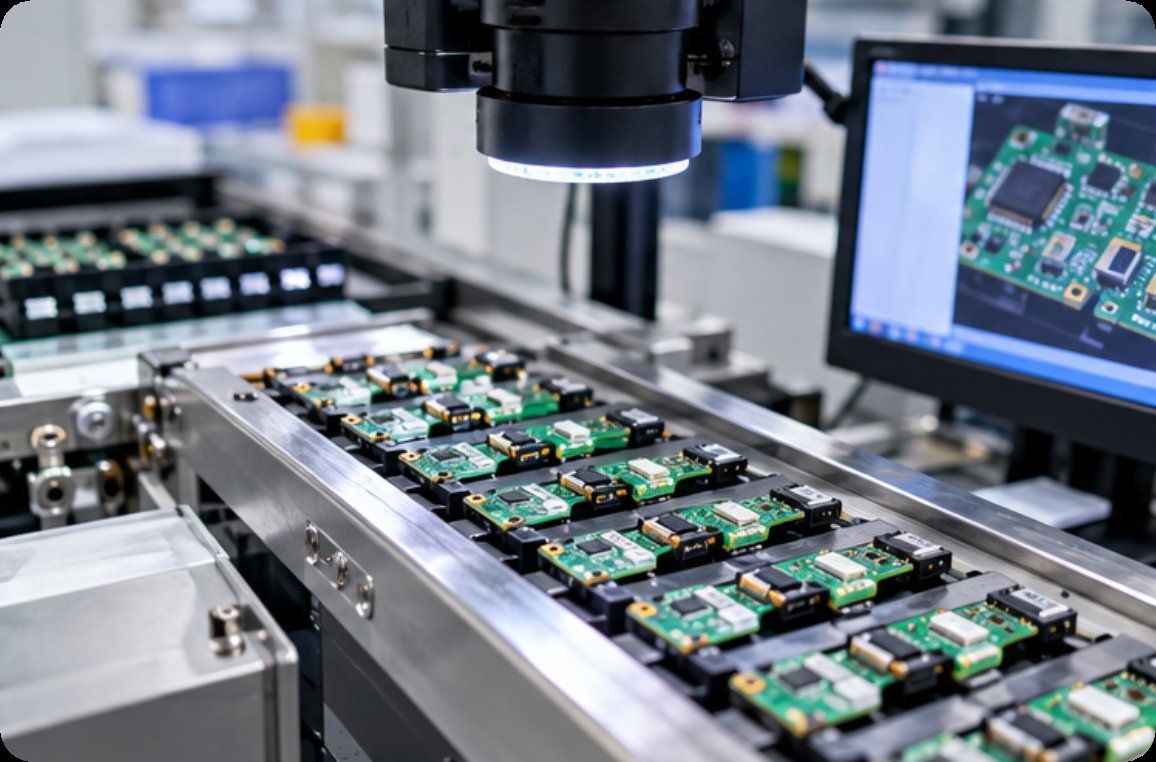
Small boards punish small drifts, which is why the routine matters more than the datasheet.
Box-build lines that learned to predict failures early
Electronic device PCBA often ships inside a larger product, so the cost of a late failure is the whole unit, not the board. The teams that learned to predict failure did it by keeping a living failure library, every return coded, every root cause traced, every fix pushed back into the line within a week. Prediction is just memory with a feedback loop. See how custom electronic devices PCBA programs build that loop into daily work instead of waiting for a quarterly review.

A finished unit that fails in the field costs ten times a board caught on the bench.
Procurement risk reduced by cross-function routines
Risk in procurement is rarely a single shortage. It is the quiet accumulation of single-sourced parts, unbuffered lead times, and forecasts nobody owns. The cross-function routine turns that silence into a weekly list with names attached. When a resistor goes long, three people already know before the line feels it. The mitigation is boring and it works, which is precisely why teams that skip it pay for it later in expedite premiums they could have avoided.
Measuring the payoff: a simple scorecard
Culture is soft until you score it. We keep one table per program so the return is visible to finance, not just to the floor. None of this requires exotic equipment; it requires treating electronics manufacturing services as a system the team owns together, not a cost center to squeeze.
| Program | Upfront effort | Payback window | First-pass yield lift |
|---|---|---|---|
| Smart wearable PCBA | Medium | 2 quarters | +6.5% |
| Electronic device PCBA | High | 3 quarters | +4.8% |
| Component procurement | Low | 1 quarter | +9.0% lead-time cut |
The numbers move because the routines moved first. A +9.0% cut in procurement lead time is not a procurement victory; it is a culture victory that happened to show up in the procurement column.
What a mature line teaches new teams
The last lesson is the cheapest to say and the hardest to copy: a mature line documents its own discipline so the next team does not relearn the pain. We hand new programs a playbook, not a warning. If you are building the same capability, our PCB manufacturing implementation guide is a reasonable place to start, and the habits behind it travel further than any single spec sheet. The return on a strong factory culture is not a line item you find at the end of the year; it is the reason the line item looks the way it does.
Tags: factory culture / ROI / wearable PCBA / devices PCBA / procurement /
Prev: PCB Fabrication and PCBA: Three Lines That Disappeared From the Board Quote
Next: EMS and SMT Assembly: Five Trends Reshaping the Modern SMT Line