Customer audits in electronics manufacturing center on verifiable floor records rather than verbal assurances. Auditors look for clear physical separation of work in progress, documented component qualification and incoming inspection, and end-to-end traceability from bare board to finished shipment. At NEWEI, each stage across through-hole assembly, BOM sourcing, and smart-home ODM production leaves physical markers and inspection records that can be checked directly during a plant review.
Examining three audit scenarios—motor-control through-hole assembly, connected-device component sourcing, and smart-home ODM delivery—shows how station discipline, supplier files, and build traceability answer distinct buyer verification requirements.
Through-Hole DIP Assembly: Station Status Markers and Pre-Solder Inspection
On the DIP Through Hole Assembly & Wave Soldering route, manual insertion and post-solder touch-up increase the risk of lot mixing if board status is unclear. Around cable and through-hole assemblies, dedicated temporary storage zones maintain distinct status identification for boards waiting for plug-in, waiting for maintenance, waiting for QC inspection, marked as defective, or waiting for QA inspection.
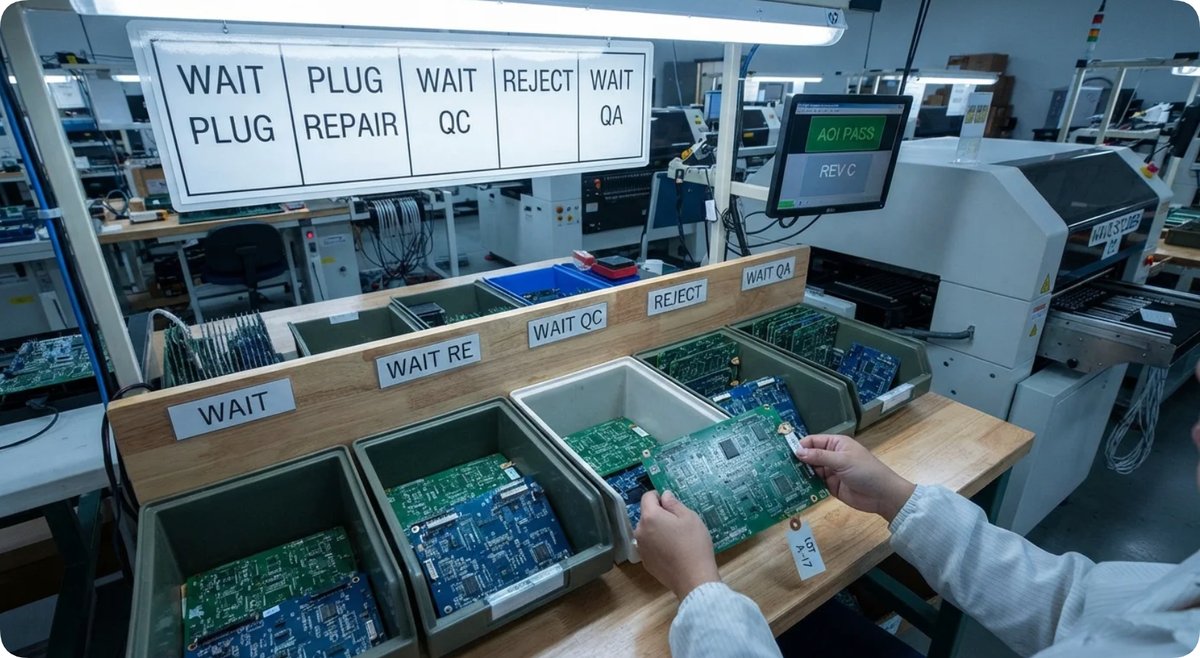
Before boards reach wave soldering, plug-in AOI checks for component errors, missing parts, and reversed polarities. The through-hole line operates four wave-soldering systems alongside fifty-six rear-welding stations with washing equipment, keeping inspection checkpoints aligned with physical routing so rejected boards stay segregated in marked areas instead of re-entering passing batches.
Lot Sampling and Quality Management Execution on the Floor
Written lot-sampling rules turn floor checks into auditable records. Through-hole production applies IPQC and QA lot sampling standards so each inspected batch carries a defined sample check and clear disposition for any non-conforming units.
Operating within management frameworks aligned with ISO 9001, ISO 13485, and IATF 16949 requires connecting high-level procedures to station-level logs. Regulated medical or automotive buyers look for sampling plans, operator/inspector records, and failure disposition—evidence that consistent lot logic supports across production lines.
Component Sourcing Audit: Supplier Qualification and IQC AQL Records
Under BOM Electronic Component Sourcing & Procurement, audit verification extends upstream to how vendors are selected and how incoming materials are screened. Suppliers undergo audit and certification, with sample evaluations and small-batch specifications reviewed prior to qualification.
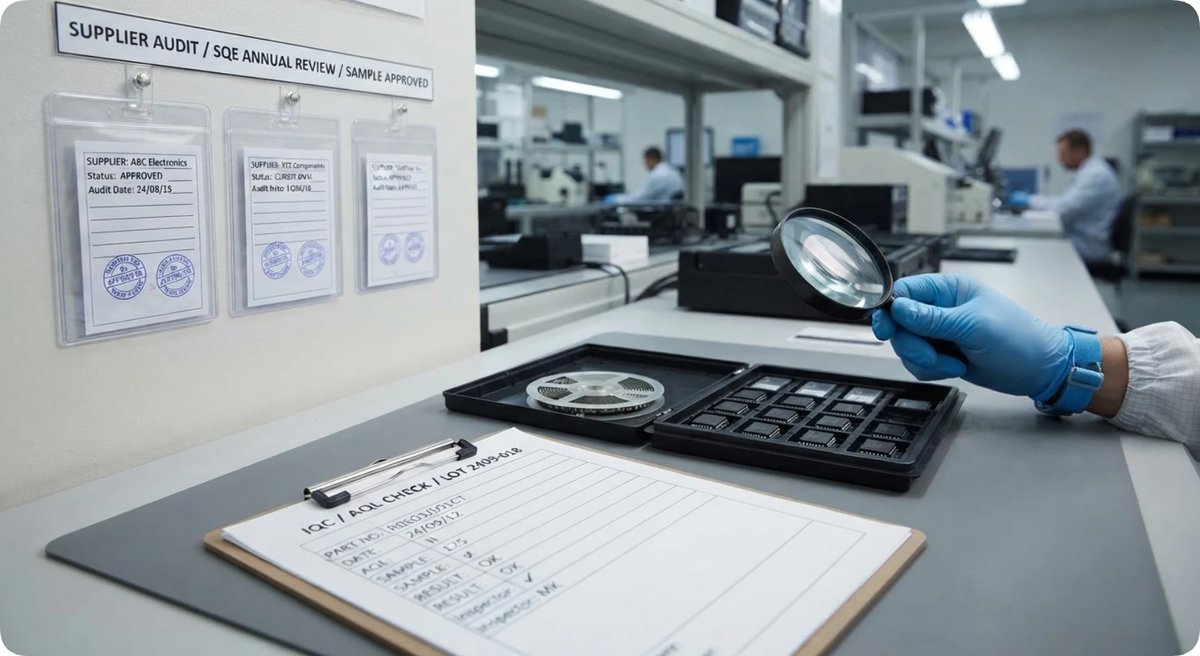
Core components undergo AQL sampling through IQC incoming inspection supported by laboratory and test equipment before entering production. Catching specification drift at receiving prevents out-of-spec parts from consuming SMT placement time or reaching board-level functional testing.
Multi-Year Supply Continuity and SQE Annual Reviews
Product lifecycles demand medium- to long-term part availability alongside current build quality. Sourcing spans ICs, resistors, capacitors, inductors, connectors, crystals, displays, transformers, relays, diodes, and transistors through original manufacturers and authorized channels with 5- to 10-year relationships, reinforced by annual SQE supplier audits.
Centralized procurement and direct factory coordination help manage pricing and allocation during tight supply periods—advantages spot-market purchasing cannot match in consistent lot quality or original-factory technical support.
Smart-Home ODM Traceability From Bare Board to Shipped Unit
For a Smart Home Electronics PCBA OEM ODM Supplier engagement covering IoT devices, smart switches, home automation, and connected appliances, brand owners need unit-to-board-to-line traceability. When a field unit—such as a smart switch exposed to humidity—requires root-cause review, tracing back through conformal coating, connector assembly, board build, and test records narrows down exact process variables.
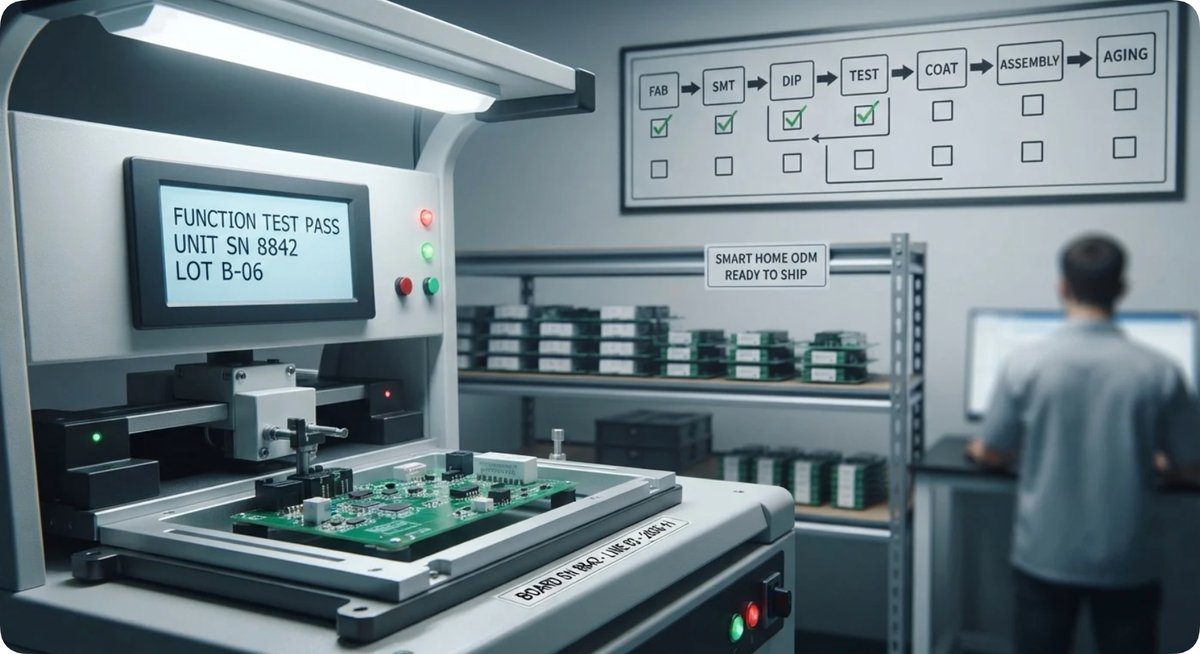
Linking Quick Turn PCB Prototyping & Board Manufacturing provenance with SMT placement, inspection, coating where needed, box assembly, and reliability burn-in maintains a continuous build record from bare board through final dispatch.
Audit Evidence Matrix Across Three Buyer Profiles
Different audit scopes prioritize different primary records during a supplier review:
| Buyer / Audit Focus | Primary Floor / File Proof | Supporting Quality / Trace Record |
|---|---|---|
| Motor-Control Through-Hole (DIP) | Marked WIP status zones (plug-in, maintenance, QC, defect, QA) and plug-in AOI check | IPQC and QA lot sampling records and non-conforming board disposition |
| Connected-Device Component Sourcing | Supplier audit/certification file, sample approval, and annual SQE review | IQC AQL incoming inspection logs on core components |
| Smart-Home ODM Program | Unit-to-PCBA-to-line trace across fabrication, assembly, and coating steps | Functional and aging/reliability test records tied to production lots |
Buyers preparing an audit can request sample WIP station photos, supplier qualification/IQC records, and lot traceability logs prior to site arrival—mirroring the layered tracking approach covered in Custom Electronic Devices PCBA and Smart Wearable ODM Shipments and the end-to-end scope on Turnkey EMS Electronic Manufacturing Services.
Frequently Asked Questions
1. What audit evidence proves boards do not mix across DIP assembly stages?
Marked WIP storage areas separating waiting, maintenance, QC, defect, and QA states—paired with plug-in AOI before wave soldering and IPQC/QA lot sampling—provide clear physical and documentary control over board status.
2. How are sourced components verified before entering production?
Suppliers are audited, sample- and small-batch-approved, and reviewed annually via SQE audits, while core components undergo IQC AQL sampling and laboratory/equipment checks upon arrival.
3. How does smart-home ODM traceability support post-shipment quality review?
Tracking units across bare-board fabrication, SMT/DIP assembly, conformal coating where applied, final assembly, and aging/functional tests links returned units to specific build steps and lot test records.
4. How do long-term supplier relationships support multi-year programs?
Multi-year relationships (5–10 years) with original manufacturers and authorized channels, supported by SQE reviews and centralized purchasing, strengthen allocation resilience and technical backing across ongoing production runs.
Summary Guide to Audit Evidence by Objective
Station Segregation & Pre-Solder Checks: Review DIP assembly WIP state markings, plug-in AOI inspection prior to wave soldering, and IPQC/QA lot sampling logs.
Upstream Component Verification: Review supplier qualification files, SQE annual audit records, and IQC AQL incoming inspection results.
End-to-End ODM Lot & Reliability Traceability: For smart-home and custom board programs, pair board-to-unit build records with PCBA Aging Test & Reliability Testing Service and functional test data across the production run.