
PCB Fabrication, PCBA Three-Proofing Paint and EMS Electronic Manufacturing: The Step After Which Nothing Can Be Undone
Every build plan carries one decision that is easier to make than to live with: where the checks sit. Move them later and a problem surfaces only after more work has been stacked around it. Move them earlier and the same problem is still cheap to answer. On a coated assembly, the spread between those two outcomes is wider than anywhere else in the chain.
Three services meet on that line. PCB fabrication produces the bare substrate, conformal coating seals the finished assembly, and EMS electronic manufacturing carries the build from file to packed carton. Each one passes the work to the next, and only one of them permanently removes the option to go back. What follows is the account of an outdoor monitoring controller order that had to be right the first time, and of what the timing of its checks actually changed.
Why the Last Coating Decides What Earlier Checks Must Catch
Three-proofing paint is formulated to resist high and low temperatures, and once cured it leaves a transparent film bonded across the board. That film is the whole point of the process — it delivers insulation, moisture resistance, leakage resistance, dust prevention, corrosion resistance and ageing resistance in a single pass. It is also what makes the step different in kind from everything before it.
Every earlier operation leaves the assembly recoverable. A trace can be reworked, a joint can be reflowed, a component can be replaced. After the film sets, none of those options survive in their original form. A repair does not begin with the joint. It begins with breaking the coating open, and it ends with a fresh application that has to be cured and re-verified. That is why the placement of the checks is a coating decision, even though it is made long before the spray head ever moves.
Where the Bare Board Is Still Open to Change
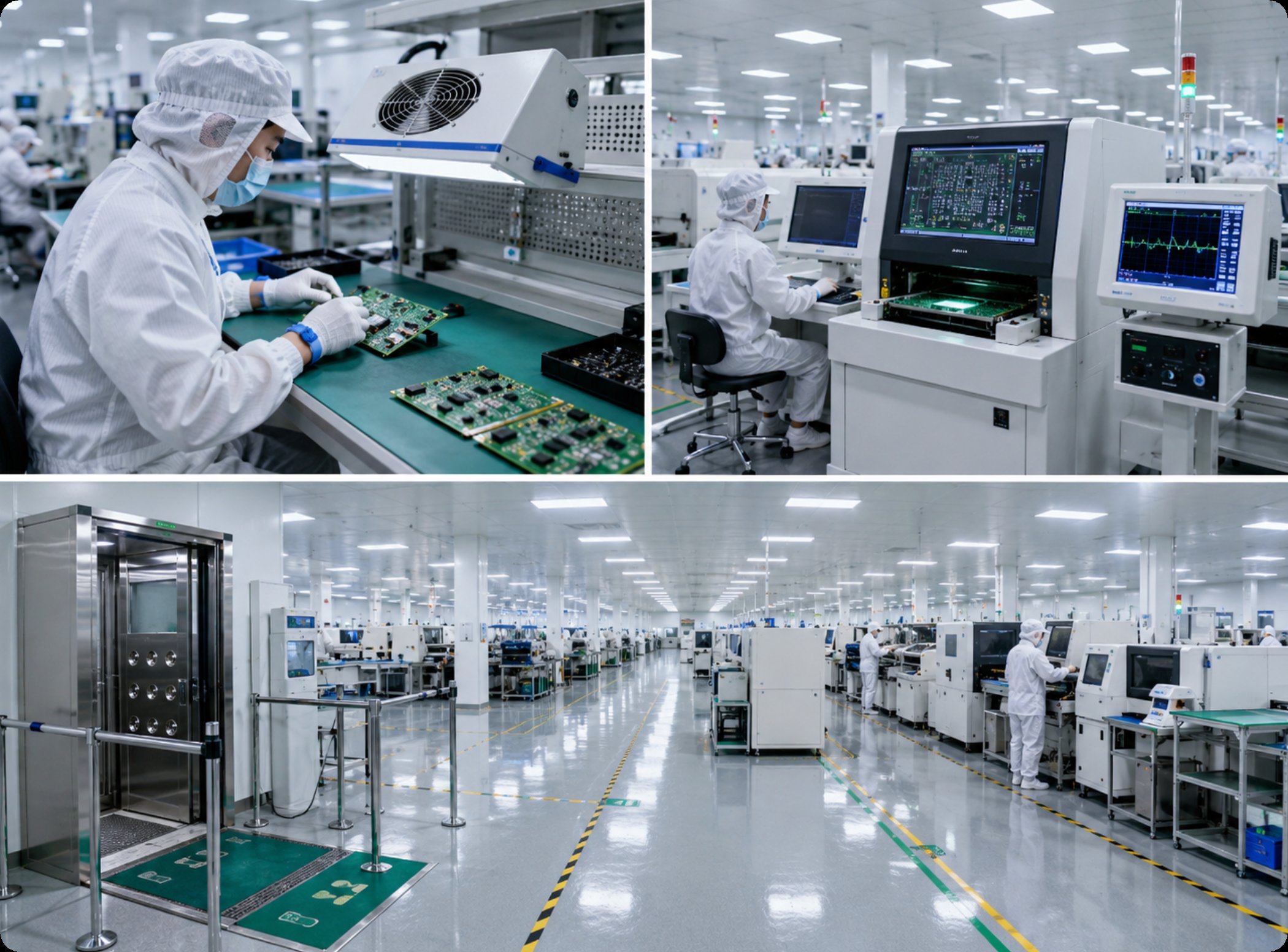
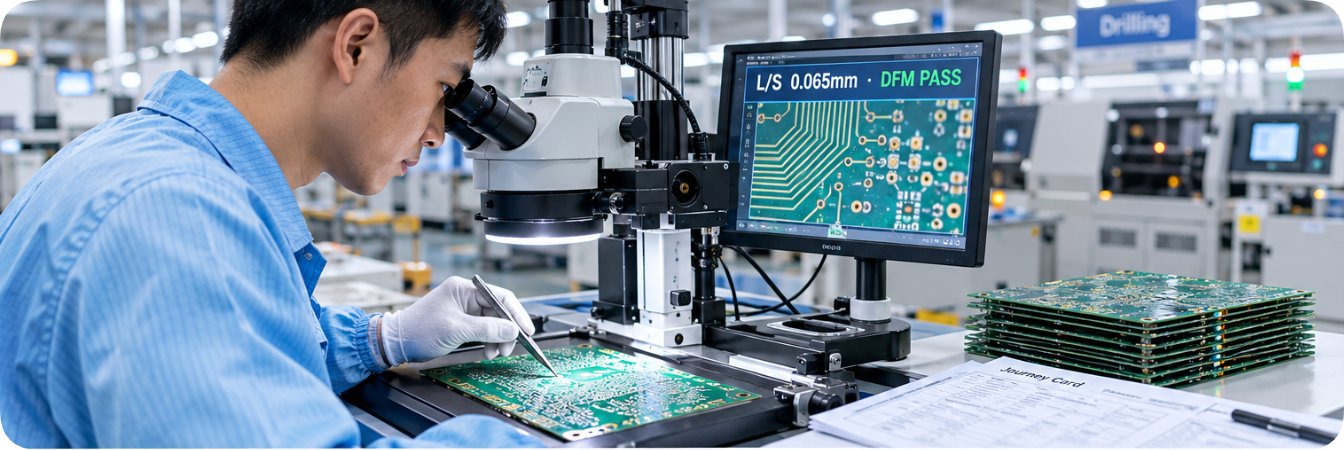
The earliest point of the order is also the most forgiving, and it belongs to the bare substrate. This shop runs 1 to 36 layer multilayer boards with HDI, blind and buried vias, BGA, in-tray holes, gold fingers, resin plugged holes, laser drilling and 3mil line width and spacing. Capability reaches a maximum of 40 layers, a plate thickness from 0.4mm to 8.0mm, a thickness-to-diameter ratio of 14:1, copper up to 10OZ and a working panel up to 2000x610mm. Surface finishes cover ENIG, OSP, HASL and hard or soft gold plating.
What made this stage useful on the controller order was not the parameter list but the reporting that comes with it. All DFM manufacturability checks and process problem discovery reports produced during production are free of charge, and the findings are reflected back in the trial production report. A stack-up that sits near an edge of the process window, or an aperture that the drill program cannot hold, is still a conversation rather than a loss. Quality management runs to ISO9001, ISO13485 and IATF16949, so the record of that conversation is filed rather than remembered.
Choosing What the Coating Must Leave Alone
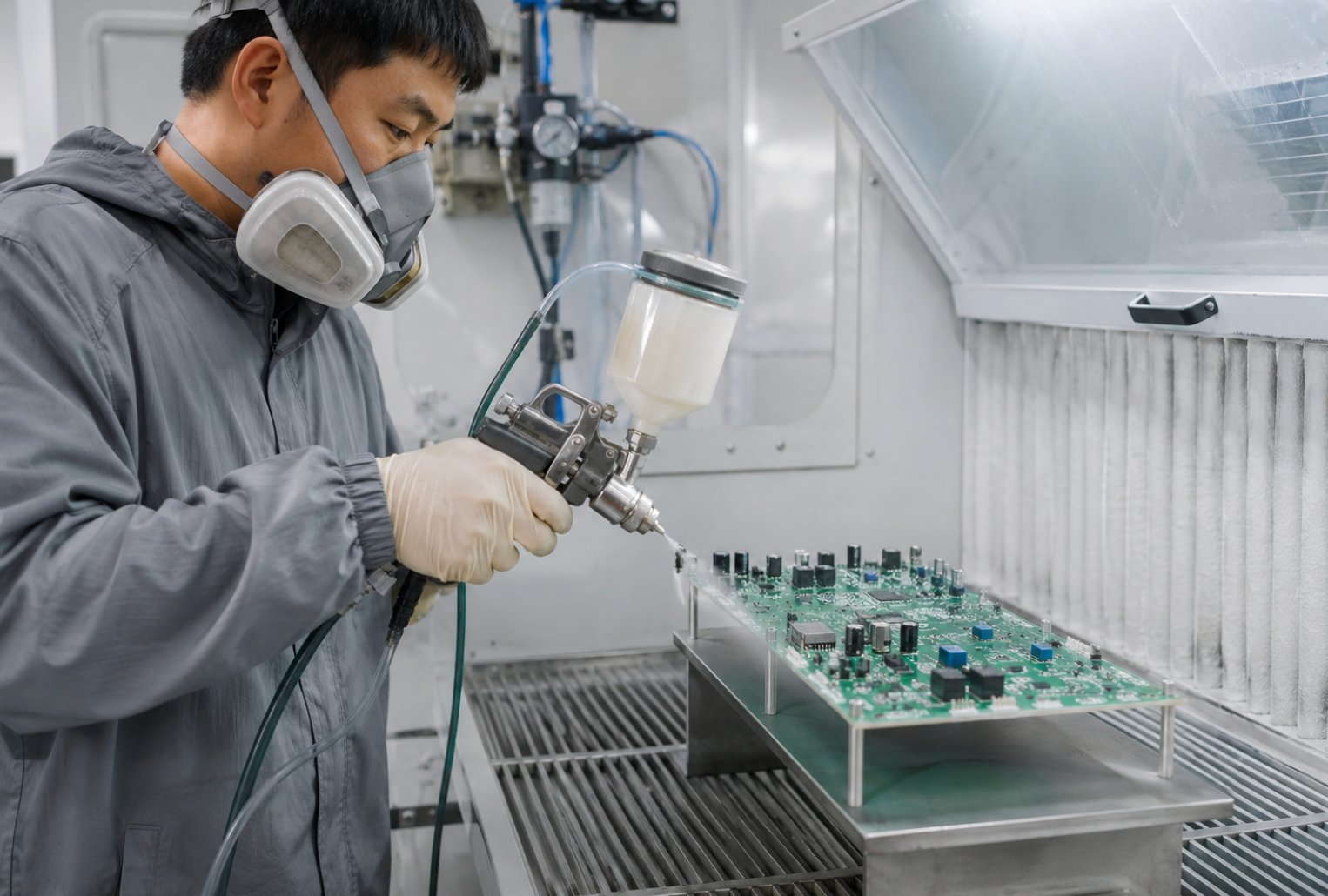
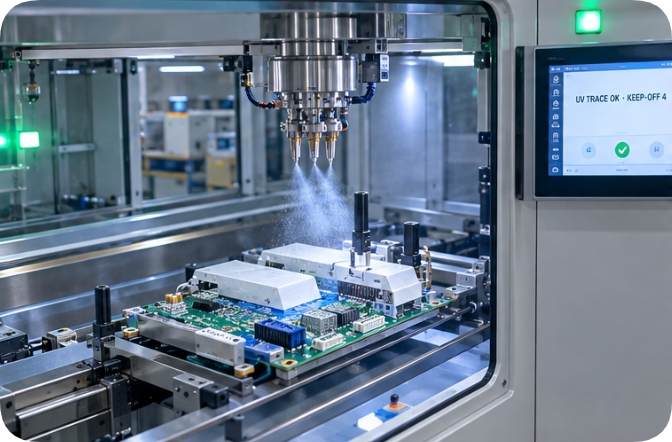
The spraying itself is where the irreversible boundary is drawn, and the drawing is deliberate. The line holds two three-proofing paint units plus UV detection and baking in a fully automatic one-stop arrangement, and it accepts large PCBA board such as 550mm x 470mm with matched carriers that keep the edge spray even. Fan-shaped and needle spraying are combined to cover a range of component profiles, and boards carrying dense, high-standing parts are handled without hand work.
The part that matters most for a build like this one is selective avoidance. Connectors, antennas, WiFi modules and heat sinks can be masked off according to the actual requirement, so the coating protects the board without sealing the interfaces that have to stay open. Traditional manual painting is where the opposite happens: thin and thick patches, contamination carried into the film, and paint finding its way into sockets or display windows. Automated application removes that class of accident, but it also fixes the result earlier in the schedule.
After the Film Sets, a Repair Means Starting Over
Once curing is complete, the assembly is no longer a set of joints. It is a coated unit, and any later change runs through a longer path: open the film at the affected area, clear the residue, rework the joint, apply fresh material, cure it again, and bring the board back under UV inspection to confirm the film is continuous. Each of those steps can be done, but each one carries its own chance of thinning the protection somewhere else.
On the controller order, a routine pull of finished assemblies ahead of the spray turned up soldering that would not have passed a later review. Because the sample was taken while the boards were still bare assemblies, the answer stayed inside the ordinary rework path. A small number of units went back to the line, the rest continued on schedule, and no coated board had to be opened up again. Had the same sample been drawn from the sealed side of the process, the correction would have been the same in principle and far more expensive in practice.
Arranging Checks Around the Point of No Return
A single partner that owns the whole route can place the checks wherever they do the most good, because nothing is handed to an outside processor between stages. The programme covers design support, component procurement, board production, SMT assembly, DIP assembly, testing, coating, finished product assembly and final verification. Board production itself never leaves the building, spanning through-hole PCB, flexible circuits, HDI, blind and buried vias and carbon film boards, at a monthly capacity reaching 50,000 square metres under TS16949, UL, CE, RoHS and ISO9001.
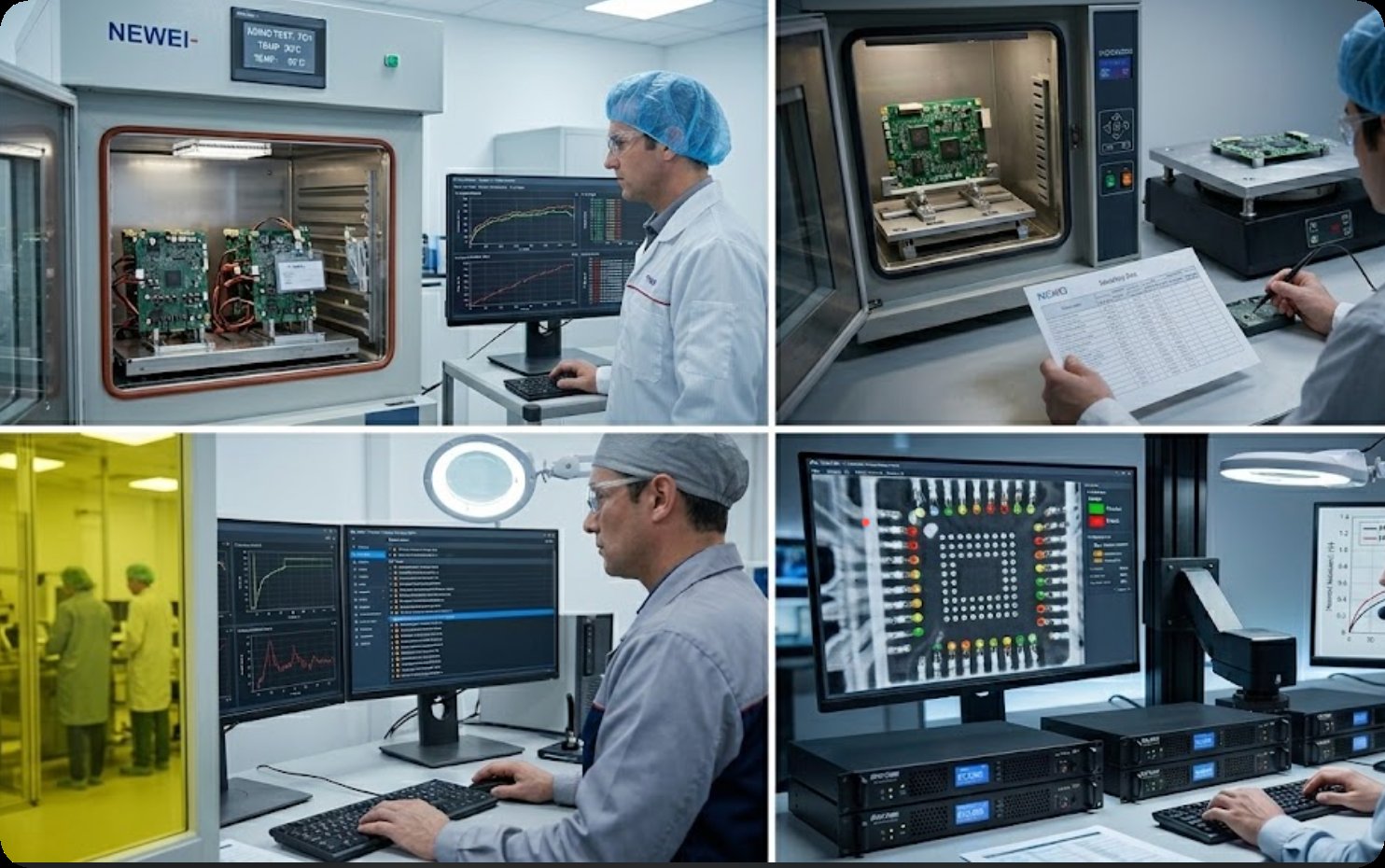
Verification on this order leaned on aging test as the backstop rather than the first filter. Products are held under specified temperature and humidity while running continuously for 72 hours to 7 days, with performance logged throughout and the results fed back into the production process. Flying probe and test fixture checks cover what can be judged electrically, and AOI covers what has to be judged visually. Put together, the arrangement means the expensive, late, irreversible verification is spent only on work that has already survived the cheap, early checks.

How the Order Ended Up
The units that returned to the line came back through the spray with the rest of the lot, and the coating run closed without a single board having to be stripped and redone. Nothing about the outcome depended on a heroic catch. It depended on where the sample was drawn — one step before the film, not one step after it. The same inspection, moved by a single operation, would have produced a very different week.
What Each Service Still Lets You Change
The three services do not offer the same freedom, and the difference is the whole reason the schedule has to be read as an order of operations rather than a shopping list.
| Service | What is still changeable | What closes here | Who normally decides |
|---|---|---|---|
| PCB Fabrication | Stack-up, drill programme, aperture sizes, copper weight, surface finish | Nothing permanent — the substrate can be re-cut or re-fabricated | Design and process engineering, from the DFM report |
| PCBA Three-Proofing Paint | Which interfaces are masked, thickness targets, single or double sided application | Direct access to every joint and component underneath the cured film | Coating engineering together with the customer's requirement |
| EMS Electronic Manufacturing | Inspection placement, test coverage, sequence of verification stages | Nothing by itself — but it decides what the coating step inherits | The manufacturing programme owner |
Questions to Ask Before You Approve a Coating Run
A short list keeps the schedule honest. Where is the last inspection taken before the film goes on, and who signs it? Which connectors, antennas, modules and heat sinks have been listed for selective avoidance, and are they listed by the customer or assumed by the shop? Is the verification plan built backwards from the irreversible step, or forwards from the first operation? And if a defect did surface after curing, has anyone written down what the recovery actually involves? Ask those before the spray head moves, and the answers are decisions. Ask them afterwards, and they are costs.
Tags: three-proofing paint / quality inspection /
Next: No more...