

SMT Assembly and EMS Electronic Manufacturing: Reliability as a Set of Permissions
A staffing plan for a reliability programme usually arrives as a headcount: so many operators, so many inspectors, so many engineers on call. None of those figures answers the question that decides whether the programme holds together. What decides it is how far down the ladder a judgement may travel before it stops, and who is standing on each rung when the second shift begins. Two factories with identical numbers on the sheet can produce entirely different reliability evidence.
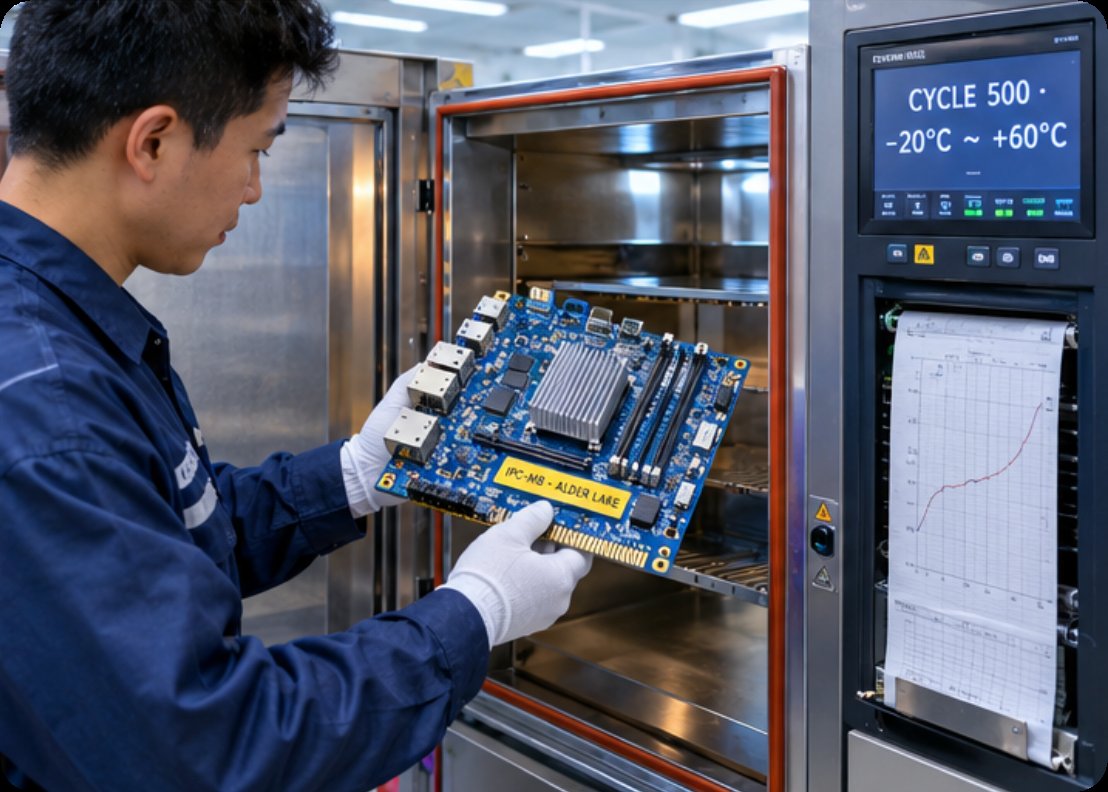
Aged boards do not fail politely. A rack that runs for three days produces a curve, and the curve is worth nothing unless somebody is permitted to read it and act on it. On our own lines the aging test window runs from 72 hours to 7 days under specified temperature and humidity, with performance logged throughout and the findings returned to production. That loop closes only when four different people are allowed to do four different things.
The Number That Never Appears on a Staffing Plan
A changeover in the middle of a soak never shows up as a headcount problem. What shows up is a board taken out of one chamber and never logged into the next, and by the time anyone notices, the hours are gone and the sample set is worthless. Under an EMS electronic manufacturing programme the work crosses design support, component procurement, board production, placement, plug-in, testing and final assembly. Every handover along that route is a place where permission either exists in writing or does not exist at all.
So the figure worth tracking is not how many people stand on the floor. It is how far a decision may travel before it needs a higher rung. That distance can be written down, audited and handed to the next shift, and once it is written down the headcount argument disappears. A line can be thin and still produce evidence that survives a customer audit, provided the thin part is the part that was never permitted to decide anything.
Rung One: Loading a Rack and Recording What It Must Prove
The first rung belongs to whoever loads the chamber, and its whole value is that judgement is not part of the job. The operator sets the profile specified for that product, whether that is a room temperature soak, a high temperature run, a low temperature run or an alternating temperature and humidity cycle. Sample quantity is counted, the clock is started, and nothing about the outcome belongs to the person who pressed the button.
This is also where the physical build meets the plan. Four high-speed SMT assembly lines load, print, place and reflow the boards that will later occupy those chambers, and those boards carry what makes an accelerated soak meaningful at all: 0201 sizes, 0.4mm pitch BGA and QFN parts. The heavier the component mix, the more exact the loading step has to be, because a sample that is not what the plan describes produces a curve that proves nothing.

Rung Two: Watching a Curve Without Intervening
Watching is its own rung, and separating it from loading is what keeps both of them cheap. The watcher reads logged performance for the duration of the run, flags anything that drifts, and records it without touching the sample. If something looks wrong, the correct action is a note and a call, not an adjustment. A soak quietly corrected halfway through is worse than a soak that fails loudly, because the failure can be investigated and the correction cannot.
Our own arrangement puts a quality team of more than twenty people around exactly this kind of boundary, with incoming inspection, in-process inspection and outgoing inspection kept as separate stations rather than one roving pair of eyes. Ten electronic engineers work alongside them on manufacturability and process improvement. The reason for splitting those duties is not supervision. It is that the person who watches a curve should never be the person whose judgement the curve is testing.
Rung Three: Naming a Lot as Failed
Somebody has to be permitted to stop a lot, and that permission cannot be borrowed for an afternoon. Naming a failure is uncomfortable work: it moves a delivery date, it opens a customer conversation, and it arrives at the exact moment when a plausible explanation is offered instead of a verdict. The rung exists so that the call is made by someone whose job does not depend on the schedule. What makes the call survivable is that the evidence behind it is never a single curve, because in-circuit checks, functional fixtures built around the customer's own test points, optical inspection and X-ray each leave their own record.
Rung Four: Signing the Waiver That Lets It Ship
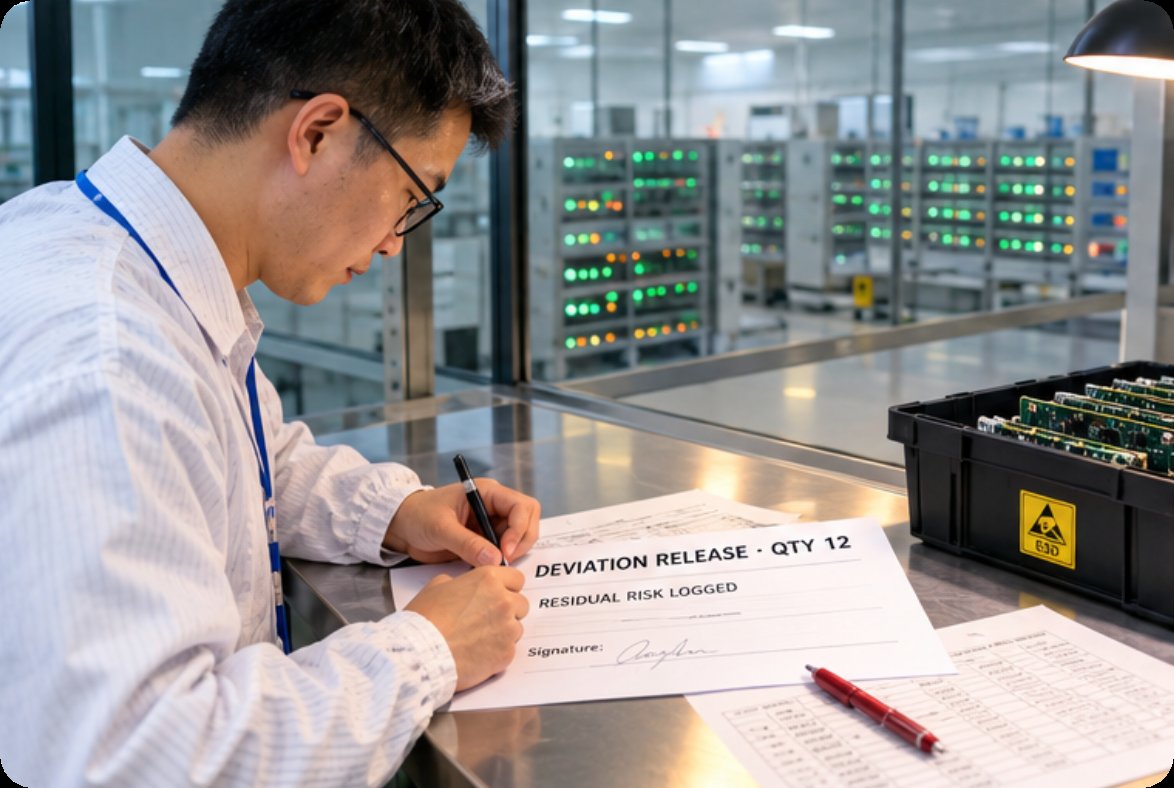
The highest rung is the least comfortable, because it exists for the case where the lot is imperfect and the order still has to move. Releasing a deviation is not the same as forgiving a defect. It is a written decision that a known departure is acceptable for a named quantity, on stated grounds, with the residual risk recorded. That signature is why the ladder has to belong to a company rather than to a person: an owner of the whole route can staff every rung from inside the building, and an internal annual supplier audit keeps the paperwork behind a release refreshed rather than inherited.
What Each Rung Has to Leave Behind as Evidence
The rungs are only real if each one produces something a stranger can read. A permission that leaves no trace is a habit rather than a control, and habits do not survive a shift change or a customer audit.
| Rung | What the holder may do | What the holder may not do | Trace left behind |
|---|---|---|---|
| Loading | Set the specified profile, count samples, start and stop the clock | Interpret the run, or decide that a drift does not matter | Profile used, sample count, start and stop times |
| Watching | Read logged performance, raise an anomaly, hold the run | Adjust the sample or the profile to keep a curve smooth | Timestamped log with anomalies flagged |
| Judging | Name a lot as failed and stop it from moving | Trade the failure against a delivery date | Verdict plus the independent records behind it |
| Releasing | Authorise a named quantity to ship with a known departure | Extend that decision to a later or larger lot | Signed waiver naming quantity, grounds and residual risk |
Read down the last column and the shape of the programme appears. Each rung passes upward a smaller and more expensive decision, and the record it leaves is sized to match.
The Gaps Between Rungs Are Where Claims Slip
Most reliability problems I have seen did not happen at a rung. They happened in the space between two of them, where a reasonable person assumed that somebody else had already looked. The classic version is a deviation acknowledged on the floor and never written down, so the customer's first notification is the failure itself. The second is a sample count agreed verbally at the start of a run and quietly reduced at the end of a shift.
Hardware makes those gaps more expensive. Industrial PC PCBA built on Alder Lake, Kaby Lake or Elkhart J6412 platforms is expected to run for years inside a cabinet, a kiosk or a vehicle, and a departure tolerated on a short-life consumer board is not tolerable on a board nobody will open again. When the service life is long, the gap between rungs is where the whole warranty quietly lands.
Where the Ladder Stops Being Optional
A ladder is not a bigger team. It is a written answer to four questions: who may load, who may watch, who may judge, and who may release. Write those down and a reliability programme becomes transferable, because a new supervisor inherits a set of permissions instead of a set of assumptions. Leave them out and the programme depends on particular people staying, which is the most expensive dependency a factory can carry. You can learn more about our manufacturing capabilities and see how the four rungs are staffed on our own lines.
If you are auditing a supplier, ask for the four rungs rather than the organisation chart. Which rung may stop a lot on its own authority, and at what point in a soak the customer is told. Those answers are short when the ladder exists, and long, vague and full of names when it does not. Send us your test plan and we will tell you which rung your product is sitting on, and which one nobody has been given.
Tags: SMT assembly / reliability ladder /
Next: No more...