Peak-season production schedules typically track machine hours, component arrival dates, and shipping targets, while overlooking the shared inspection desk. In practice, three distinct outputs from an electronics program converge on that same desk within the same week—and each requires a verification that the others cannot substitute. Bare boards from Quick Turn PCB Prototyping & Board Manufacturing must pass copper-geometry and dimensional checks before placement begins. Populated boards from High Precision SMT Assembly Lines Factory require in-process solder and placement verification while the line is running. Boards destined for Industrial Computing IPC Motherboard Manufacturer builds require reliability soak testing before shipping as finished embedded hardware. When peak demand fills the calendar, throughput depends on queue order at the inspection desk as much as line speed.
Rather than repeating machine capacity figures, this operational guide breaks down the three non-interchangeable verifications, identifies which checks can be pulled forward into quieter weeks, and shows how to sequence peak-season schedules around immutable inspection windows.
💡 Why the Inspection Desk Sets Peak-Season Delivery Dates
Four high-speed SMT placement lines equipped with solder paste printing and SPI solder paste thickness inspection, paired with a three-to-five-day turnaround window, often make placement capacity look like the sole bottleneck. Once peak-season order volume rises, engineering and quality resources become the tighter constraint: a quality team of more than 20 specialists handles incoming quality inspection (IQC), in-process inspection (IPQC), and final factory inspection (FQC) across all programs, working alongside 10 electronic engineers who author design-for-manufacturability (DFM) feedback. Production lines can add shifts, whereas verification sign-offs depend on shared specialist bandwidth and physical test fixtures.
Treating inspection as a fixed background step rather than a finite daily decision queue explains why completed PCBs sometimes wait on release sign-off at the end of a busy day. Planning peak volume around daily verification capacity—and moving non-time-bound checks earlier—prevents last-minute dispatch delays.
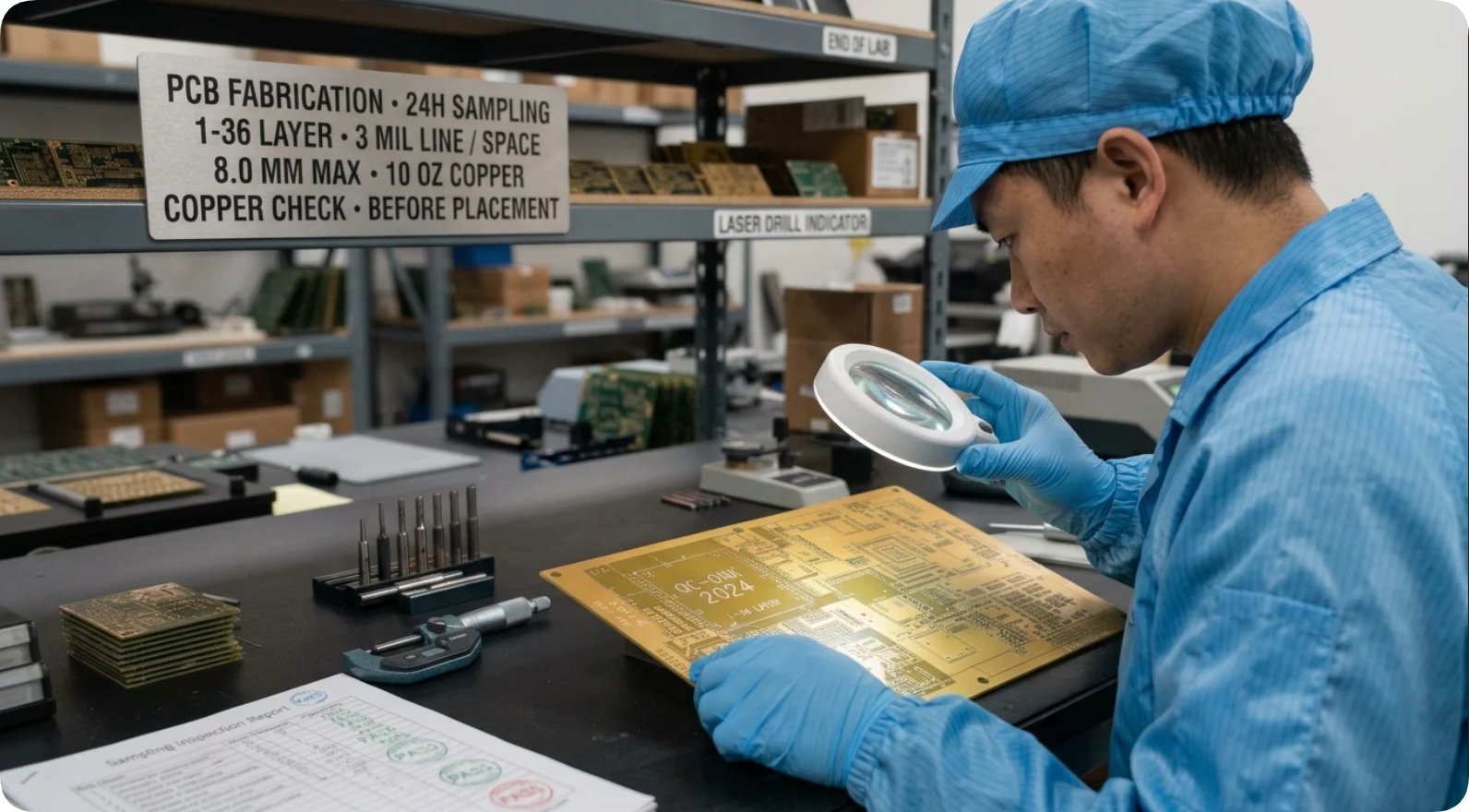
Bare-Board Verification Before SMT Placement Begins
PCB manufacturing capabilities span rapid 24-hour sampling, 1-to-36-layer boards, 3-mil minimum line width and spacing, up to 8 mm board thickness, up to 10 oz heavy copper, and panel sizes up to 2000 × 610 mm. Process capability defines what the factory can build, not whether a given revision meets acceptance criteria before components are mounted. Copper geometry, via drilling and plating, blind/buried vias, BGA land patterns, and gold-finger edges must be verified before SMT placement, since components obscure internal and under-package features once assembled.
Because bare-board acceptance ties to board revision rather than a specific placement shift, it can be scheduled during quieter pre-peak weeks. Completing sampling, DFM review, and dimensional sign-off early reduces peak-week inspection load to revision confirmation—and pairing bare-board records with BOM Electronic Component Sourcing & Procurement ensures incoming material inspection and board records are ready together.
In-Line SMT Verification During Active Production Runs
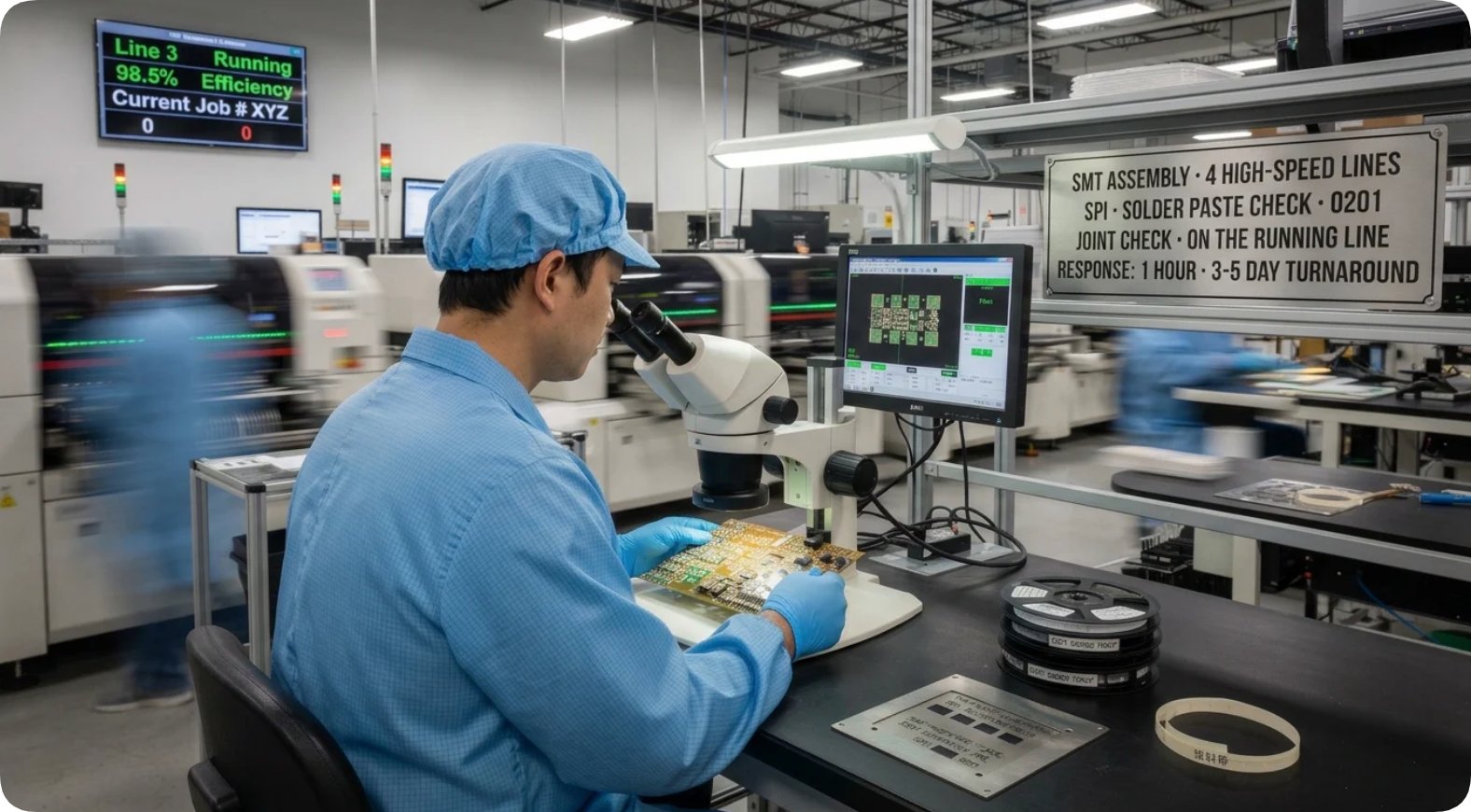
Surface-mount verification depends on live process data captured while the line runs: SPI solder paste deposit checks, high-speed placement down to 0201 passives, and solder-joint inspection under a standard three-to-five-day delivery window (assuming kitted materials and normal line conditions). Supported by a one-hour abnormal-condition response workflow and electronic production-plan tracking, line-side checks catch paste or placement drift in real time—whereas post-run checks cannot recreate live process state.
During peak weeks, IPQC inspectors cover both bare-board and SMT workflows simultaneously. Scheduling a placement run on a less congested day naturally moves its inspection window along with the run, whereas trying to defer inspection without moving the run loses real-time process visibility.
Comparing the Three Non-Interchangeable Verifications
The table below contrasts what each verification accepts, when its evidence is generated, and how much scheduling flexibility it allows during peak periods.
| Program Output | Verification Scope | When Evidence Exists | Schedule Flexibility |
|---|---|---|---|
| Bare Fabricated PCB | Copper geometry, hole tolerance, plating, and sampling report | After PCB fabrication, prior to SMT placement | Can be pulled forward into quieter pre-peak weeks |
| SMT Assembled PCBA | Solder paste deposit, component placement, and joint quality on the line | During active production line operation | Moves only together with the scheduled SMT run |
| Embedded Industrial Board Build | Reliability soak test results under powered operation and build records | After board assembly is completed | Cannot be pulled forward; follows assembly completion |
Backward scheduling from the ship date starts with the post-assembly reliability check because it requires a finished board and cannot be executed ahead of placement.
Post-Assembly Reliability Soak for Industrial Computing Boards
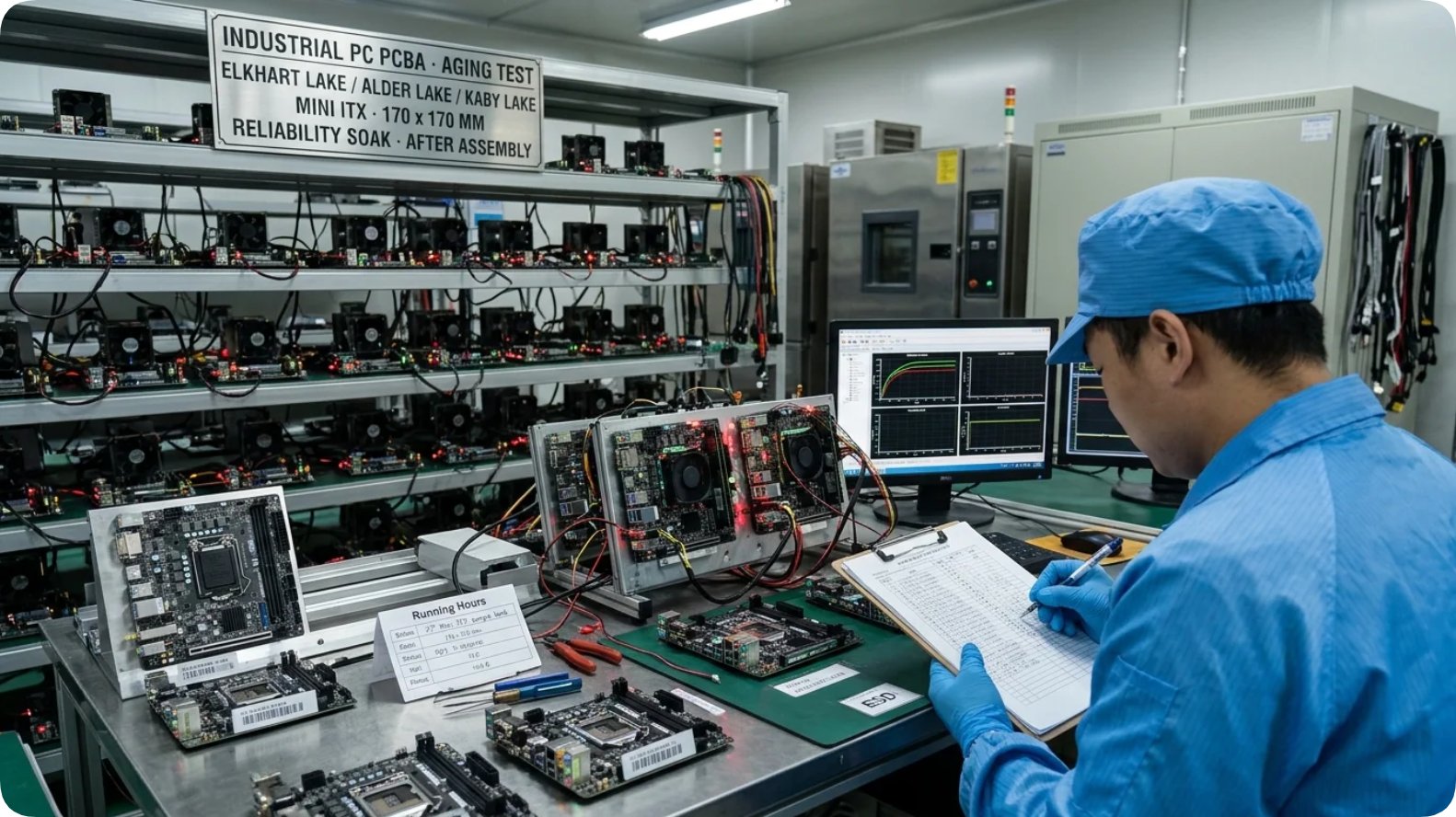
Industrial computing platforms—including embedded designs across Intel Elkhart Lake, Alder Lake, and Kaby Lake architectures as well as 170 × 170 mm Mini-ITX and 3.5-inch form factors—are specified as functional computing products rather than bare or populated boards alone. Through PCBA Aging Test & Reliability Testing Service, powered burn-in under load verifies functional stability and detects early drift before shipment.
Because powered burn-in requires a complete assembly and runs for a defined soak duration, reserving soak time upfront ensures assembly finishes early enough to complete testing without compressing quality sign-off.
Queue Prioritization and Pre-Peak Planning Checklist
When bare-board, SMT line, and embedded reliability verifications arrive during a peak push, sequencing by process dependency—bare-board sign-off before placement, in-line SMT checks during the run, and reliability soak after assembly—protects irreplaceable evidence regardless of order size. Within Turnkey EMS Electronic Manufacturing Services, clear sequence rules keep urgent release exceptions transparent and auditable.
Before peak volume hits, lock in three steps: complete bare-board sampling and DFM acceptance ahead of rush weeks, align SMT inspection coverage and one-hour exception response with scheduled line dates, and reserve reliability soak hours working backward from target ship dates. To see how component procurement and mechanical enclosures coordinate on the material side, read Electronic Component Procurement and Shell Mold: How Both Streams Reach a Peak-Season Pack-Out Bench Together.
Frequently Asked Questions
1. Can bare-board verification be completed ahead of peak-season SMT placement?
Yes. Bare-board copper geometry, hole tolerances, plating, and sampling reports apply to the board revision itself and can be verified during quieter pre-peak weeks so peak-week placement runs start with accepted boards.
2. Why must SMT assembly verification happen during the active production run?
In-line checks capture real-time SPI paste thickness, component placement accuracy, and joint conditions while the line operates, allowing immediate correction and preserving process evidence that cannot be reconstructed after the run ends.
3. Which verification window should anchors backward scheduling from a target ship date?
The post-assembly reliability soak anchors backward scheduling because it requires a completed board and runs for a set duration after SMT assembly, giving planners a fixed end-stage duration to build around.
4. Does order volume override verification sequence at the shared inspection desk?
No. Verification priority follows technical sequence—bare-board acceptance before placement, live line checks during placement, and reliability soak after assembly—so order size never bypasses prerequisite checks.
5. How do DFM engineering and quality teams reduce peak-week inspection bottlenecks?
Early DFM review catches manufacturability issues before volume runs, while structured IQC, IPQC, and FQC scheduling aligns specialist inspection capacity directly with confirmed build dates.