

Where Each Fault Gets Caught on a Custom Industrial PC PCBA ODM Order
An industrial PCBA order does not fail at one moment. It fails at three: a layout decision that was frozen months ago, a component that would have died in week two, and a coating that was skipped to save half a day. Each of those failures surfaces at a different point in the journey, and the later it surfaces, the more the shipment itself has to absorb — thicker foam, bigger cartons, more desiccant, and eventually a return label. The efficient way to think about outbound protection is therefore not "how strong is the box" but "at which moment does this order catch its own faults".
NEWEI runs the three catching points as separate, bookable services on the same floor: product assembly solutions that carry a board from SMT to final packing, an aging bench, a dedicated three-proof paint line, and an ODM engineering team that shapes the board before it exists. This article walks a Custom Industrial PC PCBA ODM order through all three moments and shows what each stage removes from the risk pile — and what the packing line no longer has to compensate for.
Three Moments a Board Can Fail, and the Bill Each One Sends Back
The three moments sit far apart in time, which is exactly why they are easy to manage separately. A fault caught on the drawing costs a revision note. A fault caught on the aging bench costs a bench-day and a reflow. A fault caught by the customer costs freight both ways plus a warranty line. The table below maps each moment to the service that owns it and to the packing burden it removes.
| Moment | Service that owns it | What it intercepts | What the carton no longer carries |
|---|---|---|---|
| Before the board exists | ODM engineering review | Connector stacks, heatsink overhang and board shapes that force odd packing | Custom-cut foam and oversized cartons |
| Before the carton seals | Aging Test run | Early-life failures that would surface in week one or two on site | Emergency replacement stock and air-freight spares |
| After the truck leaves | Three-proof paint film | Condensation and corrosion inside a box that rides through rain and cold snaps | Extra desiccant bags and heavy vapor barriers |
Reading the table from top to bottom, the cost of being late grows at every row. That asymmetry is the whole argument for placing protection work before packing rather than inside it.
The Drawing Stage: Layout Choices That Shrink the Shipping Risk
The first catching point costs nothing extra, because it happens inside the ODM engagement itself. Board form factor is the clearest example: our Custom Industrial PC PCBA ODM line covers Mini ITX boards at 170 by 170 mm, compact 3.5-inch boards, and ATX or Nano ITX variants, so a customer who does not truly need the larger footprint can step down a size class and shrink both the carton and the buffer volume per unit. Fewer cubic centimeters per board means more boards per pallet, and pallet math is where delivery budgets are really won.
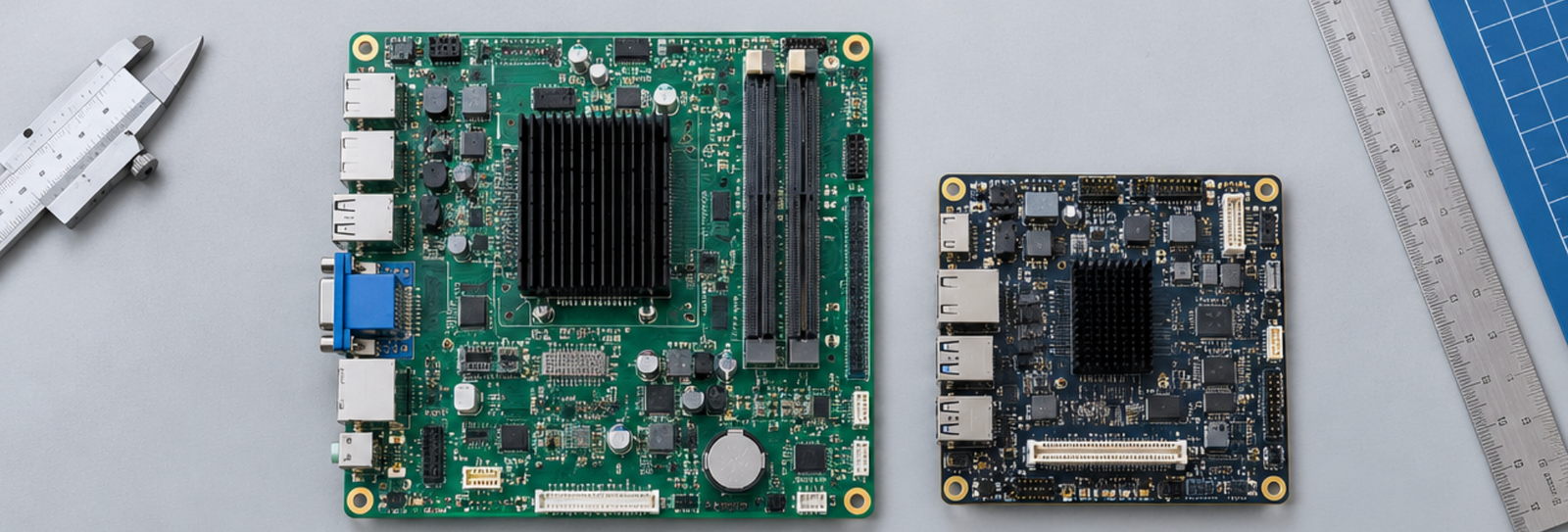
Connector placement works the same way. A debugging header left standing 25 mm above the board surface, or a heatsink that overhangs the board edge, forces the packing line to build a cavity around one unit — and a cavity that fits one revision may not fit the next. When the ODM review flattens the topography of the board, the packing line can fall back to standard flat-lay trays. Nobody invoices for that change, yet it removes the single most common reason an industrial PCBA needs bespoke foam in the first place.
Aging Test on the Line: 72 Hours to 7 Days Before the Carton Seals
The second catching point is the Aging Test bench, where finished boards run under power in controlled temperature and humidity for 72 hours up to 7 days, with occasional on/off impact cycles layered on top. The point is not to certify the design — it is to let the short tail of early-life failures die here, on a bench that has a soldering station next to it, instead of in a control cabinet somewhere that a service visit takes two weeks to schedule.

The window is not one number, because products do not share one duty cycle. A blood-glucose meter mainboard in our records went through up to 500 simulated operation cycles across roughly 48 hours at room temperature. A solar storage controller aged for 24 hours through three full charge and discharge cycles. An environmental controller destined for livestock buildings ran 24 hours of continuous network communication. A transport camera board took 72 hours at 60 degrees Celsius and 70 percent relative humidity. Four orders, four windows — each one set by how the customer's own site will stress the board.
Alongside electrical aging, the same gate can hand a batch to drop, vibration or salt-spray testing, and anything the factory cannot physically host goes to the China Electronics Laboratory as an accredited third party. The deliverable is a performance log per run, which doubles as evidence when a customer's own QA team asks why a field failure six months later cannot be an early-life defect.
Three-Proofing Paint Keeps Working After the Truck Leaves
The third catching point is unusual because it is the only one that works while the shipment is unattended. A PCBA Three-Proofing Paint film is a transparent cured layer that resists moisture, dust, salt corrosion, insulation leakage and corona, and it does this inside a sealed carton for the entire transit — through a wet port, an unheated container, and a warehouse that sits at 90 percent humidity for a week. Desiccant spends itself; the film does not.

Application quality is what makes the film trustworthy. Our line pairs two automatic spray machines with UV inspection and inline baking, and it handles boards up to 550 by 470 mm on dedicated carriers that keep edge coverage uniform. Fan-shaped and needle nozzles are combined so dense high-pin components still get covered, and the program can deliberately keep coating off connectors, antennas, WiFi modules and heatsinks where film would do harm. Double-sided spray-and-bake is supported, and the average spray time runs 0.5 to 3 minutes per board.
The alternative — hand brushing — is where packaging teams learn to distrust coatings. Manual work brings uneven thickness, stray particles, and the classic accident of paint wicking into an LCD window or a socket. When a film fails that way, the fault appears at the customer's bench, which is the most expensive catching point of all. A line with UV verification exists precisely so that the coating stage never becomes the reason a shipment turns around.
The Stage Sheet: What Each Service Hands Over
Buyers rarely need convincing that protection is useful; they need to know what each stage verifiably produces, so the invoice lines map to artifacts rather than promises.
| Service | Verifiable deliverable | Typical window or rate | Where it is recorded |
|---|---|---|---|
| Aging Test | Per-run performance log across powered operation | 72 hours to 7 days, set per product duty cycle | Batch test log kept with the order file |
| Three-Proofing Paint | UV-verified film coverage with keep-out zones respected | About 0.5 to 3 minutes spray time per board | Line checklist plus UV inspection record |
| ODM build | Board form factor and connector plan frozen at drawing | Settled before the first article is built | Engineering file shared with the customer |
Two caveats keep this sheet honest. The aging window is a range, not a promise: a 24-hour continuous-communication run and a 7-day humidity cycle both exist in our records, and quoting one number for every product would be fiction. The spray rate is likewise an average per pass — a double-sided job with keep-out programming takes longer than the raw spray seconds suggest. Neither caveat weakens the case; both are exactly why the deliverables, not the durations, are what a buyer should put in the purchase order.
Matching the Stack to the Order Profile
Not every order needs all three catching points at full depth, and pretending otherwise would just be overselling. A useful quick sort runs like this. Orders bound for coastal or tropical destinations with a monsoon season on the route get the full film treatment without debate, because condensation risk inside the box is near certain at some point in the year. Orders with a long warranty period — industrial controllers commonly carry multi-year commitments — justify the longer aging windows, since every early-life failure caught on the bench is a service visit that never gets scheduled. And any order where the enclosure, heatsink or connector layout is still being negotiated belongs in our electronics manufacturing services conversation early, while the drawing can still absorb the packing implications for free.
The sorts compound. A compact 3.5-inch board with a flattened topography, a 72-hour aging gate and a selective-coat film ships in a smaller carton, with lighter desiccant, lower declared risk and a shorter warranty reserve. None of those four savings appears on the coating invoice or the aging invoice, which is why they get missed — and why it pays to review the three stages as one stack instead of three line items.
One Pass Through the Stack, Then the Truck
A practical close: treat the three catching points as a fixed sequence on the order review, not as optional extras. First the drawing, where the ODM team trades connector height and board class for packing simplicity. Then the bench, where the aging window is set from the product's own duty cycle rather than a catalog default. Then the paint line, where the film takes over the watch that the carton was never designed to keep. When a board has been caught at all three moments, the packing line does what it does best — pack flat, seal, and label — and the first surprise in the shipment's life is how uneventful it was.
If you are mapping your own order onto this stack, start from the manufacturing capabilities overview and bring the destination climate and warranty terms to the first call; both of those decide how deep each stage needs to run.
Frequently Asked Questions
1. Can the aging window be shortened for simple products?
Yes, and it should be set by duty cycle rather than habit. Our records include a storage controller aged 24 hours over three charge-discharge cycles and a livestock environment controller aged 24 hours on continuous communication, alongside a blood-glucose mainboard that took 500 simulated operations across about 48 hours. The window follows how the customer's own site stresses the board.
2. Does three-proof paint interfere with connectors or antennas?
No, because the spray program carries explicit keep-out zones. Connectors, antennas, WiFi modules and heatsinks can be selectively left uncoated, and the fan-shaped plus needle nozzle combination covers dense high-pin areas without drifting into those zones. UV inspection confirms the boundary after baking.
3. How large a board can the spray line handle?
Boards up to 550 by 470 mm run on dedicated carriers that keep edge coverage uniform, and double-sided spray-and-bake is supported. High components and dense layouts are handled by combining fan-shaped and needle spraying rather than by slowing the line to a manual pace.
4. What if a required test cannot run inside the factory?
Drop, vibration and salt-spray testing sit in the same gate as electrical aging, and anything beyond the factory's own equipment is entrusted to the China Electronics Laboratory, an accredited cooperative third party, so the batch still leaves with a documented result rather than a skipped test.
Tags:
Next: No more...