
New IC Layout Design Protection Regulations Impact on PCBA SMT 2026
New Integrated Circuit Layout Design Protection Regulations: What PCBA and SMT Factories Must Know Before October 15, 2026
On October 15, 2026, China’s revised Regulations on the Protection of Integrated Circuit Layout Designs () officially take effect. This is not a routine legal update—it is the most consequential regulatory shift for the electronics manufacturing services (EMS) industry in years. The revised rules expand the scope of layout protection, sharply increase infringement compensation, and—most critically—extend liability down the entire manufacturing chain. For PCB fabrication plants, SMT assembly factories, and PCBA turnkey providers, the question is no longer whether compliance matters, but how fast you can adapt before a single order turns into a million-yuan liability.
This article breaks down the regulatory changes, their direct impact on SMT and PCBA operations, and the strategic actions your factory must take before the enforcement date.
🔌 Legal Risk Extends Directly to SMT and PCBA Contract Manufacturers
The most significant change in the 2026 regulations is the explicit extension of legal liability to assembly and manufacturing partners. Previously, intellectual property disputes over chip layouts were largely confined to chip designers and distributors. That era is over.
Liability Chain Now Reaches Assembly Plants
Under the revised rules, any entity that commercially sells, processes, or ships boards containing chips with infringing layout designs can be held jointly liable. This includes SMT factories, PCBA assembly plants, and turnkey manufacturers. Consider a typical scenario: a customer provides unbranded or suspicious chips—perhaps cloned MCUs or driver ICs—and asks your factory to solder them into mainboards and ship the finished product. Under the new regulations, the original chip vendor can sue your assembly plant directly, even if you had no knowledge of the infringement.
This shifts the burden of due diligence squarely onto manufacturers. "The customer said it was compliant" is no longer a valid defense.
Compensation Upgraded Sharply
The financial stakes have risen dramatically. Key changes include:
Punitive damages for willful infringement, potentially multiplying the base compensation several times over.
Statutory compensation ceiling raised to RMB 5 million when actual losses or infringer profits cannot be precisely calculated.
Courts may now include lawyer fees, notarization costs, and appraisal expenses in the total damages awarded.
For batch SMT/PCBA orders, courts calculate infringing profits based on total order volume, not per-unit margins. A mid-size SMT plant can face million-level damages from a single production run.
Protection Scope Expanded
The revised regulations broaden coverage to include power ICs, MCUs, driver chips, and Bluetooth SoCs—components that are staples in SMT assembly. Critically, infringement occurs even if only a unique portion of the layout is copied. So-called "compatible alternatives" or "reverse-engineered clones" that replicate any original layout segment now fall squarely within the red line. Reverse engineering is permitted only for personal research or teaching; batch processing and commercial assembly are explicitly prohibited.
False Registrations and Cloned Layout Certificates
The regulations introduce tougher substantive verification of layout design registrations. If a customer supplies a fake or cloned registration certificate and your factory failed to verify its authenticity, courts will find the plant negligent in its duty of reasonable review. This removes the "we didn't know" defense entirely. Factories must now proactively validate the IP status of every chip they process.

🏆 Order Intake and Customer Management Rules Are Now Mandatory
Compliance is no longer just a legal department concern—it must be embedded into your operational workflow, from sales inquiries to final shipping.
New Chip Qualification Review Process
Before accepting any order, your factory must verify three documents for each chip type:
Original manufacturer authorization or distribution certificate
The corresponding layout design registration certificate
A commercial license from the layout right holder (if different from the manufacturer)
Orders lacking these compliance documents—including white-label chips, cloned components, or refurbished ICs without clear provenance—must be refused. This is not optional; it is a legal requirement.
New IP Indemnity Clauses in Processing Contracts
Every processing agreement must now include robust intellectual property indemnity provisions. The customer must warrant that all supplied chips have legal layout authorization. They must also agree to bear all compensation, litigation fees, and administrative penalties arising from any layout infringement, plus compensation for factory downtime or line seizure. Your contract should also grant the factory the right to suspend processing and hold orders until the customer provides complete IP qualification documents.
Stronger Retention of Incoming-Material and Production Records
Courts can now demand SMT line records, incoming warehouse receipts, and shipping ledgers as evidence in infringement cases. Your factory should maintain detailed records of chip model, supplier, batch number, and associated contracts for at least three years. Missing traceability will be interpreted as presumed knowledge of infringement—a presumption that can be nearly impossible to overturn in court.
For factories looking to strengthen their component sourcing and traceability solutions, implementing a digital audit trail is no longer a competitive advantage—it is a survival requirement.
💡 Industry Opportunities — Compliant Companies Gain Advantage
While the regulations impose new burdens, they also create significant strategic opportunities for compliant manufacturers.
Growth in Orders from Legitimate Domestic Chip Customers
Original chip makers can now enforce their rights more effectively, which will curb the proliferation of clones. Brand OEMs will phase out cheap non-compliant chips and shift toward domestic MCUs and power ICs with complete IP documentation. SMT plants that serve legitimate brands will gain both pricing power and order volumes. Factories specializing in industrial, medical, and automotive PCBA niches can turn compliance into a decisive bidding advantage.
Own-Scheme PCBA Makers Can Build IP Assets
If your company designs its own companion chips or board-level schemes, the new rules offer a powerful way to build intellectual property assets. Filing layout design registrations qualifies as a Type-1 IP asset, which can support High-New-Tech Enterprise certification and government subsidies. The revised regulations also clarify transfer, licensing, and co-ownership arrangements, allowing you to license your layouts for new revenue streams. More importantly, you can now take legal action against competitors who copy your board schemes, with punitive damages available as a deterrent.
Market Cleanup of Low-Price Vicious Competition
Small workshops that rely on cloned white-label chips will face sustained legal liability and will be forced out of the market. Compliant mid-sized and large PCBA factories will enjoy reduced unfair price pressure, allowing them to compete on quality and reliability rather than cutting corners.

🔌 Six-Step Compliance Action Plan for Electronics Manufacturers
With the enforcement date fast approaching, here is a six-step action plan to bring your factory into compliance:
Contract overhaul: Update all processing and OEM agreements with chip IP warranty clauses and infringement liability provisions. Include the right to suspend production pending IP verification.
New incoming-material audit role: Designate a dedicated compliance officer to verify original authorization and layout registration certificates for every chip. Build an archive file for each supplier and chip model.
Tiered business control: Raise pricing for white-label or no-certificate chip orders, or refuse them outright. Make this policy explicit in your sales guidelines.
Internal training: Ensure sales, procurement, and production managers understand the concept of joint liability. Ban batch processing of unverifiable chips, regardless of customer pressure.
Own-scheme strategy: File layout design registrations for self-developed companion chips to build an IP moat around your products.
Inventory cleanup: Audit your current stock and clear loose cloned chips without complete IP proof. This reduces the risk of line seizure during a legal dispute.
Impact Summary by Company Type
The new regulations affect different types of manufacturers in fundamentally different ways. The table below summarizes the contrasting positions:
| Dimension | Pure Contract SMT Plant | Own-Scheme PCBA Company |
|---|---|---|
| Overall Outlook | Compliance pressure rises; risk-control costs increase significantly. | Opportunity outweighs risk; IP assets become a growth lever. |
| Main Challenge | Tightening incoming-material audit and controlling white-label orders. | Balancing R&D investment with compliance overhead. |
| New Opportunity | Attracting legitimate brand customers who demand compliant partners. | Striking at copycats, capitalizing on own layouts, and winning key tenders. |
| Key Action | Implement strict chip qualification review and contract indemnity clauses. | File layout registrations and use compliance as a strategic gate. |
| Legal Exposure | High—joint liability for processing infringing chips, even unknowingly. | Moderate—mitigated by own IP portfolio and stronger bargaining position. |
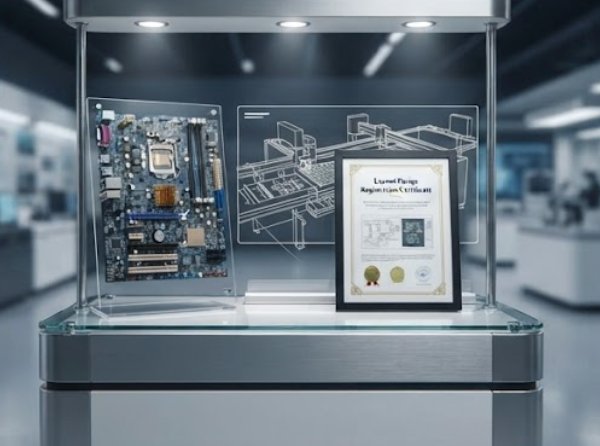
🏭 Partnering for Compliant Manufacturing
The October 2026 deadline is not just a compliance burden—it is a strategic inflection point. Factories that embrace the new regulations will win the trust of legitimate chip vendors and brand OEMs, build durable IP assets, and escape the race to the bottom. Those that delay will face mounting legal exposure and shrinking order books.
NEWEI is ready to support your transition. As a professional electronics manufacturing services partner, we combine mature PCB fabrication and assembly capabilities with rigorous incoming material control. Our compliant SMT production lines are backed by full traceability systems, and our reliability and aging test programs ensure that every board we ship meets both performance and legal standards. When you choose NEWEI, you choose a partner that treats IP compliance as a core manufacturing discipline—not an afterthought.
The new regulations are coming. The question is whether your factory will be a plaintiff or a defendant. Contact NEWEI today to discuss how we can help you build a compliant, future-proof manufacturing operation.
Tags: PCBA /SMT /NEWEI /compliance /2026 /IC layout design /
Prev: NEWEI PCBA PCB SMT Quality Inspection Performance Test
Next: NEWEI Incoming Quality Control Supply Chain ROI Analysis