Procurement teams evaluating a contract manufacturer often encounter headline numbers across service pages: four listed smart-home boards, seven consumer-electronics boards, and a 72-hour to 7-day aging-chamber capability window. While those figures summarize production breadth and environmental chamber capacity, actual lot release happens on the shop floor through first-article verification, product-specific inspection gates, and documented aging logs signed by designated technicians.
Understanding the gap between public service summaries and shop-floor sign-off prevents scheduling and quality surprises—especially in multi-line environments where operators rotate across product families, incoming inspectors interpret tolerances against control drawings, and field service engineers rely on serialized production records months after shipment.
Starting with Quick Turn PCB Prototyping & Board Manufacturing, bare-board geometry is defined by Gerber files, drill tables, and panel drawings. Once components are populated, soldered, housed, and stressed, each product family transitions into distinct acceptance criteria.
Four Smart-Home Boards Require Four Distinct First-Article Sign-Offs
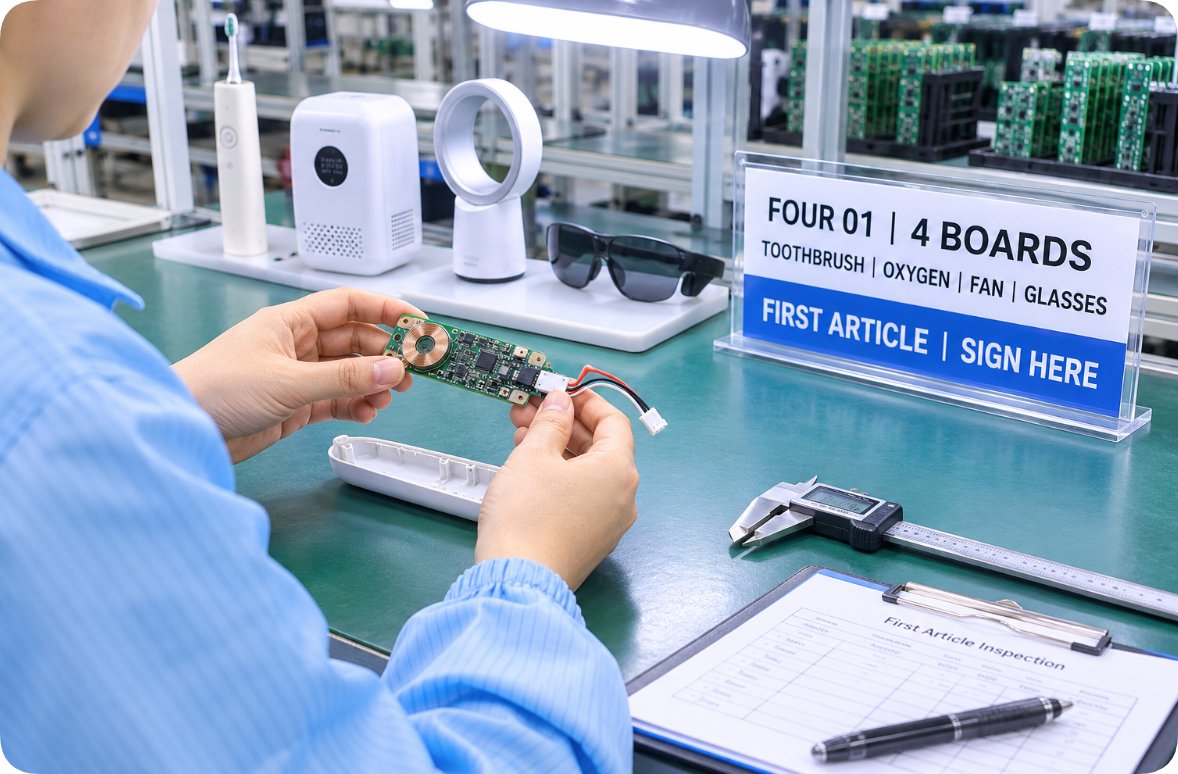
Within Smart Home Electronics PCBA OEM ODM Supplier programs, four representative assemblies—an electric toothbrush controller, an oxygen generator board, a bladeless fan driver, and a smart massage glasses board—appear together as a compact category. On the assembly floor, however, each unit undergoes a distinct first-article approval sequence tailored to its mechanical and operational risks:
Electric toothbrush controller: First-article sign-off checks the wireless charging coil gap against the molded plastic housing, because a board that passes electrical continuity on the bench can still fail wireless charging efficiency or waterproof sealing once closed.
Bladeless fan driver: Acceptance depends on thermal behavior inside a sealed enclosure rather than open-bench motor spin tests alone.
Smart massage glasses board: Sign-off occurs with the optical module already mounted, since optical alignment cannot be corrected after frame closure.
Oxygen generator control board: Release requires a dedicated functional run-in period to confirm continuous operating stability before batch clearance.
Grouping four catalogue models into a single pilot schedule overlooks these mechanical and run-in dependencies. Each board requires its own first-article record signed by the line leader and assembler at the exact assembly state where faults can still be caught.
Seven Consumer-Electronics Boards Governed by Family-Specific Release Gates
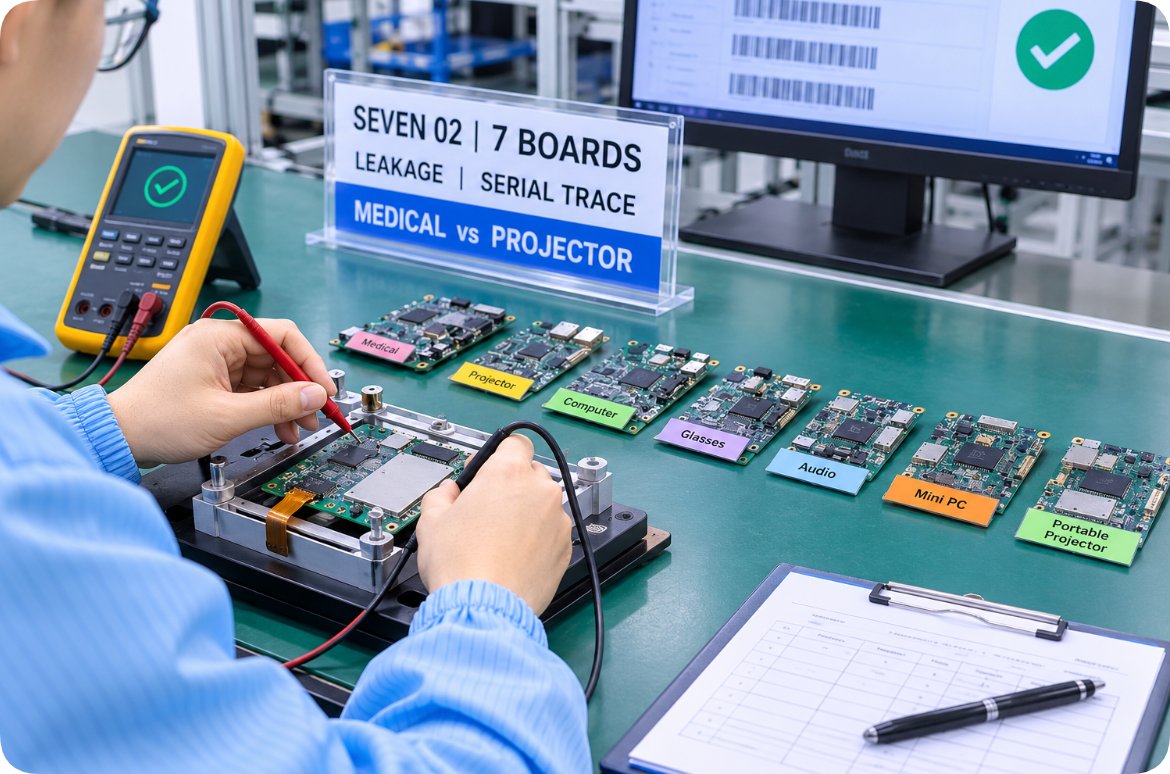
Across Consumer Electronics PCBA Assembly Factory operations, seven listed platforms—a smart medical motherboard, projector board, computer motherboard, smart glasses board, wireless audio board, industrial mini-PC and embedded board range, and portable projector solution—share SMT placement infrastructure while diverging sharply at inspection and release gates.
A smart medical motherboard requires serialized traceability and measured leakage limits logged against individual board IDs for downstream auditability. A projector board is evaluated on optical/image-path signal behavior, while high-cycle I/O boards prioritize connector seating integrity and mechanical retention. To prevent cross-line ambiguity when operators rotate between jobs, each product family maintains a dedicated release sheet directly at the workstation, signed contemporaneously as units clear each gate rather than batch-signed at shift end.
72 Hours to 7 Days: Environmental Chamber Capacity vs. Application Dwell Profiles
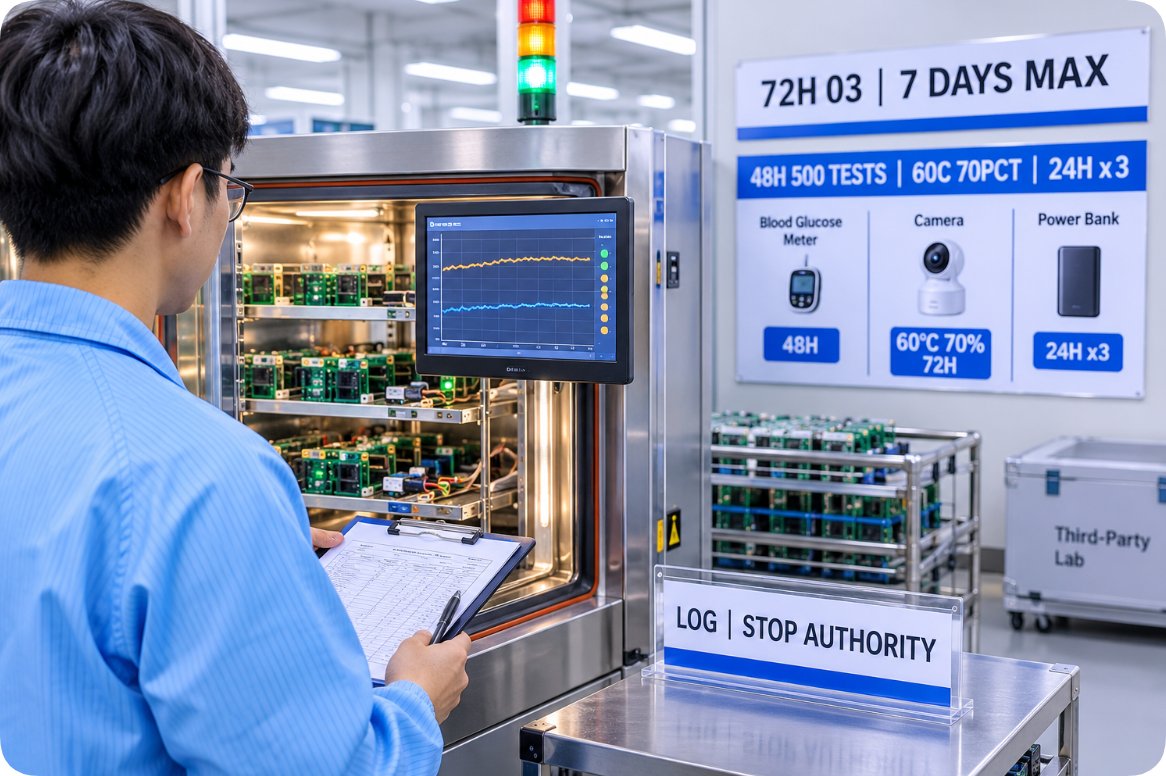
On the PCBA Aging Test & Reliability Testing Service page, the 72-hour to 7-day range defines environmental chamber capability for sustained burn-in and stress screening. In actual production, aging duration, temperature, humidity, and load cycles are matched to the end-use failure mode of each assembly:
Glucose-meter motherboard: Operated for approximately 48 hours across up to 500 simulated measurement cycles at ambient room temperature to validate measurement repeatability.
Transport camera motherboard: Held at 60°C and 70% relative humidity for 72 hours to screen thermal-humidity drift and solder/component stability.
Energy-storage controller: Cycled three times across a 24-hour window under active charge/discharge control conditions.
Agricultural/livestock environmental controller: Run for 24 hours with active sensor control and network communication verified continuously.
Equally critical on the shop floor are escalation and handover rules: defining who is authorized to halt a chamber run when telemetry drifts, separating fixture faults from board defects at hour 60, and documenting chain-of-custody sign-offs whenever specialized tests transfer to a cooperating external laboratory.
How Service-Page Metrics Map to Actual Release Records
Each quality record serves a distinct engineering and operational audience. Workstation release sheets guide line operators and supervisors; chamber logs give reliability engineers timestamped environmental telemetry; and service-page summaries help procurement teams evaluate baseline capability. When a board passes line inspection yet flags an anomaly in chamber testing, that discrepancy provides actionable diagnostic feedback on dwell time, thermal dissipation, or fixture contact rather than guesswork.
| Service Area | Published Figure | Shop-Floor Acceptance Point | Primary Sign-Off Owner |
|---|---|---|---|
| Smart-Home PCBA | 4 listed board types | First article verified with housing, coil gap, or optical module fitted | Line leader and final assembler |
| Consumer-Electronics PCBA | 7 listed board types | Board-family release gate (serialized leakage, image-path, or connector checks) | Qualified line/QC inspector |
| Aging & Reliability Test | 72 hours to 7 days | Completion of product-matched thermal/humidity/cycle run or lab handover | Reliability / chamber technician |
Unifying SMT Placement with Auditable Shop-Floor Sign-Offs
While High Precision SMT Assembly Lines Factory operations provide the shared placement and reflow foundation for smart-home, consumer, medical, and industrial boards, downstream reliability depends on enforcing product-specific release discipline. Closing mechanical tolerances early on smart-home units, preserving serialized test records on medical and computing boards, and refusing to truncate aging runs under schedule pressure are shop-floor habits maintained through written station sign-offs.
In Turnkey EMS Electronic Manufacturing Services, buyers auditing a manufacturing partner gain the clearest picture by reviewing sample first-article records, family release sheets, and chamber logs alongside catalogue capabilities. For a related look at aligning commercial scope with shop-floor execution, see our comparison of procurement, DIP assembly and incoming inspection as contract widths.
Frequently Asked Questions
1. Why do four listed smart-home boards require four separate first-article sign-offs?
Each board has distinct mechanical and functional acceptance conditions: electric toothbrush controllers require coil-to-housing gap verification, oxygen generator boards require a run-in period, bladeless fan drivers require enclosed thermal verification, and smart massage glasses boards are signed off with the optical module mounted.
2. Why cannot a medical motherboard and a projector board use the same release gate?
Medical motherboards require serialized leakage measurements logged to individual unit IDs for long-term traceability, whereas projector boards are verified against image-path signal performance, requiring dedicated workstation release sheets and qualified inspectors.
3. Is every PCBA aged for the full 72 hours to 7 days?
The 72-hour to 7-day range represents chamber capability rather than a uniform dwell time; actual profiles match end-use stress, such as 48 hours of simulated cycles for glucose-meter boards, 72 hours at 60°C/70% RH for transport cameras, or 24-hour cycling for energy-storage controllers.
4. How are discrepancies between line inspection sheets and aging-chamber logs resolved?
When a board passes workstation checks but triggers an anomaly in aging, technicians audit chamber logs and test fixtures to distinguish fixture faults from thermal or dwell-related component drift before releasing or holding the lot.