
Where an ESD Control Plan Stops Being a Document: Sourcing, Aging Test and PCB Fabrication
Most static-control programmes we are asked to audit look complete on paper. There is a wrist-strap log, a grounding-continuity record, a humidity log, and a signed training sheet. Then the first audit turns up a part on the board that nobody on the line can trace back to the purchase order, and the whole document set stops meaning anything. That gap is not a discipline failure. It is a structure failure: the control plan describes what happens after parts reach the building, while the three decisions that actually determine whether static survives the journey happen much earlier, in three different teams, in three different documents.
Our position is straightforward. An ESD requirement that lives in a quality document and never reaches a purchase order is a statement of intent. It only becomes a control when three specific records meet: what the buyer was told to buy, what the warehouse received, and what the line was permitted to substitute. If those three do not agree, the plan does not fail at the bench, it fails in the supply chain, and the bench is simply where the evidence surfaces.
The Plan Was Approved, the Parts Arrived Different
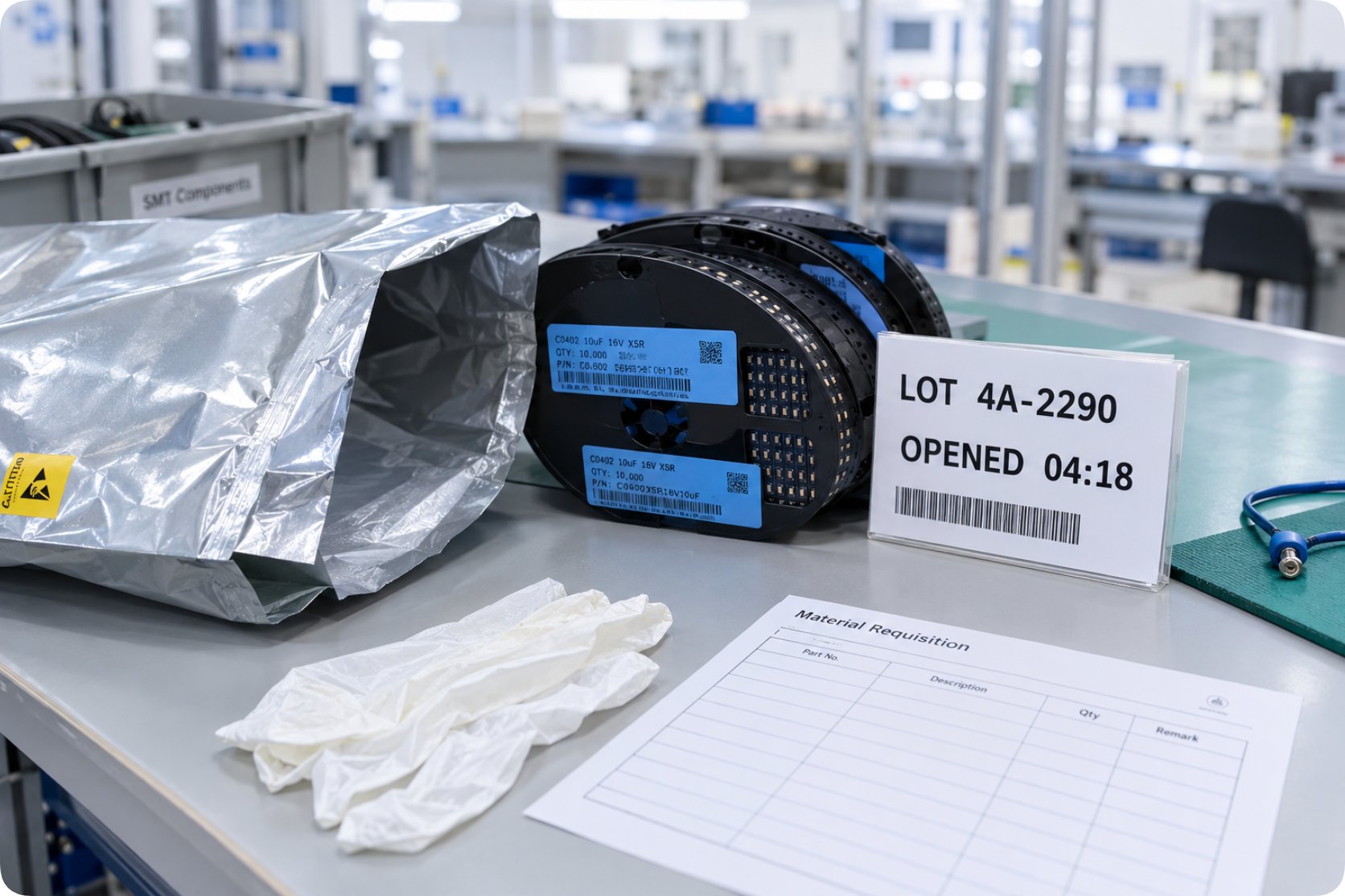
A customer specification for a control board may call out moisture-barrier bags, a humidity indicator card, and a specific package. The PCBA three-proofing paint stage and the coating specification that goes with it are downstream of that instruction, and both assume the parts arrived in the condition the instruction described. In practice the gap opens much earlier. A bag is opened at the incoming bench, components go onto a reel, the reel sits on a shelf for four days while the line waits for the rest of the kit, and nothing in the paperwork treats that shelf time as a controlled parameter because the paperwork does not track it.
The part is still in spec. That is the problem. Moisture-barrier packaging protects a device from a defined amount of absorbed moisture over a defined window, and once opened the protection is spent whether or not anyone measured the window. The specification was written for a sealed condition, and it was quietly reinterpreted as an open condition. Nobody made a mistake that day; a control was simply designed for one state and then used in another.
Three Teams, Three Versions of the Same Requirement
Ask three departments for their view of a static-control requirement and you will get three documents. Purchasing reads it as a line on a supplier scorecard. Quality reads it as an inspection gate. Production reads it as a rule about who may touch a bare board and with what. None of the three is wrong, and all three are incomplete, because each team is reasoning from a copy of the requirement rather than from the requirement itself.
The version that reaches purchasing is usually the weakest. It says what the part number should be. It rarely says what happens when that part number is unavailable, and it almost never says who decides. So the buyer is left with an option nobody authorised: ask whether a substitute would be acceptable, wait for an answer that arrives after the schedule has already slipped, or take the part that is on the shelf. The third of those is what actually happens, and it is invisible to the quality document because quality never sees a deviation that nobody logged.
Our view is that the static requirement should be written once and then appear in three places with the same wording: the purchase specification, the incoming checklist, and the line work instruction. Same words, same part number, same substitution rule. When all three carry the same sentence, a substitution becomes something the team has to discuss rather than something that happens quietly in a corridor.
Why a Substitution Passes Incoming Inspection
Incoming inspection is designed to answer a different question from the one that matters here. It asks whether what arrived matches what was ordered. It does not ask whether the ordered part was the right part for the static requirement, because that question requires information the inspection record does not contain.
Consider a family of parts that are identical in every respect an inspector can measure: same package, same pin count, same marking format, same declared rating on the datasheet. A part that was specified for its internal construction, its substrate, or its qualification data can be exchanged for one that is only equivalent on paper, and the incoming record will pass cleanly. The inspector is not making an error. The inspection is doing exactly what it was defined to do, on a definition that does not include the property at risk.
This is where our component sourcing services have to carry more than a price comparison. A sourcing arrangement that keeps a qualified alternative on record, with the reason it was qualified and the conditions under which it may be used, converts a silent substitution into a documented one. That single record is the difference between a deviation and a decision.

Reading the Three Published Figures Together
Three numbers get quoted when static control is discussed, and on their own they mean very little. Read together they describe where a programme is actually strong.
| Figure | What it measures | What it cannot tell you |
|---|---|---|
| Wrist-strap continuity | Whether the operator-to-ground path is intact at the moment it was measured | Whether the parts already in the reel were handled correctly |
| Moisture indicator card reading | The condition of one sealed bag at the moment it was opened | How long that bag stood open on the shelf |
| Line humidity log | The condition of the room over the logged interval | Whether a single unprotected reel spent an afternoon elsewhere |
The gap between those three is where programmes quietly lose ground. Every figure can be correct on its own and still describe a process in which an unprotected component sat near a door for an afternoon. The numbers stay green because none of them was ever asked to cover that case. A programme is only as good as the widest gap between what it measures and what it assumes.
The same logic applies at board level. Our PCB fabrication services are specified with surface resistance and ionic contamination in mind because those two properties interact with the assembly floor in ways that neither controls alone. A board that is well within resistance limits can still be a problem if the process leaves residue that becomes conductive under humidity. The board and the floor have to be specified as a pair, or the pair will quietly disagree.
What Humble Supplier Records Settle and What They Do Not
Supplier documentation is usually treated as the weakest form of evidence in the chain, and the instinct is right. A certificate that states a part meets a specification tells you very little about the lot in your building, because it describes a family, not a shipment, and it is issued by someone who benefits from your confidence.
What these records do settle is narrower and more useful than they are usually given credit for. A record that names the wafer lot, the date code, and the qualification basis lets you put a boundary around the population of parts that carry a given level of evidence. It does not certify those parts. It defines the group inside which your confidence is reasonable and outside which it is not. That boundary is what makes an audit possible: instead of asking whether every part is perfect, you ask whether every part inside the boundary is documented and every part outside it has a named approver.
Our aging test service adds the dimension that documents cannot supply. Running a populated board under load and elevated temperature for an extended period does two useful things: it exposes early-life failures that would otherwise surface in the field, and it exposes assembly workmanship problems that a component datasheet will never mention. A joint solder defect that passed visual inspection and survives room-temperature functional test will very often fail in the first hours of a burn-in. That failure is a static-adjacent finding, because handling during assembly is often the cause, and it is only visible if someone ran the board hot for long enough to tell.

Putting the Burn-In Stage Inside the Same Chain
Neweiom places the burn-in stage between assembly and final test rather than beside it, and that ordering is deliberate. A board that fails in burn-in usually fails again in final test, so a board that reaches final test has already survived the conditions most likely to expose a latent problem. Boards that pass burn-in and then fail final test are, in practice, rare, and the failures that do occur tend to be fixture and contact issues rather than component issues. That difference saves diagnostic time: the engineer knows before opening the fixture which class of problem to look for.
The same ordering holds for the paperwork. A burn-in record carries the board serial, the chamber profile, and the actual duration, which means it can be compared against the next shipment rather than merely filed. A record that says a board was tested, without the numbers, cannot be compared to anything. That is the difference between a log and evidence, and it is cheap to get right at the point where the record is created and expensive to reconstruct afterwards.
A Walk-Through on a Single Purchase Order
The following sequence is one real order and nothing more than one order, but it is the shortest path we know from an approved drawing to a board you can defend in an audit.
1. The purchase specification names the substitution rule
The buyer is given the exact part numbers, the permitted alternates, and the conditions under which an alternate may be used without a new approval cycle. This is where our electronics manufacturing services start: with a document that makes the decision before the pressure arrives, not after.
2. Incoming inspection records the population, not the sample
Every bag that arrives is logged with its lot and date code, whether or not it gets sampled. The sample tells you about the sample; the population log tells you which parts you are actually accountable for, and it is what makes a later recall or a field question answerable.
3. The line instruction repeats the same sentence
The static requirement appears in the work instruction in the same wording as the purchase specification. If the two documents disagree, the discrepancy is visible on the shop floor rather than in an audit two years later.
4. Burn-in produces numbers, not a signature
Chamber profile, duration, board serial, and result are captured per board or per lot. These are the figures that make the next shipment comparable.
5. For industrial computing builds, the requirements come earlier
A customer building custom industrial PC PCBA boards is usually working to a field environment with wide temperature swings and long service intervals, so the static and moisture requirements are specified at the architecture stage rather than discovered at the line. That conversation is far cheaper than a substitution discovered three weeks after the first shipment.
Questions Worth Settling Before the First Order
Five questions come up in almost every audit we run, and every one of them is cheaper to answer before the order than after it.
Who approves a substitution when the ordered part is unavailable, and is that person the same one who signed the incoming record? If the answer is no, the programme has two authorities and will use whichever is closer to the deadline.
Is your requirement written against the sealed condition or the open one? A requirement that says the bag must be sealed, without saying what happens after it is opened, describes the first hour of the part's life and says nothing about the next three days.
Can you list the parts currently on your floor that came from an unrecorded deviation? If the answer takes longer than a few minutes, the deviation log is not doing its job.
Does your burn-in record contain numbers? A signature proves somebody attended; a profile and a duration prove the board was stressed.
Finally, is your static requirement present in the purchase specification, or only in the quality manual? If a supplier auditor reads your purchase order, they should be able to see the requirement without opening a second document. If they cannot, your supplier is working from a weaker specification than your own team assumes.
Where These Controls End Up in Practice
Six applications where this chain has to hold together, each of which fails in a different way if it does not.
Industrial computing boards for cabinet-mounted and DIN-rail equipment, where the line is long, the boards are handled repeatedly during integration, and a marginal part can sit in service for years before the field symptom appears.
Gateway and edge equipment where the enclosure is metal and grounded but the board leaves the line unshielded, so the static control that mattered was the one applied before the enclosure ever reached it.
Automotive electronics where qualification data is part of the purchase, which means an unrecorded substitution is not just a quality event but a documentation event with regulatory weight.
Medical and diagnostic boards where humidity and residue combine with a cleaning regime, and where the incoming condition of the parts interacts directly with what happens in service.
Consumer devices built to a cost target, where the temptation to substitute is strongest and the evidence of the substitution is easiest to lose, which is precisely why the rule has to be written down rather than assumed.
Smart home and wearable boards where assembly is short, volumes are high, and the only realistic place to catch a handling-related defect is immediately after the line.
Three Records Instead of One Document
The point of all of this is not a longer procedure. It is a shorter distance between a decision and the evidence for that decision. A static-control programme that produces three records which agree with each other is easier to audit, easier to hand to a customer, and easier to run on a day when two people are covering for three. A programme that produces one long document nobody on the floor has read is harder to run, harder to audit, and quietly weaker at exactly the moment it matters.
The change is not expensive. It is a sentence written into a purchase specification, a column added to an incoming log, and a decision made once at the architecture stage instead of repeatedly under schedule pressure. Free consultation and quotation, custom PCB assembly from prototype to mass production, ISO certified manufacturing, worldwide shipping, and a dedicated project manager are all available when you want to see how the three records line up for your own parts.
Frequently Asked Questions
1. Who approves a component substitution, and should it be the same person who signs the incoming record?
Ideally yes, but many programmes have two authorities. Purchasing decides what to buy because of availability or cost, and quality signs off on what arrived because they are the ones holding the inspection record. When those are different people, the substitution is decided under schedule pressure and reviewed afterwards against a definition the decision did not consider. We recommend one named authority for both, or at minimum a rule that any substitution touching moisture-sensitive or qualification-controlled parts requires written approval before shipment rather than a review after.
2. Our ESD requirement says parts must arrive in sealed moisture barrier bags. Is that enough?
It is enough only if the requirement also states what happens after the bag is opened. Sealed barrier packaging protects a device for a defined absorbed-moisture budget over a defined window. Once opened, that protection is spent regardless of whether anyone tracked how long the reel sat on the shelf. A requirement written against the sealed condition describes roughly the first hour of a part's life and says nothing about the next three days, which is usually where the exposure happens. Add an open-condition clause: maximum time out of bag, storage temperature and humidity for the opened reel, and whether the indicator card is recorded per bag or per shipment.
3. How do I list parts on my floor that came from an unrecorded deviation?
Compare three populations: what the purchase orders authorised, what the incoming log recorded as lot and date code, and what is physically on the floor. Anything that exists in the third population but not in the first two is an unrecorded deviation. If completing that comparison takes more than a few minutes, the deviation log is not doing its job and the problem is in the record format rather than in the team's diligence. Most of the effort disappears once every incoming bag carries a lot and date code instead of only the bags that get sampled.
4. Does an aging test record prove anything, or is it just paperwork?
A signature proves somebody attended the chamber. It does not prove the board was stressed. A useful record carries the chamber temperature profile, the actual duration, the applied load, the board serial or lot, and the result. Those numbers are what make one shipment comparable to the next; without them the record can only confirm an event happened, not what was tested. This matters most when you are chasing an intermittent field failure, because an unquantified record cannot distinguish a board that ran for four hours at one temperature from one that ran for twelve hours across a profile.
5. How far back should a static-control requirement be specified?
At the architecture stage, not at incoming inspection. By the time parts reach the receiving dock, most of the decisions that determine whether static survives the journey have already been made: the part numbers, the alternates, the board materials, and the assembly method. For industrial computing, automotive, or medical builds especially, raising static and moisture requirements at the specification stage is close to free, while raising them after the first shipment usually means requalification. Neweiom can take that requirement through the build before the first purchase order is placed, so the burn-in profile is agreed alongside the purchase specification rather than after the boards exist.
Tags: PCB fabrication / PCBA / component sourcing /