
What a Mixed SMT and Through-Hole Board Really Costs: An ROI Model for 2026 Builds
What a Mixed SMT and Through-Hole Board Really Costs: An ROI Model for 2026 Builds
Every quote for a mixed-technology board gets compared on unit price, and unit price is the least informative number in the whole document. Two suppliers running the same gerber file can land twenty percent apart on total cost, and almost none of that gap comes from the placement fee. It comes from process decisions made before the first panel is loaded: how the panel is arranged, where the through-hole components sit relative to fine-pitch parts, and which soldering method is allowed to touch each joint. Below is the model we run internally when a customer asks whether a process change is worth paying for, written out with the numbers we actually use.
Where the Money Goes on a Placement Line
A placement machine is quoted by throughput and billed by the hour, but the hour is the wrong unit to optimise. What you are really buying is the fraction of that hour during which the machine is placing parts. Depreciation, nozzle and feeder maintenance, programme preparation, first-article verification and operator time are all fixed against the shift, so any minute the line spends waiting for a feeder cart or a solder paste inspection result is billed at the same rate as a minute of production.
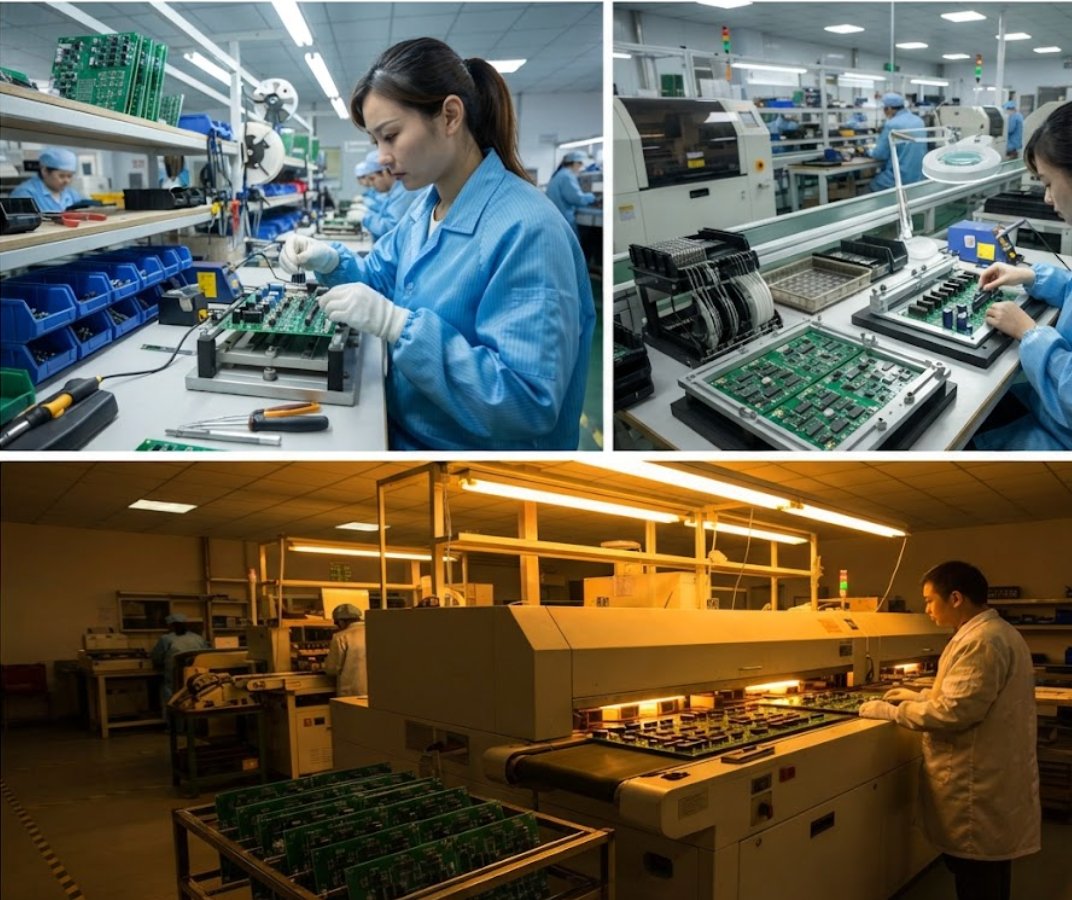
On a mid-speed line rated around forty-five thousand components per hour, real output across an eight-hour shift typically lands between fifty-five and sixty-five percent of the nominal figure once changeovers, feeder replenishment and first-article checks are counted. That utilisation gap, not the machine rating, is what separates two quotes on the same board. Our surface-mount placement capacity is scheduled around protecting that percentage: identical part numbers are grouped into shared feeder setups, and programme preparation happens off-line so the machine never waits for a file.
Feeder Setup, Changeovers, and the Batch Size Trap
A changeover costs roughly the same whether it precedes five hundred boards or five thousand, which makes batch size the single most powerful lever on unit cost. Split a ten thousand unit annual requirement into twenty runs of five hundred and you pay twenty changeovers; consolidate it into four runs of two thousand five hundred and you pay four. The arithmetic favours consolidation until inventory carrying cost, storage life of moisture-sensitive parts, and the risk of an engineering change landing mid-run pull the other way.
The practical compromise is off-line feeder preparation. When the next job is set up on a second cart while the current job is still running, the mechanical swap drops to a fraction of a full setup, and the only remaining cost is first-article verification. For customers building in the five hundred to two thousand unit range, that saving is usually larger than any discount available on component pricing, and it is visible on the quote only if you ask how changeover time is treated.
Fine-Pitch Placement and the Price of Rework
The economics of inspection are unglamorous and decisive. A defect caught at solder paste inspection costs a wipe and a reprint. The same defect discovered at functional test costs a technician's diagnostic time, a rework station booking, and usually a scrapped component. Discovered by the end customer, it costs a field return, a replacement unit, and a conversation nobody budgets for. The multiplier between those stages is the reason a marginally cheaper build can end up more expensive per shipped unit.
| Stage where the defect surfaces | How it is caught | Relative cost to correct |
|---|---|---|
| Paste deposition | SPI volume measurement | 1x (stencil wipe and reprint) |
| Post-reflow joint | AOI plus targeted review | 4x to 6x |
| Hidden joint under package | X-ray sampling | 8x to 12x |
| Electrical fault | ICT or functional test | 20x to 30x |
| Field failure | Customer return | 100x and upward |
Parts at 0201 and packages at 0.4 millimetre pitch sit at the steep end of that table because they fail in ways visual inspection cannot see. Spending on inspection capacity at the front of the line is not a quality premium; it is a purchase of the cheaper row.

Choosing Between Wave, Selective, and Hand Soldering
Once the surface-mount side is reflowed, the through-hole content still has to be joined, and there are three routes with very different cost shapes. A full wave is the fastest per board and the least flexible: it needs a mask fixture that exposes only the joints to be soldered, which is a one-time tooling charge that only makes sense across volume. Selective soldering addresses joint groups one at a time under controlled dwell, costs more per board and nothing in tooling, and is the right answer when the through-hole parts are spread out or sit next to heat-sensitive components. Hand soldering under a documented profile is slowest of all and remains the correct choice for heavy screw terminals and parts with large thermal mass.
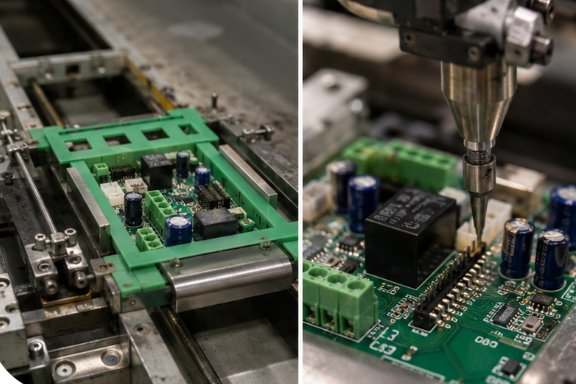
The crossover is a function of joint count, batch size, and how densely populated the underside already is. As a working rule, a fixture earns its keep when the joint pattern repeats across thousands of boards; below that, selective soldering usually wins on total cost even though the per-board number looks worse. Our through-hole insertion and soldering service quotes both routes side by side for exactly this reason, because the cheaper-looking line item is often the more expensive programme.
Yield Curves That Requote Themselves
Yield is quoted as a percentage and felt as labour hours. On a ten thousand board programme, moving first-pass yield from ninety-eight and a half percent to ninety-nine and a half removes a hundred boards from the rework queue, and each of those boards would otherwise have absorbed diagnosis, touch-up, re-test and handling. At even a modest fifteen minutes per board that is twenty-five hours of technician time recovered, which dwarfs most line-item negotiations.
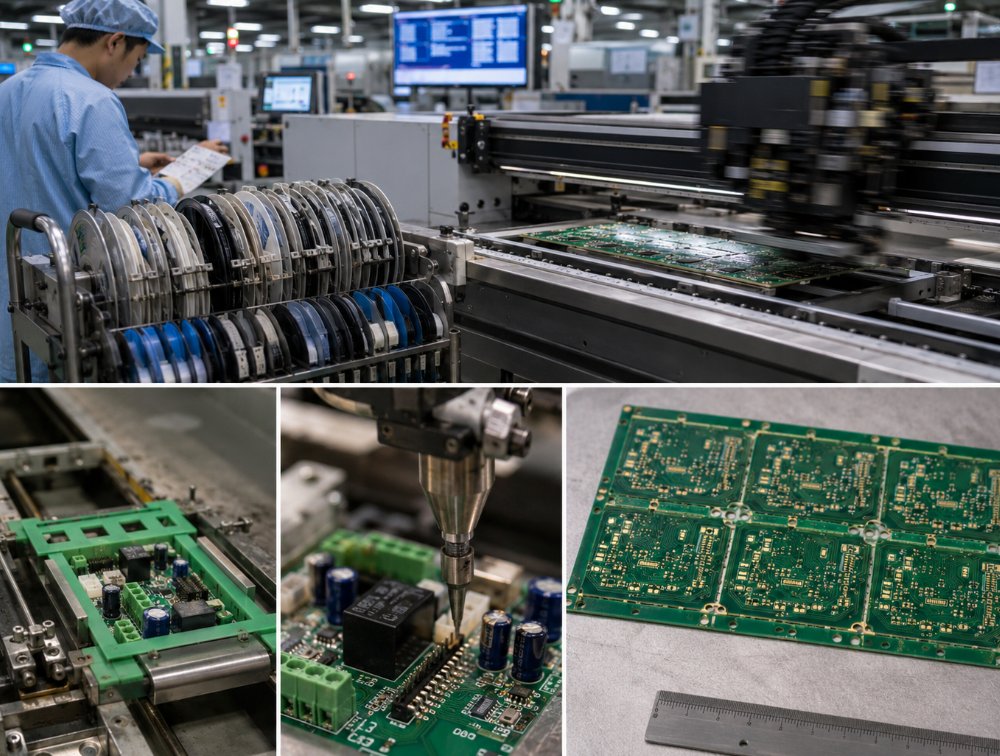
A meaningful share of that yield is decided before assembly begins. Panel utilisation sets how many boards come off each panel and how much edge material is paid for and discarded. Copper weight and stack-up determine how aggressively a board pulls heat during soldering, which is the usual origin of cold joints on terminal blocks. Annular ring size and via treatment decide whether drilling and plating hold tolerance across a full production run. These are choices made at the bare board fabrication stage, and they are far cheaper to correct there than after the panels are populated.
A Twelve-Month Payback Worksheet
When a customer asks whether a process investment pays for itself, we build the answer on four columns: what is spent once, what comes back every month, how long the recovery takes, and what happens if nothing changes. The table below uses index figures per thousand boards rather than currency, because labour rates and volumes vary far more than the ratios do.
| Investment | One-time effort | Recovered per 1,000 boards | Typical recovery window |
|---|---|---|---|
| Off-line feeder preparation cart | Hardware plus two setup procedures | Changeover minutes cut by half on repeat jobs | Two to four months |
| SPI programme tuned to fine-pitch apertures | Half a day of process engineering | Defects caught two rows earlier on the cost table | Within the first production batch |
| Selective soldering programme for through-hole groups | Path teaching on first articles | Bridging and cold joints removed from rework queue | Three to six months |
| Panel array redesign for better utilisation | One layout revision cycle | More finished boards per laminate panel | Six to twelve months, then permanent |
Programmes that mix dense surface-mount logic with power-stage through-hole content benefit most, because they carry both cost structures at once. An industrial controller of the kind we build around the FT-J6413-V1.1 edge gateway board is a textbook case: fine-pitch logic that wants early inspection, plus terminals and connectors that want a soldering route chosen deliberately.
Questions to Put in Your Next RFQ
Five questions reliably separate a quote that will hold from one that will grow. Ask how barrel fill on through-hole joints is verified and at what sampling rate. Ask whether quoted changeover time includes first-article verification or stops at the mechanical swap. Ask what panel utilisation the board array achieves, and whether a redesign would improve it. Ask whether rework records feed back into the process or only into the scrap bin. And ask who owns the tooling after the programme ends, because a fixture you do not own is a fixture you will pay for twice.
None of these questions are adversarial. They are the ones a supplier with a documented process can answer in an email, and the ones that tell you whether the unit price in front of you is the number you will actually pay.
Run the Model on Your Own Board
Send us a board file and a monthly volume range and we will run this worksheet on your actual build, with the changeover, yield and soldering figures filled in from comparable programmes rather than from a template. Our electronics manufacturing services team covers the sequence from bare board through placement and through-hole assembly to final test, so the numbers come from one process flow instead of three separate quotes. If the model says your current route is already the right one, we will tell you that too.
Tags: SMT assembly cost / through-hole assembly / PCB assembly ROI / mixed technology /
Prev: How Smart Home PCBs Learned to Survive the Bathroom: A Conformal Coating Story