
Smart Wearable, Industrial PC and DIP Assembly: Matching the ROI to the Order Structure
Most buyers meet this factory through a single product family and assume the whole plant works that way. It does not. The same Shenzhen floor runs a consumer wearable line, an industrial computing line, and a through-hole assembly line, and each one earns its keep in a completely different way. A purchasing team that evaluates all three with the same spreadsheet will misjudge at least two of them, because the return profile of a mixed wearable program looks nothing like the return profile of a board that ships in five platform variants for a decade.
This article walks through the three lines as three order structures. The point is not which line is better; the point is knowing what each structure rewards, what it punishes, and where the payback actually accumulates before you commit tooling, certification effort, or a long-term agreement to any of them.
Why One Factory Runs Three Different Order Structures
The three lines exist because three kinds of customers exist. A wearable brand needs many board variants in small runs, revised each season. An industrial customer needs one board family kept stable across years of repeat orders. A device maker with connectors, relays, or power sections needs through-hole work that surface-mount lines cannot finish alone. Serving all three from one campus lets the factory amortize its quality system across very different rhythms, and it gives a buyer a single point of accountability when a program later spans several of these categories.
The Wearable Line: Return Carried by Variety
The wearable program covers four board families: VR headset boards, massage-device control boards, smart bracelet boards, and wireless audio boards. Each family refreshes often, so the economic engine here is variant turnover rather than unit volume. A buyer who ships six colorways of a bracelet and a revised headset board in the same quarter is not buying cheap panels; they are buying short changeover intervals and a first-article loop that catches layout mistakes before they reach a full run.

The return profile rewards preparation. Customers who arrive with locked gerber files, a defined test plan, and packaging decided early see their per-variant cost drop faster than any price-list negotiation could achieve. Customers who revise layouts mid-run lose the variant economics entirely, because every revision reopens sourcing and requalification. Custom Smart Wearable PCBA ODM work therefore pays back through discipline, not through volume discounts.
The Industrial PC Line: Return Carried by Platform Longevity
The industrial computing line builds motherboard families across Mini ITX, 3.5-inch SBC, ATX, and Nano ITX form factors on Intel platforms from Elkhart through Alder Lake generations. The buyer here is not chasing seasonal refresh; they are embedding a board into machines that must stay serviceable for years. The return shows up in the second and third repeat order, when the validated material set, the tested BIOS configuration, and the known assembly fixture all carry forward without new engineering charges.

This is why platform selection dominates the ROI conversation on this line. A board designed around a long-availability chipset keeps its qualification valid across repeat batches; a board built on a consumer-grade part forces a redesign mid-life and erases the accumulated return. Buyers should also note that form-factor decisions, once tooled, persist: a Mini ITX fixture that passes qualification this year remains usable for the follow-on variants of the same family, which is a quiet but substantial saving across a multi-year program.
The DIP Line: Return Carried by Straight-Through Yield
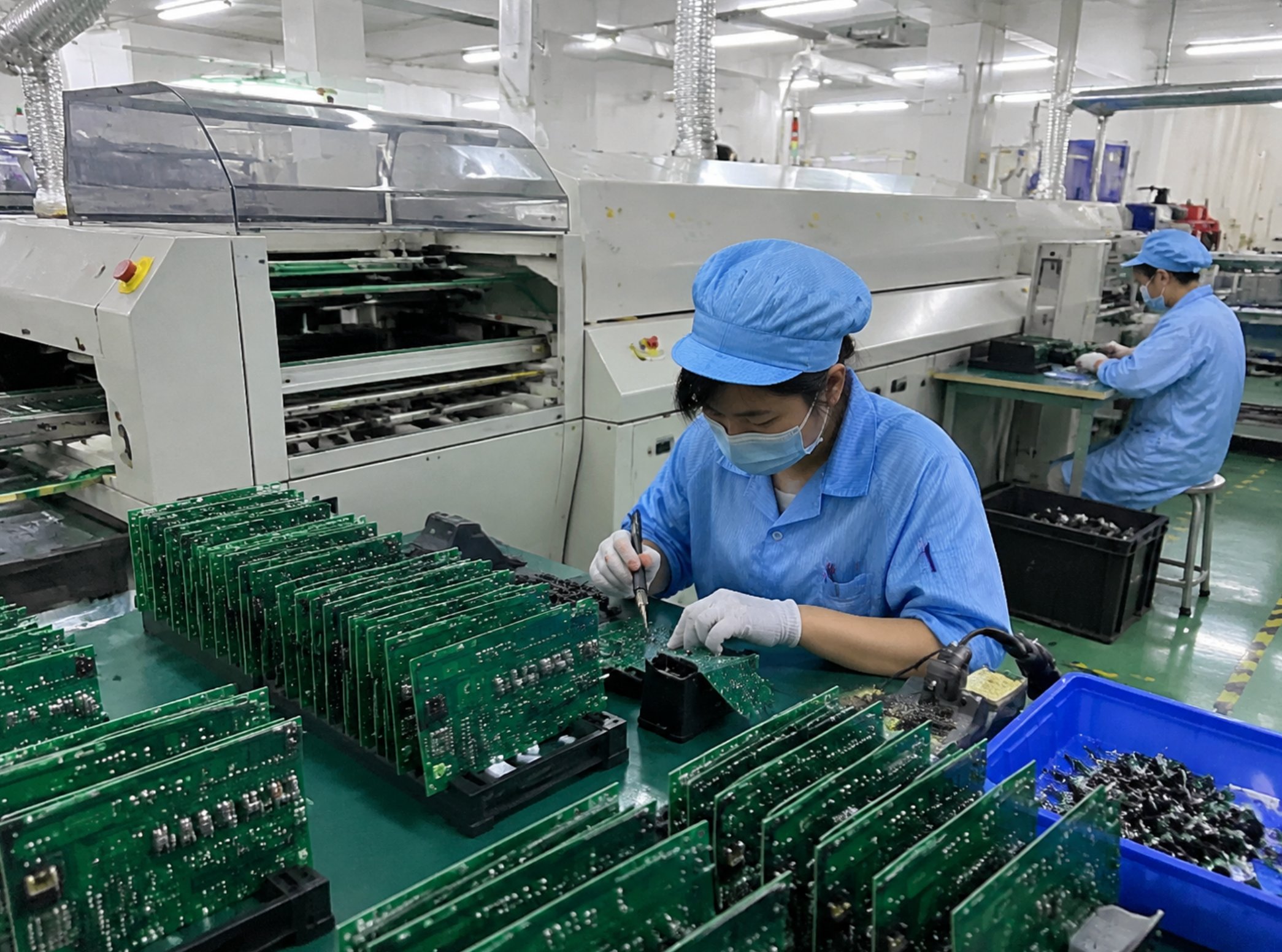
Through-hole work earns its return in a different currency: pass-through yield. The line operates four wave-soldering units, four washing machines, and fifty-six hand-soldering stations, with automated optical inspection dedicated to catching inserted-component errors, missing parts, and reversed polarity before they propagate. Fifty-six stations is not a rounding number; it is the capacity that decides how quickly a mixed batch with heavy cabling clears the rear-welding stage without queueing behind another customer's lot.

The floor management detail matters as much as the equipment. Work-in-progress around each cable assembly is held in separately identified zones for waiting plug-in, waiting repair, waiting QC, defectives, and waiting QA, so boards never mix between statuses. Strict IPQC and QA lot-sampling standards, run under an ISO9001:2015 quality system with ISO13485 and IATF16949 certifications for the applicable product categories, keep the yield math honest. DIP Assembly return is therefore visible in the rework rate a customer measures lot over lot, not in any headline price.
What the Three Lines Share on the Floor
Despite the different rhythms, the shared assets are real. One quality-management system covers all three lines. The surface-mount front end feeds the wearable and industrial boards alike, and the through-hole back end absorbs the connector-heavy work from both. A customer running a mixed program, for example an industrial controller with a wearable companion device, gets consistent process documentation and one corrective-action loop instead of coordinating two suppliers with two audit calendars.
Comparing the Three Structures Side by Side
The table below compresses the three lines into the dimensions that actually move their economics. It is deliberately a structure table, not a price table, because the pricing conversation depends on each customer's bill of materials and test requirements.
| Dimension | Wearable line | Industrial PC line | DIP line |
|---|---|---|---|
| Order shape | Many variants, small runs, seasonal refresh | Stable family, repeat batches over years | Lots defined by connector and cabling content |
| Board families | VR headset, massage device, bracelet, wireless audio | Mini ITX, 3.5-inch SBC, ATX, Nano ITX | Through-hole sections of mixed assemblies |
| Where return accumulates | Fast variant turnover with locked files | Repeat orders reusing validated materials | Pass-through yield and contained rework |
| What punishes ROI | Mid-run layout revisions | Consumer-grade platform redesigns mid-life | Mixed board statuses and missed inspections |
| Key floor assets | SMT front end with first-article loop | Form-factor fixtures reused across variants | 4 wave-solder units, 4 washers, 56 rear-weld stations |
| Quality gate emphasis | First-article and per-variant test plans | Long-availability component sourcing | Insertion AOI, IPQC and QA lot sampling |
Read the table as a matching exercise rather than a ranking. A buyer who treats a wearable program like an industrial one, demanding multi-year stability from a seasonal product, pays for stability nobody needs. A buyer who treats DIP work like a commodity panel price misses the point that the entire return lives in inspection density and zone discipline.
Placing a Mixed Program Across the Three Lines
Programs that span categories are increasingly common, and the campus structure handles them with one manufacturing file trail. A practical sequence: qualify the industrial controller board first, because its platform decisions have the longest shadow; run the wearable companion through the first-article loop while the controller batch repeats; schedule the through-hole sections into the DIP line once connector allocations are final. Buyers who sequence this way keep each line's return mechanism intact instead of forcing one structure to subsidize another. The aging and reliability verification stage can then run against the assembled program, as described in Aging Test, before any shipment leaves the campus.
Frequently Asked Questions
1. Can a wearable board and an industrial controller board be built under the same roof without cross-contamination of processes?
Yes. The surface-mount front end is shared, but each program runs its own stencil set, reflow profile, and first-article record. The wearable variant loop and the industrial repeat-batch loop never share a line configuration, and the ISO9001:2015 system documents them as separate process families, with ISO13485 and IATF16949 applying to the categories that require them.
2. How does a small-batch wearable program ever reach a positive return?
Through variant discipline rather than volume. Four board families refresh often, so the cost that matters is the cost of introducing a revision: locked gerber files, an agreed test plan, and packaging decided before the run. A customer who ships six revisions a quarter with locked files spends less per variant than one who ships two revisions and changes layout mid-run.
3. Why do repeat batches of an industrial motherboard cost less to requalify?
Because the qualification objects persist. The validated material set, the BIOS configuration, and the form-factor fixture for a Mini ITX or 3.5-inch board carry into the next batch unchanged. The return accumulates on the second and third order, when no new engineering charge is raised for work already proven.
4. What exactly does the insertion AOI catch on the DIP line, and what happens to a flagged board?
It inspects inserted components and solder joints for three error classes: wrong component insertion, missing components, and reversed polarity. A flagged board moves into the separately identified waiting-repair zone, never back into the plug-in queue, and re-enters through the QC and QA sampling gates. That zoning is what keeps fifty-six rear-weld stations and four wave-soldering units from mixing statuses across lots.
The decision that shapes everything else is not which factory to use but which structure a program belongs to, and buyers who name that structure early write better agreements. When a program genuinely spans the wearable, industrial, and through-hole worlds, one campus with EMS Electronic Manufacturing accountability across all three removes the coordination tax that splits programs usually pay. The fastest way to see the structure in practice is to review how a comparable program was built, as in this customer case walkthrough, then map your own order shape against the table above before the first purchase order is signed. A grounded starting point for the upstream stages is the PCB manufacturing overview, which every one of these three lines sits downstream of.
Tags: smart wearable pcba odm / industrial pc pcba odm /
Prev: A Procurement Checklist for Aging Reliability in Smart Home PCB and Consumer Electronics PCBA
Next: No more...