
Aging Test and Reliability: The New Standard for Custom PCB Assembly in 2025
Aging Test & Reliability: The New Standard for Custom PCB Assembly in 2025
Aging Test & Reliability: The New Standard for Custom PCB Assembly in 2025
My Take: For too long, "aging test" was treated as an optional checkbox in the PCB assembly process—something done only for military or aerospace projects. That's no longer viable. In 2025, with the explosion of IoT, automotive electronics, and industrial automation, reliability isn't a feature; it's the price of entry. I've seen too many products fail in the field because a manufacturer skipped a 48-hour burn-in cycle. The industry trend is clear: aging reliability is becoming a standard deliverable for any serious PCB Assembly (PCBA) partner. At NEWEI, we've embedded this into our core workflow, not as an add-on, but as a fundamental design principle.
Every electronics manufacturer is feeling the pressure. Supply chain volatility has shortened product lifecycles, while end-users demand devices that operate flawlessly for years in harsh environments. Whether you're building a rugged tablet for a factory floor or a mini PC for a digital signage network, one faulty board can destroy your brand's reputation. That's why we've invested heavily in dedicated aging reliability solutions that simulate real-world stress before your product ever ships. If you are looking for a partner who treats reliability as a non-negotiable, our Custom PCB Assembly Services are designed from the ground up to include rigorous aging protocols.
Why Aging Test Matters More Than Ever
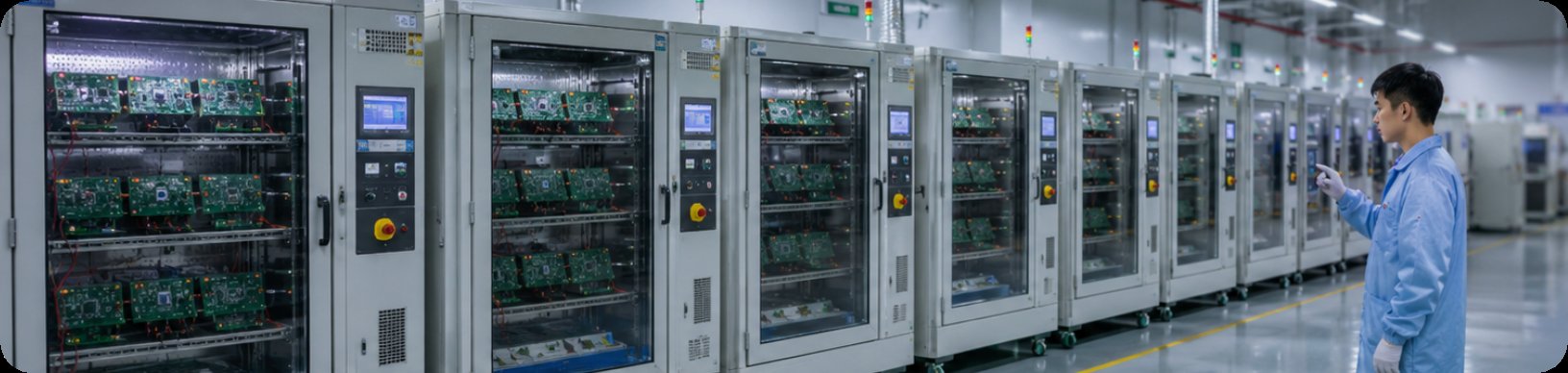
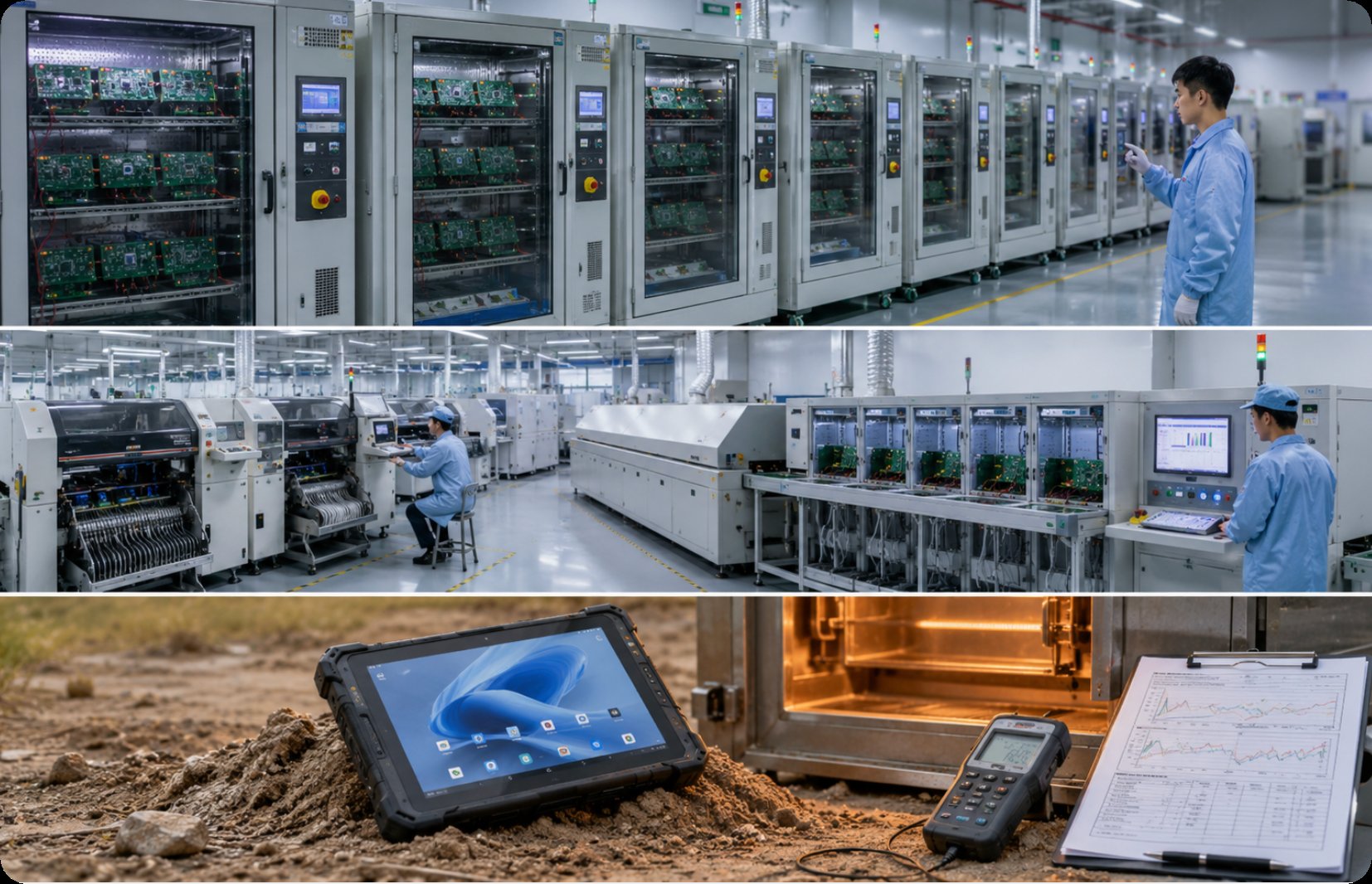
The old thinking was: if it passes functional test, it's good. But functional test (FCT) only tells you the board works now. It doesn't tell you if it will work after 1,000 hours of continuous operation in a hot warehouse. An aging test (also called burn-in or reliability test) applies combined thermal, voltage, and load stress to accelerate latent defects. Components with weak solder joints, marginal ICs, or hidden manufacturing flaws fail during aging—not in your customer's hands.
Industry data from 2024 shows that products subjected to a 48-hour burn-in cycle have a field failure rate 60% lower than those that skip it. That's not a small number. For a company shipping 10,000 units per month, that could mean hundreds of avoided returns. This is especially critical for our automotive electronics clients, where a single failure can trigger a costly recall.
How We Integrate Aging into the Full PCBA Workflow
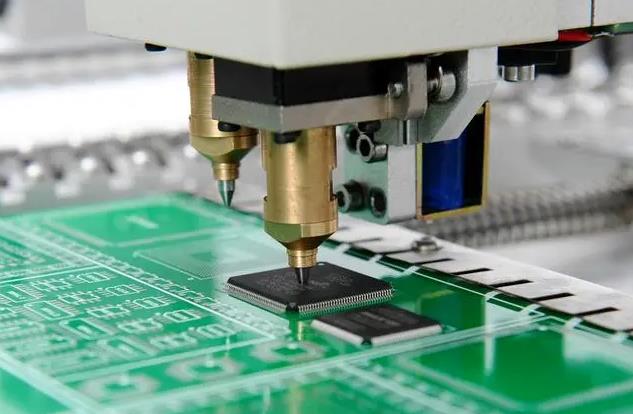
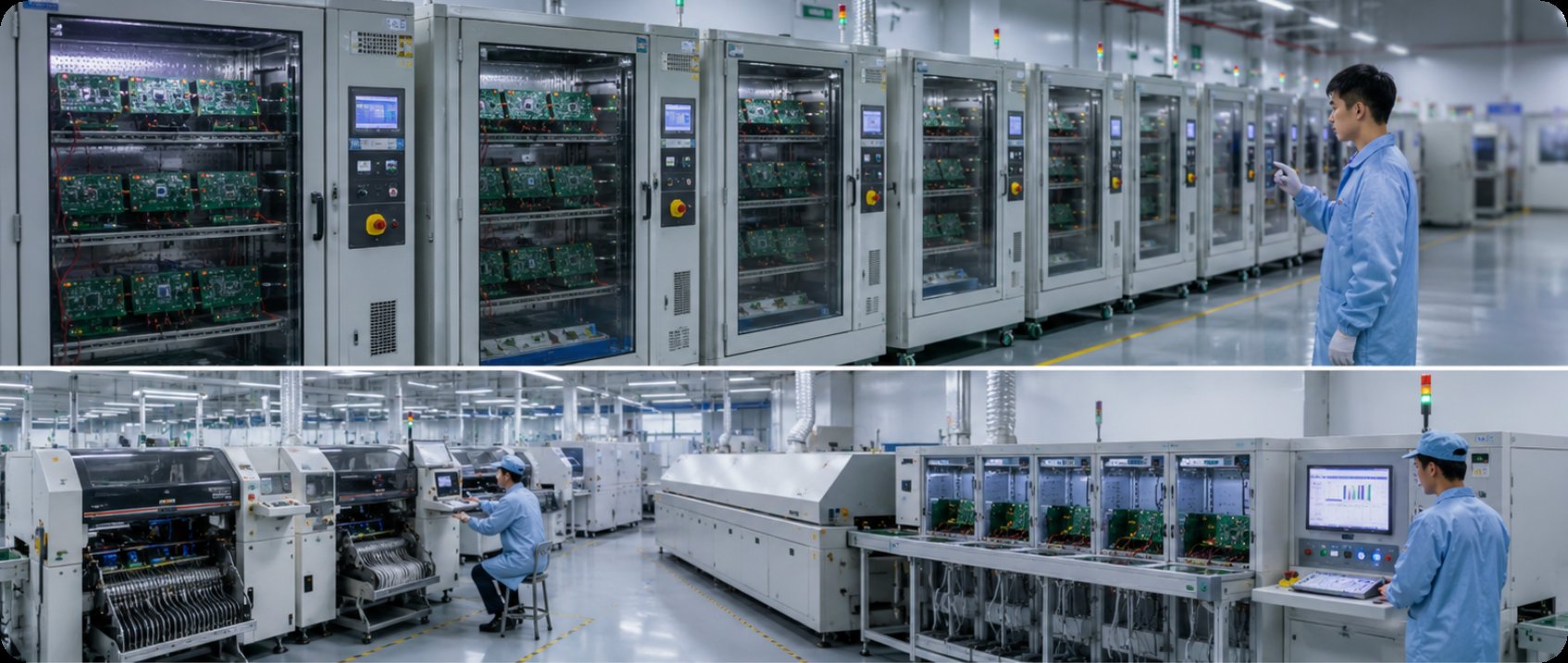
Reliability doesn't start in the aging chamber. It starts with component selection and continues through every step of assembly. For a recent project combining an industrial motherboard and a handheld PDA terminal, we coordinated three services in parallel: SMT Assembly for dense BGA and 0201 components, PCBA Three-Proofing Paint for moisture and dust resistance, and a full aging protocol that included 72-hour power cycling at -20°C to +85°C.
This isn't just about throwing boards into an oven. We design the aging profile based on the product's end-use environment. For a bluetooth thermometer used in cold chain logistics, the profile focuses on low-temperature stability and battery endurance. For a custom PC running a 24/7 server application, the profile stresses power supply ripple and thermal dissipation. Each profile is documented and traceable to the individual board serial number.
Product-Service Synergy: Two Real Examples
Let me give you two concrete combinations that show how we think about reliability holistically.
Combination 1: Industrial Motherboard + Rugged Tablet + EMS Manufacturing + Aging Test
An industrial motherboard destined for a factory automation controller must survive years of vibration, dust, and temperature swings. We pair our EMS Manufacturing service with a custom aging protocol that includes random vibration during thermal cycling. The same approach applies to a rugged tablet for field service technicians—we add a 2-meter drop test before aging to ensure mechanical integrity. The result: a product that passes MIL-STD-810G criteria without requiring a separate qualification run.
Combination 2: Mini PC + Smart Home PCB + SMT Assembly + Three-Proofing
A mini PC used as a smart home hub sits in a living room, but it still faces dust, humidity, and occasional power surges. Our SMT line places components with 99.99% accuracy, and the three-proofing coating protects against accidental spills. We then run a 48-hour aging cycle with AC line voltage fluctuations (±15%) to catch any power supply weaknesses. This combination has helped a smart home client reduce field returns by 45% in the first year.
Real-World Applications Driving the Trend
The demand for certified aging reliability is spreading across industries. Here are the most common scenarios we're seeing:
Automotive Electronics (ADAS, infotainment): A single PCB failure in a parking sensor can cause a crash. We perform 168-hour aging at 85°C with active CAN bus communication to simulate real driving cycles.
Industrial IoT Gateways: These devices sit in remote locations for years. Our aging protocol for a handheld PDA used in warehouse scanning includes 1,000+ read cycles under vibration.
Medical Devices (bluetooth thermometer, patient monitors): Reliability is life-critical. We run 72-hour controlled aging at 40°C with data logging every 5 minutes to verify sensor accuracy drift.
Smart Home Hubs (smart home PCB, mini PC): Consumers expect zero maintenance. A 48-hour aging cycle with Wi-Fi and Bluetooth stress testing catches RF interference issues before shipment.
Digital Signage (custom PC, industrial motherboard): Displays running 24/7 need power supplies that don't degrade. We combine aging with thermal imaging to identify hot spots on the board.
Telecom Infrastructure: Base station controllers must survive lightning surges and extreme heat. Our aging includes surge injection testing alongside thermal cycling.
Cost vs. Value: Why Skipping Aging Is False Economy
I've had clients push back on the cost of aging test—typically adding 5-8% to the per-unit price for a 48-hour cycle. But let's do the math. If you're producing 10,000 units at $50 per board, and you have a 3% field failure rate without aging (300 units), that's $15,000 in replacement costs, plus shipping, plus customer frustration. A $4 per board aging investment ($40,000) prevents most of those failures. The payback is immediate. And for high-reliability products like automotive or medical PCBA, there's no alternative.
We've also streamlined our process to minimize time-to-market impact. While the aging chamber runs, we proceed with final assembly and packaging for non-aged samples. Once the batch passes, we release the full order. This parallel workflow means a 48-hour aging cycle adds only 2-3 days to the overall lead time—a trade-off our clients consistently find worthwhile.
What's Next: The Future of Reliability Testing
The industry is moving toward data-driven, predictive reliability. Instead of just "pass/fail," we're now collecting continuous telemetry from each board during aging—current draw, voltage ripple, temperature gradients—and using that data to predict long-term failure probability. We've already implemented this for a few automotive electronics projects, and the results are promising. In the next 12 months, we plan to offer a "reliability score" for every board, giving clients a statistical confidence level for their product's lifespan.
Another emerging trend is HALT (Highly Accelerated Life Testing), which pushes boards to destruction to find design margins. While HALT is still primarily for R&D, we're seeing more production-level applications. We recently helped a client redesign a smart home PCB power stage after HALT revealed a weak capacitor at 90°C. The fix cost pennies but prevented a potential 5% failure rate.
If you're evaluating a PCB Assembly (PCBA) partner, ask them not just "can you do aging test?" but "how do you customize the profile for my product?" and "what data do you collect during the test?" The answers will tell you a lot about their commitment to quality. At NEWEI, we treat every board as if it were our own product. Learn more about our manufacturing capabilities and see how we build reliability into every stage.
Ready to ensure your product survives the real world? Contact us for a free consultation and quotation. Custom PCB Assembly from prototype to mass production, ISO certified, with worldwide shipping and dedicated project manager support.
Tags: PCBA /PCB /SMT /aging test /
Prev: Why Your PCB Assembly Line Keeps Failing—And How to Fix It With the Right Factory Culture
Next: Prototype to Production: Debugging Your PCB Assembly and Packaging Delivery Workflow