
From Prototype to Perfection: How Rigorous PCBA QC Ensures Zero-Defect Manufacturing
From Prototype to Perfection: How Rigorous PCBA Quality Control Ensures Zero-Defect Smart Thermometer and Handheld Game Console Manufacturing
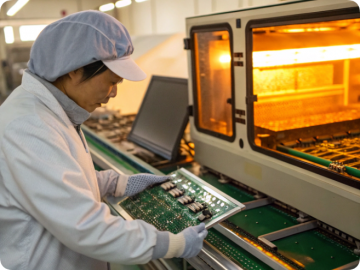
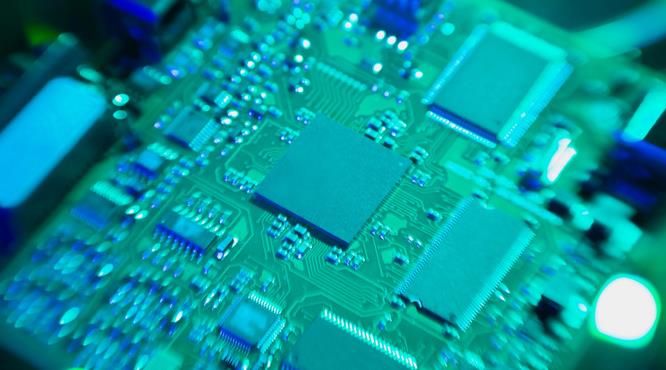
Over fifteen years of overseeing electronics production lines, I have learned one hard truth: the difference between a product that delights customers and one that becomes a warranty nightmare almost always comes down to the PCBA quality control process. Whether you are engineering a precision bluetooth thermometer OEM for a hospital’s neonatal unit or a high-volume handheld game console manufacturing run for a global toy brand, the margin for error is razor-thin. A single cold solder joint on a BLE 4.2 chip can cause a thermometer to drift by 0.3°C, and a hairline crack under a BGA on a PSP motherboard can brick the device after 50 hours of gameplay. That is why partnering with a proven Custom PCB Assembly Services provider becomes the single most important decision in your production cycle. Here, I want to walk you through exactly how we build quality into every board, from the first NTC sensor to the final functional test on a retro console.
My take: Too many hardware startups treat quality control as a final inspection checkpoint. That is a mistake. True zero-defect manufacturing for complex products like IoT temperature sensors and portable gaming devices requires a closed-loop system where every AOI scan, X-Ray image, and ICT reading feeds back into the SMT process. At NEWEI, we do not just catch defects—we prevent them from happening in the first place. And that is the only way to hit the six-sigma defect rates that medical and consumer electronics demand today.
AOI Optical Inspection: The First Line of Defense for Fine-Pitch Components
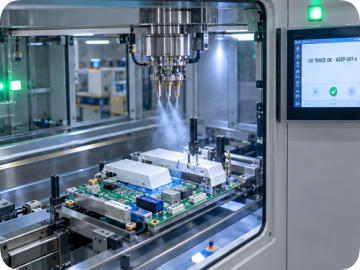
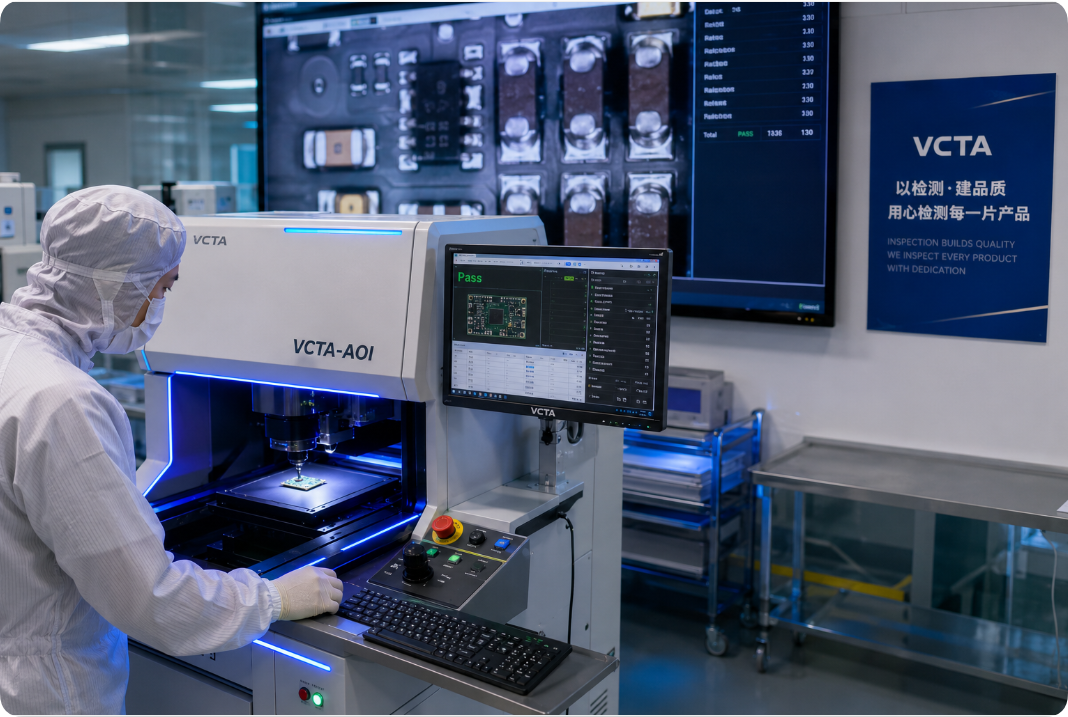
Every single board—whether it is the core of a smart thermometer manufacturing line or a retro gaming console—passes through Automated Optical Inspection immediately after the reflow oven. For a product like the Bluetooth thermometer, which relies on a tiny NTC thermistor and a compact BLE module, the solder paste on those 0402 components must be perfectly aligned. Our AOI systems check for tombstoning, insufficient solder, and bridging at a resolution that catches defects as small as 10 microns. On the flip side, retro game console assembly for devices like the RK3326-based PSP clone involves many through-hole connectors and micro USB ports. The AOI verifies that every Type-C port is seated flush and every analog stick solder joint is free of cold joints. This step alone catches about 70% of potential failures before the board ever reaches the functional test bay.
X-Ray BGA Inspection: Seeing the Unseen in High-Density PCBs
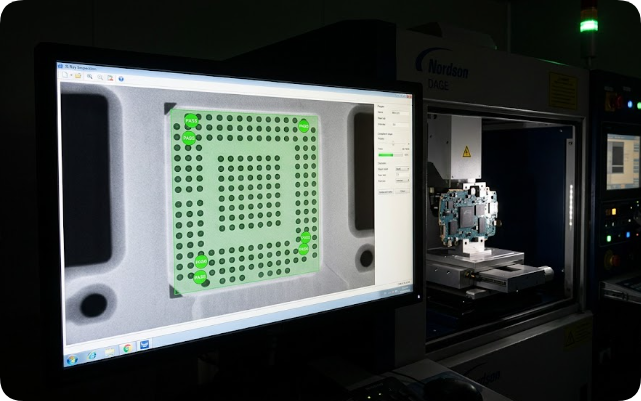
When you are dealing with a portable gaming device OEM that packs a quad-core processor, DDR3 memory, and a power management IC into a space smaller than a smartphone, you cannot rely on visual inspection alone. The BGA (Ball Grid Array) packages underneath the RK3326 chip have hundreds of solder balls hidden from the naked eye. A single void or short in that array can cause the console to randomly freeze during gameplay. For the Bluetooth thermometer, the X-Ray check focuses on the BGA of the BLE 5.0 SoC. We use real-time X-Ray imaging to inspect for voids, head-on-pillow defects, and insufficient wetting. We also look at the antenna area to ensure the ground plane is properly stitched—a critical step that directly impacts wireless range. In my experience, skipping X-Ray inspection on BGA-heavy designs is the fastest way to see field failure rates spike above 2%.
ICT and FCT: Verifying Every Circuit Before It Leaves the Factory
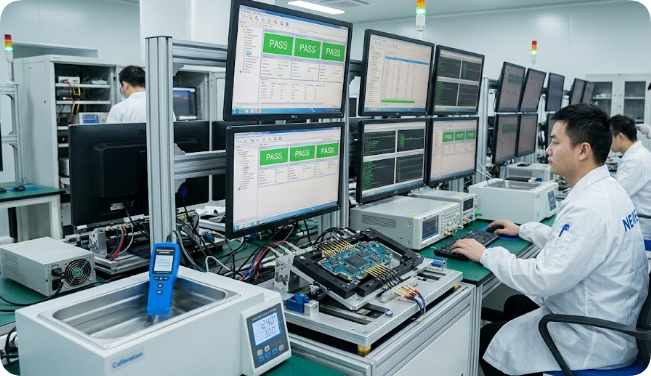
After the optical and X-Ray checks, we move to electrical testing. In-Circuit Testing (ICT) is our go-to for verifying the passive components on boards like the IoT temperature sensor PCBA. We measure the resistance of the NTC sensor path, check for shorts between the CR2032 battery terminals, and confirm the voltage regulator outputs 3.3V. If a capacitor is missing or a resistor is swapped, the ICT flags it instantly. For the handheld game console, the ICT bed-of-nails fixture tests the continuity of every button matrix, the analog stick potentiometers, and the audio amplifier circuit. Then comes Functional Test (FCT), which simulates real-world operation. For the thermometer, we immerse the sensor in a calibrated water bath at 37.0°C and verify the BLE output reads 37.0°C ± 0.1°C. For the gaming console, we run a custom firmware that cycles through a stress test of graphics rendering, audio output, and controller input for 15 minutes. Any device that fails FCT is logged and sent to our analysis lab. This is where the Aging Test Services really shine—we can run a 24-hour burn-in on a sample batch to catch early-life failures.
Comparing Quality Challenges: Precision Sensor PCBA vs. High-Density Game Console PCBA
One of the most common questions I get from clients is whether the same PCBA quality control process works for both a medical-grade thermometer and a consumer game console. The honest answer is that the philosophy is the same, but the focus areas are very different. For the Bluetooth thermometer, the critical parameters are sensor accuracy and wireless stability. The NTC sensor must be calibrated to a tight tolerance, and the antenna impedance must be controlled within ±2 ohms. Any contamination on the sensor pad can cause a 0.2°C drift. That is why we add an extra cleaning step before conformal coating on these boards. For the PSP-style game console, the biggest challenge is thermal management and BGA reliability. The RK3326 processor can draw up to 2.5W under load, and if the thermal vias are not properly filled, the chip can overheat and cause solder ball cracks. Our process adds a dedicated X-Ray inspection for the thermal pad area and a 30-minute FCT test with the processor at 100% load. Both products benefit from our Custom Electronic Devices PCBA ODM approach, where we tailor the test plan to the specific failure modes of each design.
Traceability: The Backbone of Zero-Defect Manufacturing
When a batch of smart thermometer manufacturing runs into an issue, I need to know exactly which shift, which machine, and which operator was responsible within minutes. That is why we built a full traceability system. Every board gets a unique QR code that links to the production database. We log the solder paste lot number, the reflow profile temperature curve, the AOI image file, and the FCT test results. For the handheld game console, we even record the torque value of every screw driver used during final assembly. This level of granularity allows us to perform root cause analysis in hours, not weeks. If we see a pattern of BGA voids on a particular X-Ray station, we can immediately recalibrate that machine and quarantine the affected boards. This system is also a requirement for clients in the medical device space—they need the ability to trace a specific thermometer back to the exact NTC sensor batch. Our Smart Wearable PCBA ODM service follows the same rigorous traceability standard, ensuring that every board that leaves our factory has a complete digital birth certificate.
Where Quality Leads: Real-World Applications of Tested PCBs
Once the boards pass our gauntlet of PCBA quality control tests, they are ready for some of the most demanding environments. The Bluetooth thermometer, with its IPX4 rating and ±0.1°C accuracy, ships to cold chain logistics companies that monitor vaccine temperatures during transport. Other units go to hospitals for continuous infant temperature monitoring, where a false reading could trigger an unnecessary intervention. The handheld game consoles, after passing the 24-hour burn-in, are packed for shipment to distributors who sell them to retro gaming enthusiasts and as educational tools for children learning logic through classic games. In both cases, the end user never sees the AOI scans or the FCT reports—but they feel the quality every time the thermometer gives a steady reading or the console boots up instantly without crashing.
If you are developing an IoT sensor or a portable gaming device, do not leave quality to chance. The cost of a field failure—in terms of returns, brand damage, and potential liability—far outweighs the investment in proper testing. We offer free consultation and quotation for your next project, whether you need a small prototype run or a full mass production line. Our ISO certified facility in Shenzhen is ready to handle your custom PCB assembly from prototype to mass production, with dedicated project manager support and worldwide shipping. Get in touch today and let us build something reliable together.
Tags: PCBA QC /bluetooth thermometer /game console /smart thermometer /fct test /x-ray bga /
Prev: Beyond the Basics: How Precision SMT, BGA Soldering, and DIP Assembly Define PCBA Quality at NEWEI
Next: Why Quality Delivery Defines the Best Custom PC Manufacturing Partner